



Best Watches for Small Wrists: Expert Picks That Wear Perfectly
Key Points:
The best watches for small wrists prioritise proportion, with 34mm to 38mm cases offering the most balanced fit.
Lug to lug measurement and case thickness often matter more than diameter alone.
Well designed 40mm watches can still work on smaller wrists when lug length and case shape are controlled.
Many compact models are automatic, making thoughtful storage and proper winding important for long term performance.
For years, having a smaller wrist felt like a disadvantage in the watch world. Case sizes crept past 42mm, bezels grew broader, and marketing leaned heavily into bold wrist presence. If your wrist measured six and a half inches or below, many modern sports watches simply felt overwhelming.
Fortunately, the pendulum has swung back. Over the past decade, brands have steadily reintroduced 36mm classics, 37mm divers and thoughtfully proportioned everyday models. What was once considered modest now feels refined. Collectors are rediscovering that elegance and balance often lie below 40mm.
The key, however, is understanding that diameter alone tells only part of the story. A 39mm watch with a compact lug to lug measurement can wear far better than a 36mm piece with long, straight lugs. Case thickness, bezel width and dial opening all influence how a watch actually sits on the wrist. True wearability comes down to proportion rather than headline numbers.
In this guide, we have selected some of the best watches for small wrists available today, from entry level mechanical pieces to modern luxury icons. Each has been chosen not simply for its case size, but for how well it wears in real terms. Whether you are looking for a compact diver, a versatile everyday watch or a refined dress piece, you will find thoughtfully proportioned options here that prove smaller wrists are no limitation at all.
What to Look for in a Watch for Small Wrists
Choosing a watch for a smaller wrist is less about chasing the lowest millimetre count and more about understanding proportion. A well designed 38mm watch can feel perfectly balanced, while a poorly proportioned 36mm model may still overhang. Before looking at specific references, it is worth understanding the elements that truly determine fit.
Lug to Lug Matters More Than Diameter
If there is one measurement to prioritise, it is lug to lug. This is the distance from the tip of the top lug to the tip of the bottom lug, effectively how much wrist the watch occupies.
For wrists around 6 to 6.75 inches, a lug to lug measurement under 46mm is usually a safe upper limit. Ideally, 42 to 45mm tends to wear best. When lugs extend beyond the natural curve of the wrist, the watch will feel unstable and visually oversized, even if the diameter sounds modest on paper.
Short, curved lugs are particularly forgiving. They allow a 38 or even 39mm case to sit neatly and follow the wrist’s contour. Straight, elongated lugs, by contrast, can make a smaller watch wear larger than expected. Always check this measurement before focusing on case diameter.
Ideal Case Sizes: The 34 to 38mm Sweet Spot
For most smaller wrists, the 34 to 38mm range offers the greatest versatility.
At 34 to 36mm, you are entering classic territory. Many vintage sports watches from the 1950s through the 1970s sat comfortably in this bracket. Today, modern 36mm models often strike an ideal balance between presence and restraint. They feel substantial without dominating the wrist.
At 37 to 38mm, you gain slightly more dial real estate while still maintaining proportion. This range works particularly well for divers and everyday sports watches, where a little extra legibility is welcome. Provided the lug to lug measurement remains compact, 38mm is often the upper end of the sweet spot for smaller wrists.
Anything above 39mm demands closer scrutiny of case shape and lug length.
Thickness and Wearability
Diameter may catch the eye, but thickness often determines comfort. A watch that stands too tall can feel top heavy and unstable, especially on a slimmer wrist.
As a general guideline, dress watches under 10mm thick tend to wear elegantly and slip easily under a cuff. Sports watches between 10 and 12mm usually strike a comfortable balance. Once you move beyond 13mm, the watch can begin to feel bulky unless the case design cleverly distributes the height.
Bezel design also plays a role. A wide bezel reduces the visible dial opening, helping the watch appear more compact. A very thin bezel, on the other hand, makes the dial look larger and the watch more expansive on the wrist.
Bracelet vs Strap Considerations
The choice between bracelet and strap significantly affects how a watch wears.
Metal bracelets add visual weight and can emphasise size. Integrated bracelets in particular tend to create a continuous line across the wrist, which can make a watch feel broader. That is not necessarily negative, but it is something to consider.
Leather or fabric straps are often more forgiving. They soften the overall profile and allow the watch head to sit more naturally. For smaller wrists, a well tapered strap can enhance proportion and prevent the watch from feeling oversized.
Ultimately, achieving the right fit is about harmony. When case size, lug to lug measurement, thickness and strap choice work together, even a slightly larger watch can wear comfortably and confidently on a smaller wrist.
Comment from Barrington Watch Winders: In our experience working with thousands of automatic watches, fit is often misunderstood. Many owners focus on diameter alone, yet lug to lug length and case thickness make a far greater difference on the wrist. Proportion always determines whether a watch feels refined or oversized.
The Best Watches for Small Wrists
Below is a curated selection of watches that consistently wear well on wrists around 6 to 6.75 inches. Each combines sensible proportions with strong design credibility, ranging from accessible mechanical pieces to modern luxury icons.
Tudor Black Bay 54
A modern reinterpretation of Tudor’s early Submariner references, the Black Bay 54 brings genuine dive watch capability into a compact 37mm case. It offers vintage proportions without sacrificing contemporary build quality.

Source: monochrome-watches.com
-
Diameter: 37mm
-
Thickness: 11.2mm
-
Lug to lug: Approx. 46mm
-
Water resistance: 200 metres
-
Why it wears well: Short lugs and a balanced bezel to dial ratio make it feel compact and secure, even on slimmer wrists.
-
Approx. price: £3,550
Rolex Explorer 36
One of the purest expressions of the modern sports watch. The Explorer 36 retains the classic proportions that defined tool watches in the mid twentieth century.

Source: monochrome-watches.com
-
Diameter: 36mm
-
Thickness: Approx. 11.5mm
-
Lug to lug: Approx. 43mm
-
Water resistance: 100 metres
-
Why it wears well: The compact Oyster case and tapered bracelet allow it to sit low and centred on the wrist.
-
Approx. price: £6,300 retail
Omega Seamaster Aqua Terra 38
The Aqua Terra in 38mm offers versatility, strong anti magnetic performance and a refined sports aesthetic suitable for daily wear.

Source: monochrome-watches.com
-
Diameter: 38mm
-
Thickness: 12.1mm
-
Lug to lug: 45.1mm
-
Water resistance: 150 metres
-
Why it wears well: The symmetrical case and neatly integrated bracelet help it hug the wrist despite the slightly larger diameter.
-
Approx. price: £6,000
Longines Spirit 37
A COSC certified pilot inspired sports watch that brings traditional aviator styling into a highly wearable size.

Source: monochrome-watches.com
-
Diameter: 37mm
-
Thickness: 11.7mm
-
Lug to lug: Approx. 46mm
-
Water resistance: 100 metres
-
Why it wears well: The compact case and restrained dial opening prevent it from feeling oversized.
-
Approx. price: £2,300
Tissot PRX Powermatic 80 35mm
The PRX 35mm captures the integrated sports watch aesthetic in a genuinely compact format.

Source: monochrome-watches.com
-
Diameter: 35mm
-
Thickness: 10.9mm
-
Lug to lug: 39mm
-
Water resistance: 100 metres
-
Why it wears well: The short lug span and slim case make it exceptionally comfortable on smaller wrists.
-
Approx. price: £610
Hamilton Khaki Field Mechanical 38
A modern field watch rooted in military design, offering simplicity and manual wind charm.

Source: monochrome-watches.com
-
Diameter: 38mm
-
Thickness: 9.5mm
-
Lug to lug: 47mm
-
Water resistance: 50 metres
-
Why it wears well: Despite the 38mm diameter, its slim profile and curved lugs keep it balanced.
-
Approx. price: £600
Cartier Tank Louis Cartier
An enduring icon of refined design. The Tank proves that rectangular cases follow different proportional rules.
-
Case size: 25.5mm width x 33.7mm length
-
Thickness: 6.6mm
-
Water resistance: 30 metres
-
Why it wears well: The slim rectangular case sits neatly within the wrist’s width, making it ideal for smaller proportions.
-
Approx. price: £11,000
Nomos Club Campus 36
A minimalist German design with clean lines and youthful character.

Source: monochrome-watches.com
-
Diameter: 36mm
-
Thickness: 8.2mm
-
Lug to lug: 47mm
-
Water resistance: 100 metres
-
Why it wears well: The thin case and narrow bezel create a light, unobtrusive feel.
-
Approx. price: £1,300
Comparison Table
|
Model |
Diameter |
Thickness |
Lug to Lug |
Water Resistance |
Approx. Price |
|
Tudor Black Bay 54 |
37mm |
11.2mm |
46mm |
200m |
£3,550 |
|
Rolex Explorer 36 |
36mm |
11.5mm |
43mm |
100m |
£6,300 |
|
Omega Aqua Terra 38 |
38mm |
12.1mm |
45.1mm |
150m |
£6,000 |
|
Longines Spirit 37 |
37mm |
11.7mm |
46mm |
100m |
£2,300 |
|
Tissot PRX 35mm |
35mm |
10.9mm |
39mm |
100m |
£610 |
|
Hamilton Khaki Field 38 |
38mm |
9.5mm |
47mm |
50m |
£600 |
|
Cartier Tank Louis Cartier |
25.5mm x 33.7mm |
6.6mm |
33.7mm length |
30m |
£11,000 |
|
Nomos Club Campus 36 |
36mm |
8.2mm |
47mm |
100m |
£1,300 |
These watches demonstrate that proportion, not size alone, defines how a watch wears. Whether you prefer a capable diver, a versatile everyday sports watch or a refined dress piece, there are thoughtfully sized options available at every level.
Can You Wear a 40mm Watch on a Small Wrist?
The short answer is yes, but only under the right conditions.
A 40mm case is often presented as a universal standard, yet on a wrist under seven inches it can easily feel excessive. That said, diameter alone does not dictate how a watch will wear. With the correct proportions and case architecture, 40mm can remain perfectly balanced.
When 40mm Works
A 40mm watch tends to work on a smaller wrist when the lug to lug measurement stays below roughly 47mm and the case thickness is controlled. If the watch sits low and follows the curve of the wrist, it will appear intentional rather than oversized.
Bezel design is also critical. A wide bezel reduces the visible dial opening, making the watch feel more compact than the headline measurement suggests. This is why some 40mm divers wear surprisingly well, while certain 38mm dress watches with expansive dials can feel larger.
Cushion Cases
Cushion and tonneau shaped cases are particularly forgiving. Because they lack long projecting lugs, the effective footprint across the wrist is reduced. The case appears broader from above, but it does not extend beyond the natural width of the wrist.
This design softens the visual impact of a larger diameter. A 40mm cushion case often wears closer to a traditional 38mm round watch. The absence of sharp lug tips helps maintain a compact, contained profile.
Short Lug Designs
Short, downward curving lugs are arguably the most important feature when considering 40mm on a smaller wrist. If the lugs terminate well within the wrist’s width and angle downwards, the watch will sit securely without overhang.
Integrated bracelet models can also work at 40mm provided the first link articulates quickly and does not extend rigidly outward. If the bracelet drapes immediately from the case, the overall presence is reduced.
Examples
Several well proportioned 40mm models illustrate this point. The 40mm version of the Rolex Submariner, for instance, wears more compactly than many expect due to its curved lugs and balanced bezel to dial ratio. Likewise, the 40mm Omega Speedmaster Professional sits flatter and more centred than its diameter suggests, thanks to its twisted lugs and relatively moderate lug to lug measurement.
Ultimately, wearing 40mm on a small wrist is less about breaking rules and more about understanding proportion. If lug length is controlled, thickness is reasonable and the case design avoids unnecessary visual bulk, 40mm can still feel entirely appropriate. The key is to assess how the watch sits, not just what the specification sheet states.
Should Men Wear 34mm Watches?
In short, absolutely. The idea that 34mm is somehow too small for men is a relatively modern invention. For much of the twentieth century, it was entirely standard.
A Brief Historical Context
From the 1940s through to the late 1970s, most men’s watches measured between 33mm and 36mm. These were not considered dress watches in the modern sense. They were everyday watches, sports watches and even tool watches.
Early explorers, military officers and professionals wore watches that would today be labelled as small. Many mid century field watches and dive watches rarely exceeded 36mm. Proportion and legibility mattered far more than visual dominance.
Even icons of the era wore modestly sized pieces without question. The cultural shift towards oversized cases only began in the late 1990s and early 2000s, when bold wrist presence became synonymous with status.
The 1950s to 1970s: The Golden Era of Proportion
During the 1950s and 1960s, a 34mm watch was considered perfectly balanced. Slim automatic movements allowed cases to remain elegant, and shirt cuffs were cut accordingly.
Brands refined case design, lug curvature and dial layout to maximise clarity within smaller dimensions. Rather than appearing diminished, these watches felt precise and purposeful.
It is worth remembering that wrist sizes have not dramatically changed over the decades. What changed was taste.
Why 34 to 36mm Is Relevant Again
Today, collectors are rediscovering the appeal of restraint. A 34 or 36mm watch often feels more refined, particularly in professional settings. It draws attention for its design rather than its scale.
Smaller watches also offer practical advantages. They are lighter, more comfortable for extended wear and less likely to catch on cuffs or laptop edges. On a wrist under seven inches, 34 to 36mm can look perfectly proportioned rather than undersized.
Modern brands have responded accordingly. Contemporary 36mm sports watches are no longer niche offerings but central to many collections. What was once considered small is now recognised as classic.
Ultimately, wearing a 34mm watch is not about nostalgia. It is about proportion. If it sits naturally within the width of your wrist and feels balanced, then it is the correct size, regardless of current trends.
Automatic Watches and Daily Wear
Many of the best watches for smaller wrists share one important characteristic. They are mechanical. Whether manual wind or automatic, compact cases often house traditional movements rather than quartz modules. That adds charm and longevity, but it also introduces considerations for daily wear.
Mechanical Movements in Compact Cases
A significant number of 34 to 38mm watches are powered by automatic calibres. These movements rely on a rotor that winds the mainspring through wrist motion. When worn regularly, they remain energised and accurate without intervention.
Because smaller watches tend to be more classically proportioned, they frequently use slimmer mechanical movements. These thinner calibres allow the case to remain elegant and balanced on a smaller wrist, but they are also finely engineered instruments that benefit from consistent use.
The Nature of Thin Calibres
Slim automatic movements are impressive from an engineering standpoint. They achieve reduced thickness through tighter tolerances and carefully arranged components. The result is comfort and refinement, but it also means they are less forgiving of neglect than a basic quartz watch.
Allowing an automatic watch to stop and restart repeatedly is not harmful in itself, yet regular, stable operation is generally preferable. Keeping lubricants evenly distributed and the movement running within its intended parameters supports long term reliability.
Regular Winding and Rotation
If you rotate between several watches, a compact automatic model may spend extended periods unworn. When that happens, it will naturally run down. Resetting the time and date every few days can become inconvenient, particularly on watches with more complex calendars.
For those who alternate between pieces throughout the week, maintaining gentle, consistent motion can simplify daily wear. It keeps the watch ready to go without unnecessary adjustment and preserves the rhythm of the movement.
Thoughtful Storage Matters
Compact watches are often chosen for their refinement. Storing them with equal care makes sense. Protecting the case from dust, accidental knocks and unnecessary handling helps preserve both aesthetics and mechanical integrity.
When not on the wrist, a controlled environment that supports steady operation and shields the watch from impact is ideal. It ensures that a carefully proportioned automatic piece remains as precise and well presented as the day it was fitted.
Ultimately, a smaller mechanical watch is not delicate in the fragile sense. It is simply a finely tuned instrument. Worn regularly and stored thoughtfully, it will provide decades of reliable service while retaining the balanced proportions that made it appealing in the first place.
Comment from Barrington Watch Winders: Compact automatic watches are beautifully engineered, but they benefit from consistent care. Keeping a watch gently wound and properly supported when not in use helps preserve accuracy and reduces unnecessary adjustment. Thoughtful storage is part of responsible ownership.
Caring for Your Automatic Watch
Many of the watches featured in this guide are automatic, compact and mechanically refined. These are not disposable accessories but precision instruments designed to run consistently and accurately over decades. If you rotate between several pieces or simply want your watch ready to wear at a moment’s notice, thoughtful storage becomes part of responsible ownership. A well engineered watch winder ensures your automatic timepiece remains wound, on time and properly supported when it is not on your wrist.
Barrington Single Winder - Midnight Blue
(The Barrington Single Winder in Midnight Blue is our flagship compact model, designed to keep any automatic watch precisely wound while presenting it with understated elegance. Its customisable Turns Per Day settings, ranging from 650 to 1,950, combined with clockwise, counter clockwise or alternating rotation, allow you to tailor operation to the exact requirements of your movement. The alternating mode most closely replicates natural wrist motion, while our Gentle Rotation method ensures the watch receives steady, controlled movement followed by a rest period, helping maintain accuracy without unnecessary strain. The watch always returns to the 12 o’clock resting position, creating a refined display when not in motion.
Despite its compact footprint of just 12cm wide, 12.5cm high and 19cm deep, the unit feels substantial and well engineered. It operates via AC mains with supplied UK, US and EU adapters, or via four AA batteries for flexible placement, and features our Barrington Jump system, allowing multiple winders to be connected and powered from a single source. The ultra quiet premium Japanese motor ensures discreet performance, making it suitable for bedrooms and living spaces alike. With a choice of Omni or Micro cushions to accommodate different wrist sizes, the Midnight Blue Single Winder is designed to protect, support and elegantly showcase your automatic timepiece, whether from Rolex, Omega, Breitling, TAG Heuer or any other major brand).
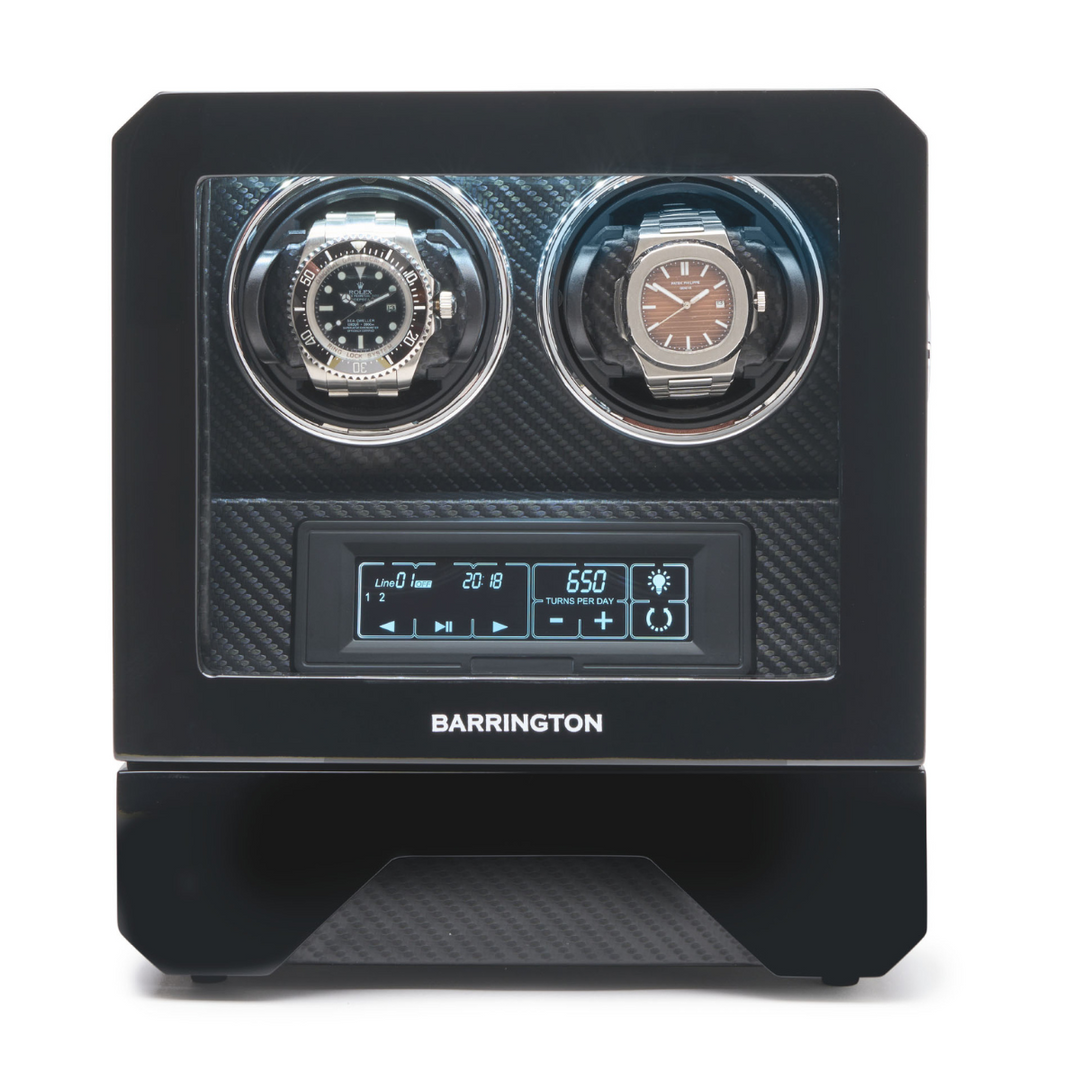
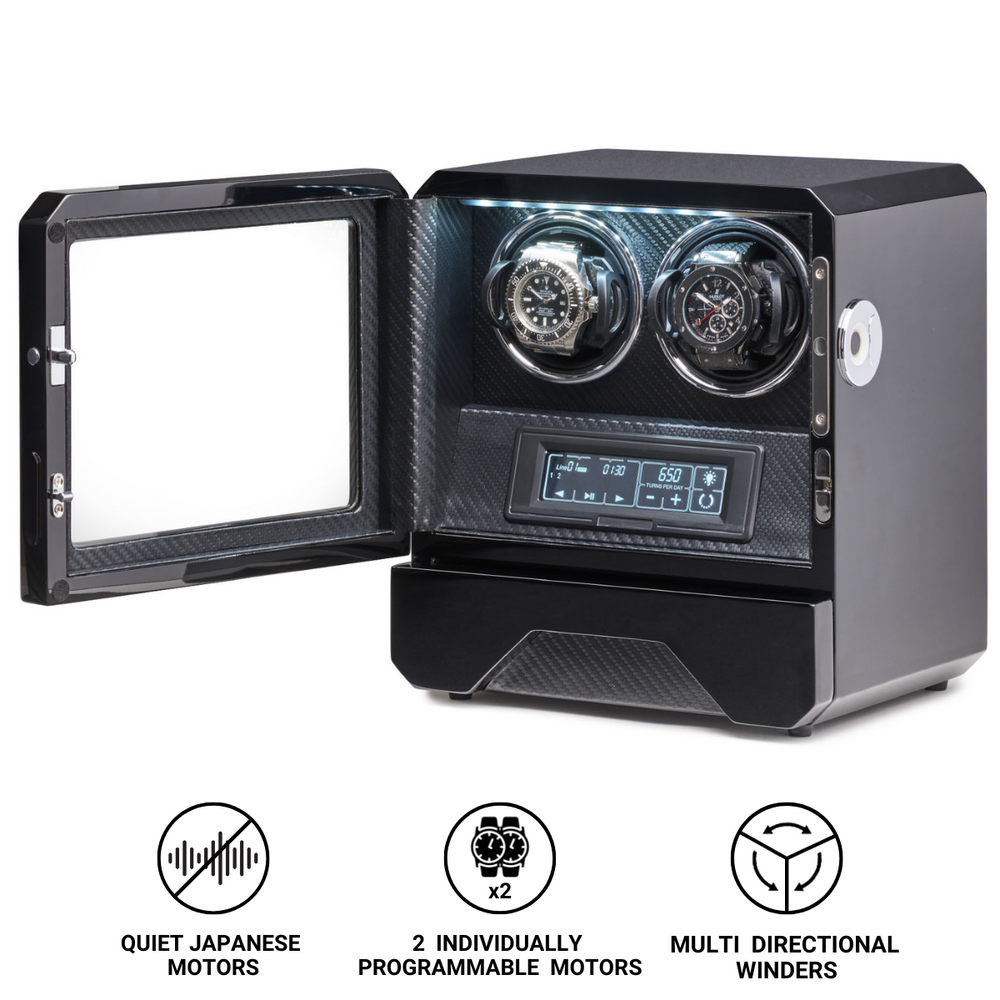
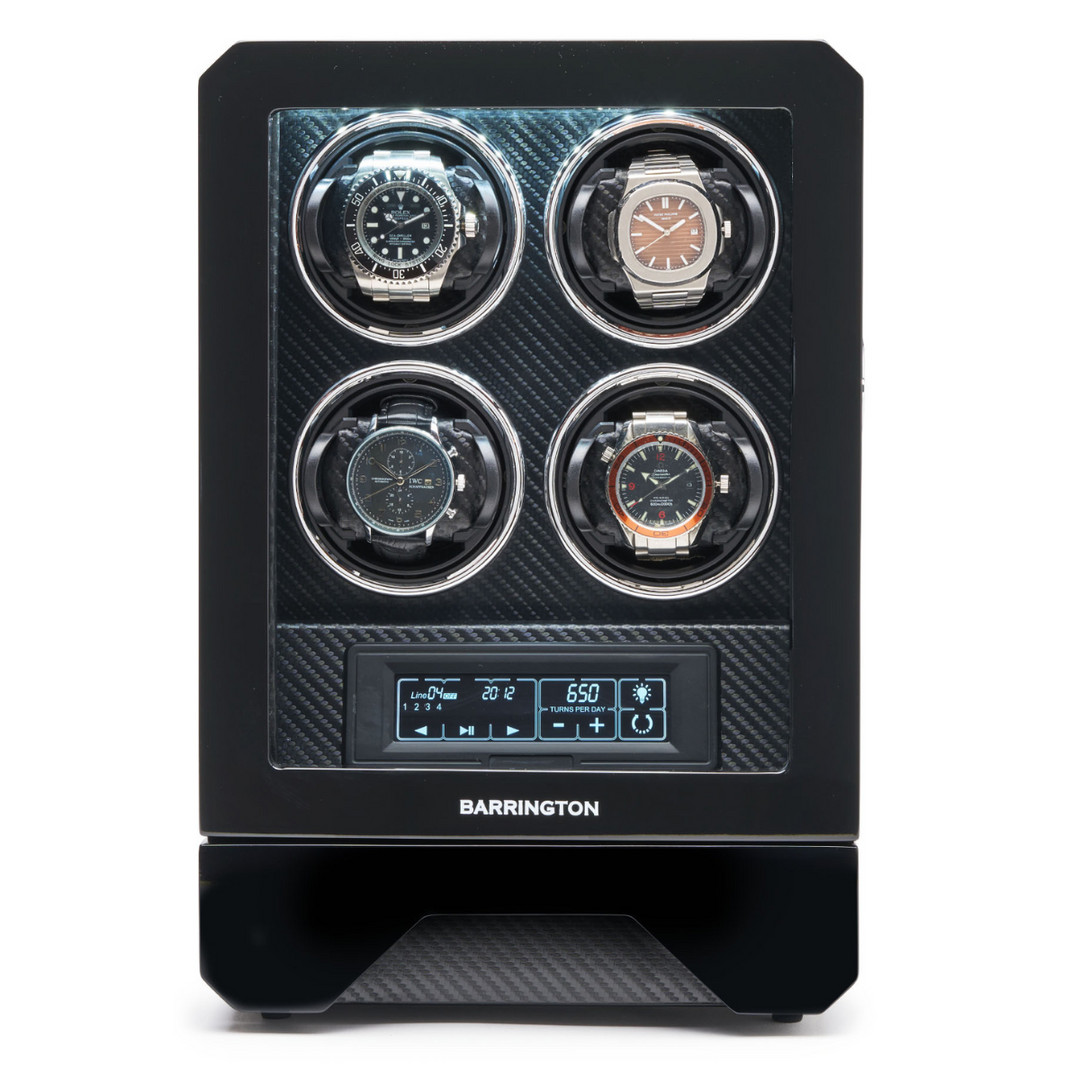
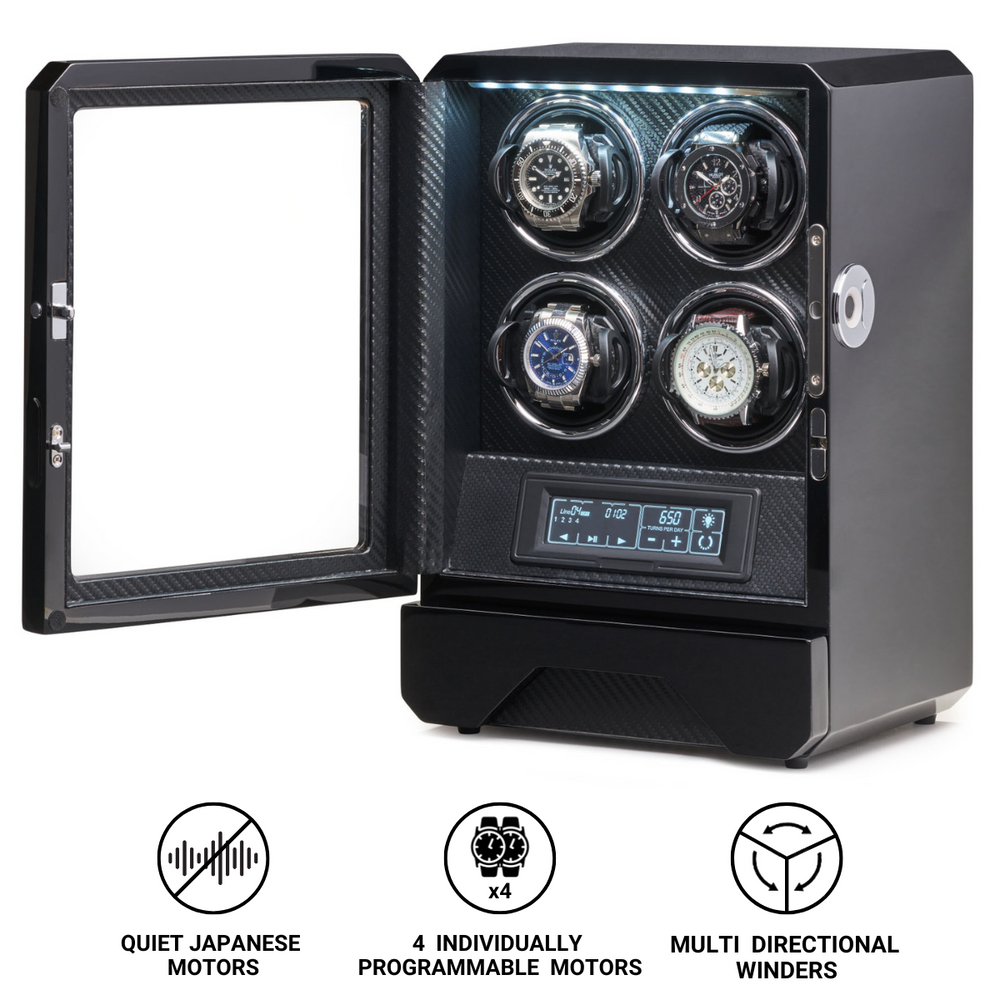
4 Watch Winder

(The Barrington 4 Watch Winder is designed for collectors who rotate multiple automatic watches and expect each to be maintained to its own precise requirements. Four individually programmable rotors allow every watch to run at its preferred Turns Per Day setting, with five preset options and a choice of clockwise, counter clockwise or bi directional rotation. Our Gentle Rotation programme runs for 12 hours before resting for 12 hours, maintaining the movement’s charge in a controlled and considered manner. Each rotor returns the watch to the 12 o’clock resting position, ensuring a balanced and elegant presentation behind the classic closed display case with its carbon fibre effect interior.
Engineered with premium Japanese Mabuchi motors, the Quad operates with exceptionally low noise, making it suitable for bedrooms or offices, particularly when using the quiet cycle overnight. Security and convenience are equally prioritised, with a fingerprint lock that stores up to 20 fingerprints, a responsive touch screen interface and a full function remote control. A built in drawer provides discreet storage for additional watches or jewellery, while LED downlighters showcase each timepiece with subtle refinement. Powered by AC mains and backed by a two year warranty, the 4 Watch Winder is built not only for daily performance but for long term reliability, with user replaceable motors that reflect Barrington’s commitment to thoughtful engineering and lasting support).
Barrington Single Winder - Racing Green

(The Barrington Single Winder in Racing Green combines precision engineering with a distinctive, heritage inspired finish that complements both modern sports watches and classic dress pieces. Designed to keep any automatic watch perfectly wound, it offers fully customisable Turns Per Day settings from 650 to 1,950, along with clockwise, counter clockwise or alternating rotation. The alternating setting most closely mirrors natural wrist movement, while our Gentle Rotation method ensures the watch receives controlled motion followed by a rest period, helping maintain consistent performance. Each cycle concludes with the watch returning to the 12 o’clock resting position, creating a composed and elegant display.
Measuring just 12cm wide, 12.5cm high and 19cm deep, the unit is compact enough for a bedside table or study shelf, yet substantial in build at 800 grams. It can be powered either by AC mains with supplied international adapters or by four AA batteries for flexible placement, and features our Barrington Jump system, allowing multiple winders to be connected and powered from a single source. An ultra quiet premium Japanese motor ensures smooth, discreet operation, suitable even for bedroom use. With a choice of Omni or Micro cushions to accommodate different wrist sizes, the Racing Green Single Winder is engineered to protect, support and stylishly present automatic watches from brands such as Rolex, Omega, Breitling and TAG Heuer).
At Barrington Watch Winders, our focus is simple. We design precision engineered, elegant winders that complement fine automatic watches without compromising their integrity. With adjustable turns per day settings, directional control and our Gentle Rotation method, each unit is built to support long term reliability while offering a refined way to display your collection. For those who value proportion, engineering and lasting performance in their watches, the same standards should apply to how they are cared for.
Final Thoughts
Proportion will always matter more than trends. Case sizes rise and fall with fashion, yet the principles of balance remain constant. A watch should sit naturally within the width of your wrist, follow its curve and feel comfortable throughout the day. Smaller wrists are not a limitation. In many cases, they allow classic proportions to shine in a way oversized designs simply cannot.
The best watch is the one that feels effortless when you wear it. Whether that is a 34mm vintage inspired piece or a modern 38mm sports model, the decision should be guided by fit rather than fashion. At Barrington Watch Winders, we spend our days around finely engineered automatic timepieces, and one truth remains clear. A well proportioned watch, properly cared for and thoughtfully stored, will reward you for decades. Choose what sits naturally on your wrist and enjoy it with confidence.





Leave a comment