



The Rolex Submariner Price History: From Tool Watch to Global Icon
Key Points:
The Rolex Submariner has evolved from an affordable professional dive watch into one of the most valuable and recognisable luxury sports watches in the world.
Its price history reflects wider shifts in the watch industry, including the move from utilitarian tool watches to heritage driven luxury timepieces.
Consistent demand, controlled production and incremental price increases have underpinned the Submariner’s long term value stability.
Proper care and storage play an important role in preserving both the mechanical integrity and lasting appeal of a Rolex Submariner.
Few watches have achieved the universal recognition of the Rolex Submariner. Introduced in the early 1950s as a purpose built tool for professional divers, it quickly set the benchmark for what a dive watch should be. Its clean dial layout, rotating timing bezel and robust Oyster case created a visual language that has influenced generations of sports watches ever since. Over time, the Submariner moved far beyond its original role, becoming not only a symbol of underwater exploration but also one of the most instantly recognisable luxury watches in the world.
Since its debut in 1953, the Submariner has undergone steady technical evolution while remaining remarkably faithful to its original design. Alongside this evolution, its price trajectory tells a compelling story. From an affordable professional instrument to a watch with multi year waiting lists at authorised retailers, the Submariner’s price history reflects wider changes within both Rolex and the luxury watch industry as a whole. Even by Rolex standards, the Submariner stands apart, with a pricing journey shaped by cultural impact, controlled production and an enduring global demand that few watches can rival.
Rolex Submariner Price History: At a Glance
The price history of the Rolex Submariner can be read as a concise summary of the modern watch industry itself. What began as a utilitarian instrument for working divers gradually evolved into one of the most valuable and consistently appreciating sports watches ever produced. While design changes were often incremental, pricing tells a very different story, with each decade marking a clear shift in how the Submariner was perceived, positioned and valued.
At a glance, the Submariner’s journey from tool watch to luxury icon can be broken down into several distinct phases. Understanding these broad movements helps place individual references and price points into context, before exploring the details in depth.
-
1950s. Launch era pricing reflected pure functionality, with the Submariner sold as professional equipment rather than a luxury item.
-
1960s to 1970s. Growing popularity and cultural exposure, yet prices remained relatively modest, even as gold and date versions were introduced.
-
1980s. A decisive shift as mechanical watches were repositioned as luxury products, leading to sharp price increases across the range.
-
1990s. Steady and sustained appreciation, alongside the emergence of collectability as a pricing factor.
-
2000s. Market maturity, stronger global demand and the final years of classic aluminium bezel models.
-
2010s to present. Accelerated price growth driven by ceramic bezels, limited availability and unprecedented waiting lists.
This overview sets the framework for the sections that follow, where each era is examined in greater detail. By looking beyond simple inflation adjustments, the Submariner’s price history reveals how technical progress, cultural relevance and brand strategy combined to create one of the most resilient value stories in modern horology.

Source: monochrome-watches.com
The 1950s: The Birth of the Submariner and Its Original Price
The Rolex Submariner was officially introduced in the early 1950s, at a time when recreational and professional diving was gaining momentum. Rolex developed the model as a dedicated underwater tool, capable of withstanding depths that were exceptional for a wristwatch of the period. With its rotating bezel for tracking dive time, highly legible dial and robust Oyster case, the Submariner immediately established itself as a serious piece of professional equipment rather than a luxury accessory.
At launch, the Submariner was priced accordingly. Early references were sold for a relatively modest sum, reflecting their functional purpose and industrial positioning. When adjusted for inflation, that original retail price still appears remarkably accessible by modern standards. This highlights just how far the Submariner has travelled, from an essential instrument for divers to a watch whose value today is driven by heritage, brand strength and global demand rather than pure utility.
Early Rolex Submariner Pricing Overview
|
Era |
Key Reference |
Approximate Original Retail Price |
Approximate Modern Equivalent |
|
Early 1950s |
Ref. 6204 |
Around £100 to £120 |
Roughly £1,000 to £1,200 |
|
Mid 1950s |
Ref. 6205 |
Slightly higher than launch models |
Still well below modern luxury pricing |
In its earliest form, the Submariner was not marketed as an aspirational object. It was built to perform a task reliably in extreme conditions, and its pricing reflected that reality. This clear focus on function laid the foundation for the model’s long term credibility, a factor that continues to underpin its value many decades later.
1960s–1970s: Rising Popularity, Surprisingly Modest Prices
During the 1960s and 1970s, the Submariner’s reputation grew far beyond the world of professional diving. Improved reliability, increased water resistance and subtle design refinements made it one of the most capable sports watches of its era. At the same time, exposure in popular culture transformed the Submariner into an object of desire. Its association with James Bond, worn on screen by Sean Connery, introduced the watch to a global audience and cemented its image as both functional and effortlessly stylish.
Despite this growing fame, prices remained surprisingly restrained. Rolex expanded the range during this period, introducing the Submariner Date and later solid gold versions, yet retail prices did not rise dramatically. Several factors contributed to this. Mechanical watches were still viewed primarily as practical objects, and the industry as a whole faced increasing pressure from quartz technology in the 1970s. The so called Quartz Crisis suppressed demand for traditional mechanical watches, limiting price growth even for highly regarded models like the Submariner.
Key characteristics of the Submariner during the 1960s and 1970s include:
-
Increasing mainstream recognition driven by film and media exposure
-
Introduction of the Submariner Date, adding everyday practicality
-
Launch of yellow gold models, expanding the range beyond pure tool watches
-
Retail prices that remained relatively low by modern standards
-
Market conditions shaped by the rise of quartz watches, holding back significant price increases
In hindsight, this period represents a rare window where cultural importance and future collectability were not yet reflected in pricing. The foundations of the Submariner’s iconic status were firmly in place, but the market had not yet caught up to its long term significance.
The Quartz Crisis and Why Prices Didn’t Explode Earlier
By the mid to late 1970s, the traditional Swiss watch industry was facing one of the most disruptive periods in its history. The rapid rise of quartz technology introduced watches that were cheaper to produce, more accurate and widely accessible. As consumer preferences shifted towards convenience and affordability, mechanical watches were increasingly viewed as outdated tools rather than desirable objects. This fundamental change in perception had a direct impact on pricing across the entire market.
Even for a brand as strong as Rolex, this environment encouraged restraint. Rather than pushing prices aggressively, Rolex focused on maintaining relevance, reliability and consistent production. The Submariner continued to evolve technically, but it was not yet positioned as a luxury symbol in the modern sense. Keeping prices relatively accessible helped preserve demand at a time when many mechanical watchmakers were struggling to survive or being forced into consolidation.
Key market factors during the Quartz Crisis included:
-
Quartz watches offering superior accuracy at significantly lower prices
-
A widespread decline in demand for mechanical timepieces
-
Pressure on Swiss manufacturers to justify traditional craftsmanship
-
Conservative pricing strategies, even among established brands
-
A market environment that prioritised practicality over heritage or collectability
This broader context explains why the Submariner’s prices remained modest well into the late 1970s. Its long term value was being built quietly through durability and design continuity, while the industry around it was undergoing a fundamental transformation that would only fully reverse in the following decade.
The 1980s: Rolex Repositions the Submariner as a Luxury Watch
The 1980s marked a decisive turning point for the Submariner and for the mechanical watch industry as a whole. After the disruption of the Quartz Crisis, mechanical watches began to re emerge not as outdated technology, but as objects of craftsmanship and prestige. Consumers increasingly valued tradition, durability and brand heritage, allowing established manufacturers to reposition their products at a higher level. Few brands executed this shift as successfully as Rolex.
For the Submariner, this change was clearly reflected in pricing. Retail prices rose sharply across the range, establishing a new baseline that would shape future increases. Stainless steel models moved well beyond their historical price levels, while two tone and solid gold versions experienced even more dramatic jumps. These increases were not short term corrections but deliberate repositioning, creating what can best be described as a premium anchor price. From this point onwards, the Submariner was no longer viewed primarily as a professional tool, but as a luxury sports watch with strong aspirational appeal.
Key developments during the 1980s included:
-
Renewed demand for mechanical watches as luxury goods
-
Significant price increases for stainless steel Submariner models
-
Strong upward revaluation of two tone versions combining steel and gold
-
Solid gold Submariners moving firmly into high luxury price territory
-
Establishment of a premium pricing foundation that persists today
This decade effectively reset expectations. By the end of the 1980s, the Submariner had completed its transition into the luxury segment, with pricing that reflected status and brand power rather than function alone.
The 1990s: Steady Growth and Collectability
Throughout the 1990s, the Submariner entered a period of measured and consistent appreciation. Unlike the dramatic repositioning of the previous decade, price increases during this era were gradual and controlled. Annual rises in recommended retail prices reflected growing confidence in the mechanical watch market and the strengthening global reputation of Rolex. By the end of the decade, the Submariner was firmly established as a premium sports watch rather than a specialist instrument.
This period also marked the early emergence of collectability as a meaningful factor in pricing. Enthusiasts began to pay closer attention to reference numbers, production variations and condition, particularly for well preserved examples. As a result, the Submariner started to be viewed not only as a high quality accessory, but as a store of value. While few buyers at the time were thinking in investment terms, the foundations were laid for the model’s later reputation as one of the most liquid and dependable watches on the secondary market.
Key characteristics of the Submariner in the 1990s include:
-
Steady and predictable increases in retail pricing
-
Strong demand for both Date and no date references
-
Growing awareness of reference specific differences among collectors
-
Early signs of secondary market premiums for desirable examples
-
A shift in perception towards Rolex watches as long term assets
By the close of the 1990s, the Submariner had matured into a watch that balanced everyday wearability with enduring value, setting the stage for the more dramatic market dynamics that would follow in the next decade.
Early 2000s: Pre-Ceramic Era and Market Maturity
The early 2000s represent the final chapter of the classic Submariner. During this period, the model retained its traditional aluminium bezel insert, slim case proportions and familiar dial layout that had defined the watch for decades. References such as the Submariner Date 16610 and the no date 14060M embodied the purest expression of the design, refined through incremental improvements rather than radical change. The market at this stage was stable, confident and increasingly global in its outlook.
In hindsight, these aluminium bezel Submariners gained particular significance once ceramic technology was introduced later in the decade. Collectors began to view the pre ceramic models as the last link to the Submariner’s original tool watch character. Prices in the early 2000s remained relatively accessible compared with modern levels, but they were already trending upward in anticipation of broader changes within the brand and the industry. This period of market maturity set the baseline from which the next phase of accelerated growth would emerge.
Key features of the early 2000s Submariner era include:
-
The final production years of aluminium bezel Submariners
-
Strong demand for both Date and no date references
-
Increasing appreciation for traditional proportions and aesthetics
-
Retail prices approaching a transition point rather than peaking
-
A market poised for a significant technological and pricing shift
These models would later be recognised as milestones, representing the end of one era and the foundation for the dramatic price movements that followed with the introduction of ceramic bezels.
The 2010s: Ceramic Bezels and Accelerated Price Increases
The introduction of the Cerachrom bezel in the late 2000s and early 2010s marked a defining moment in the Submariner’s modern history. This proprietary ceramic material offered exceptional resistance to scratches, fading and corrosion, instantly elevating the perceived quality and durability of the watch. While the overall design remained familiar, the visual presence and longevity of the ceramic bezel signalled a clear technological step forward and became a catalyst for renewed demand.
Alongside this update came a new generation of references, including the stainless steel Submariner Date 116610 and its distinctive green bezel variant, often referred to as the Hulk. Retail prices began to rise at a faster pace than in previous decades, reflecting both the technical upgrades and the growing power of the brand. Demand soon outstripped supply, leading to the emergence of waiting lists at authorised retailers. For the first time, many buyers were unable to purchase a Submariner on demand, a shift that fundamentally changed the relationship between retail pricing and market value.
Key developments during the 2010s include:
-
The adoption of Cerachrom bezels as a defining feature
-
Introduction of new references with updated cases and movements
-
Accelerated increases in recommended retail prices
-
Growing divergence between retail and secondary market values
-
The establishment of long term waiting lists for popular models
This decade cemented the Submariner’s position not just as a luxury sports watch, but as one of the most sought after timepieces in the world, with pricing dynamics shaped as much by availability as by technical merit.
Comment from Barrington Watch Winders: As modern Submariners became harder to obtain and more valuable, ownership shifted from simple wear to long term stewardship. Watches that spend more time off the wrist benefit from being kept correctly wound and protected, ensuring they are always ready to wear without unnecessary stress on the movement.
Retail Price vs Secondary Market Price
One of the most distinctive aspects of the modern Submariner market is the growing gap between official retail pricing and real world transaction values. The recommended retail price set by Rolex reflects long term brand positioning and controlled annual increases, but it does not account for immediate availability. As demand has consistently exceeded supply, the retail figure has become only part of the overall pricing story.
On the secondary market, Submariner models often command noticeable premiums above retail. Buyers who are unwilling to wait months or even years are prepared to pay more for immediate ownership. This dynamic is further reinforced by the Submariner’s strong liquidity and global recognition, which reduce perceived risk for purchasers. As a result, market prices are driven less by production cost or official pricing and more by scarcity, desirability and timing.
Key reasons the Submariner frequently trades above retail include:
-
Limited availability at authorised retailers
-
Persistent multi year waiting lists for popular references
-
Strong global demand across both new and experienced collectors
-
High confidence in long term value retention
-
Immediate access through the secondary market
This divergence between retail and market prices has become a defining feature of the Submariner in the modern era. Rather than weakening demand, it has reinforced the model’s status as one of the most sought after and dependable watches on the market.

Source: monochrome-watches.com
Recent Rolex Price Increases and Their Impact
In recent years, Rolex has implemented regular price adjustments across its collection, reflecting a combination of rising production costs, currency fluctuations and long term brand strategy. These increases are typically measured rather than dramatic, reinforcing the perception of stability and careful control rather than short term opportunism. Within this framework, the Submariner has remained one of the core models through which these changes are most visible.
Each price increase has a cumulative effect on the Submariner’s position in the market. Higher retail prices establish a new baseline that is rarely reversed, effectively locking in previous gains. This not only raises the entry point for new buyers, but also supports values on the secondary market by narrowing the gap between older purchases and current retail levels. Over time, this pattern has contributed to the Submariner’s reputation for resilience, with incremental increases reinforcing confidence rather than dampening demand.
Key impacts of recent Rolex price increases include:
-
Gradual upward movement of recommended retail prices
-
Strengthening of the Submariner’s premium positioning
-
Reinforcement of secondary market values
-
Reduced likelihood of price retracement once increases are implemented
-
Continued alignment between brand strategy and long term demand
Rather than being viewed in isolation, these price adjustments form part of a broader approach that has helped maintain the Submariner’s status as one of the most stable and desirable watches in the modern luxury landscape.
Caring for an Icon: How to Store and Maintain a Rolex Submariner
A Rolex Submariner is designed to withstand extreme conditions, yet like any fine mechanical watch, it benefits from thoughtful care when it is not being worn. Proper storage is not simply about protection from knocks or dust. It plays an important role in preserving accuracy, maintaining lubrication within the movement and ensuring the watch is always ready to wear. For owners who rotate between multiple watches, how a Submariner is stored can be just as important as how it performs on the wrist.
Barrington Single Winder - Racing Green

(The Barrington Single Winder – Racing Green is designed for owners who want to store and maintain an automatic watch with the same level of care that went into its manufacture. Compact yet substantial, it provides fully customisable Turns Per Day and rotation direction to suit everything from a modern Rolex Submariner to lighter vintage pieces, while ensuring the watch always comes to rest at the 12 o’clock position for a clean and elegant presentation. Secure cushions protect the bracelet or strap, and the ultra quiet Japanese motor allows the winder to be placed anywhere in the home without distraction. With the flexibility of mains or battery power and the ability to connect multiple units through the Barrington Jump system, it offers a refined and practical solution that aligns perfectly with the long term care of high quality mechanical watches).
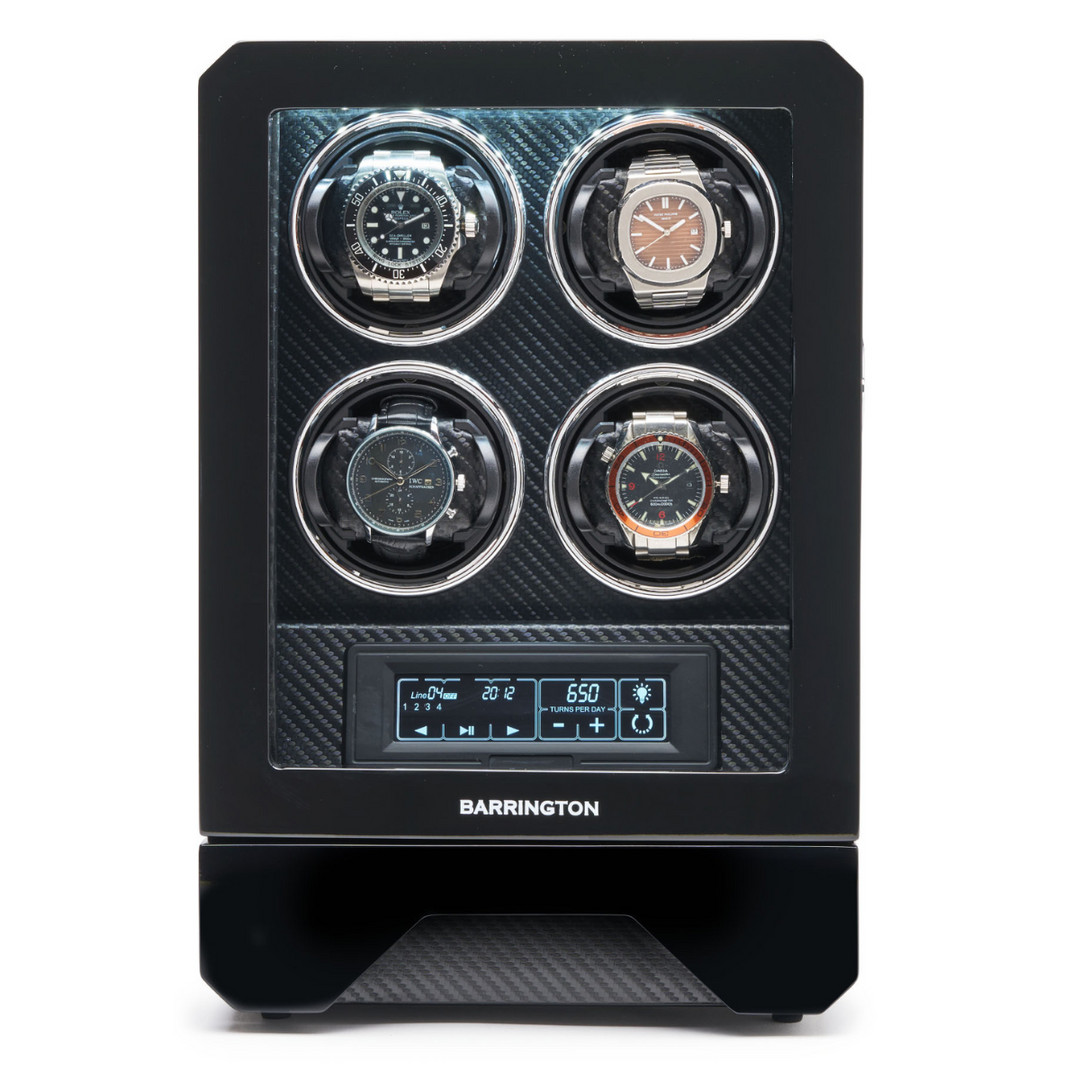
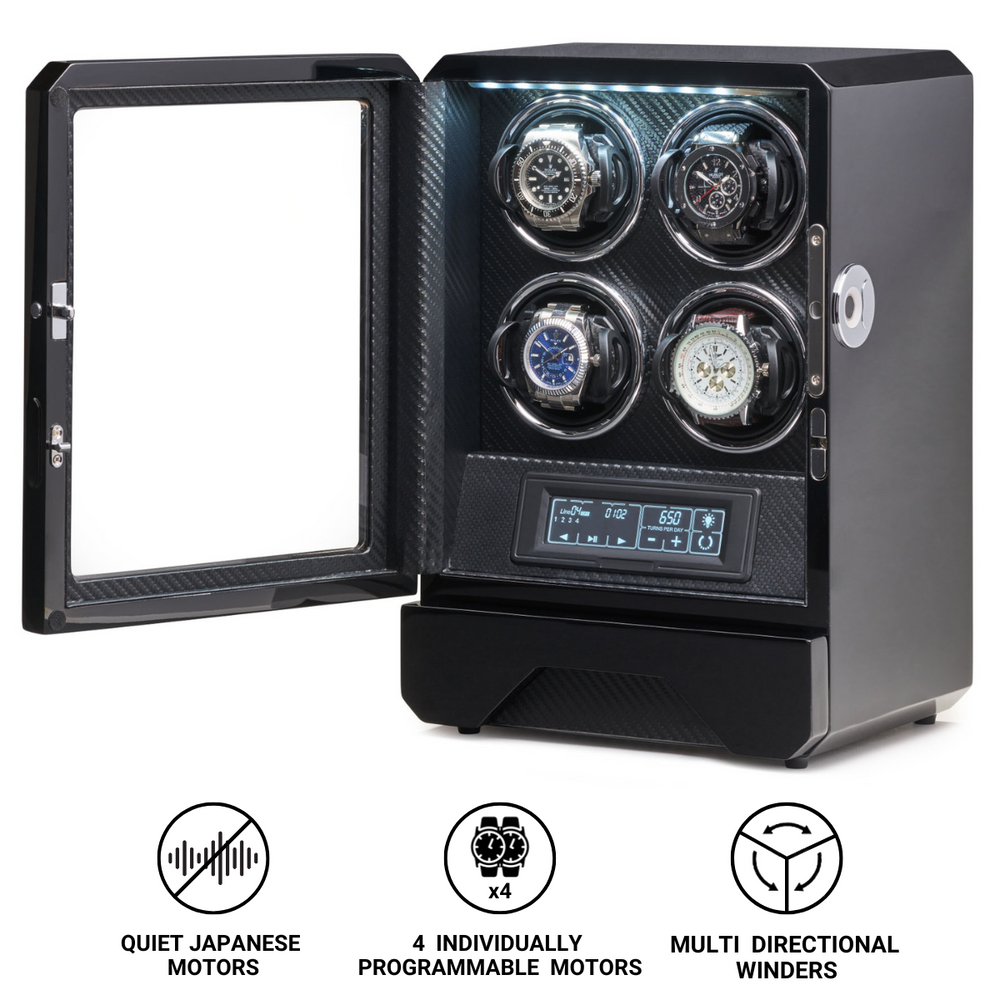
4 Watch Winder

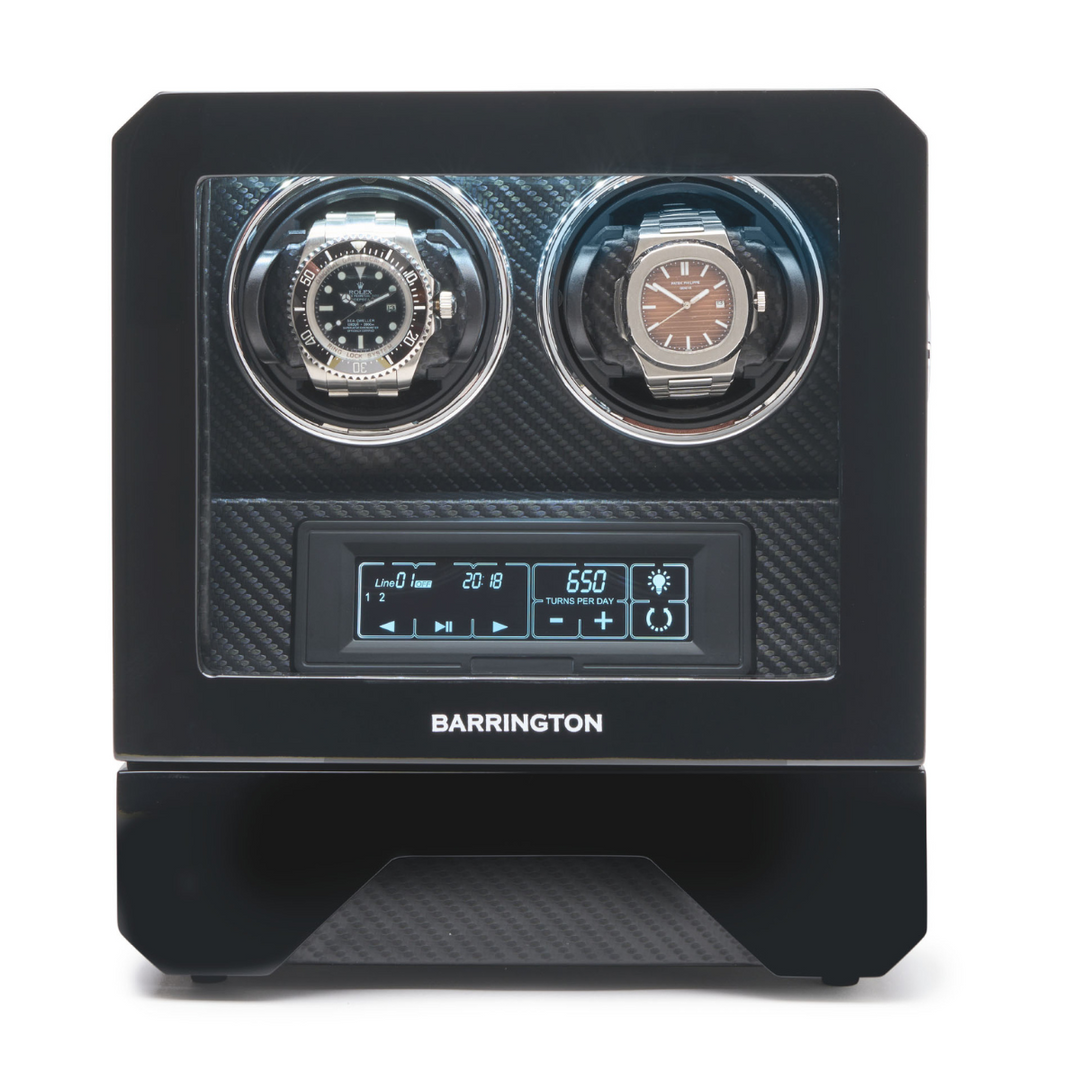
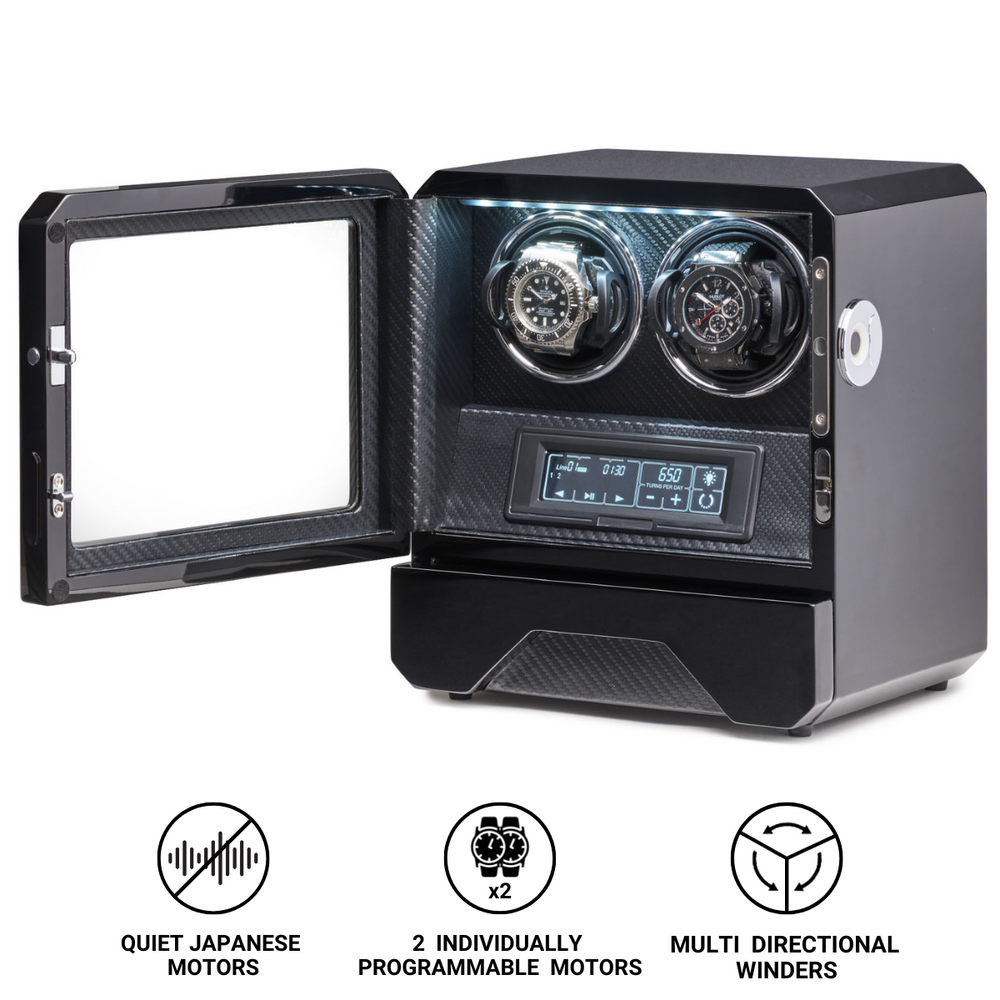
(The Barrington Quad Watch Winder is designed for collectors who rotate several automatic watches and want complete control over how each piece is maintained. Housed in a refined closed display case with a carbon fibre effect interior, it allows four watches to be wound simultaneously, with each rotor individually programmable for precise Turns Per Day and rotation direction. Secure clip in cushions, a fingerprint lock capable of storing multiple users and rotors that always stop at the 12 o’clock position combine protection with an elegant presentation. Ultra quiet Japanese Mabuchi motors and a 12 hour on and 12 hour off gentle rotation cycle make it suitable even for bedrooms, while features such as touch screen controls, a full function remote and a discreet storage drawer add everyday practicality. For owners managing a growing collection, the Quad offers a considered balance of security, performance and presentation, reflecting the engineering approach).
Barrington Single Winder - Midnight Blue

(The Barrington Single Winder – Midnight Blue offers a refined and understated solution for maintaining an automatic watch when it is not on the wrist. Designed with a compact footprint, it fits effortlessly into a variety of settings while delivering precise control through adjustable Turns Per Day and rotation direction to suit everything from modern sports watches to lighter vintage models. Secure cushions protect the watch, which always comes to rest at the 12 o’clock position, ensuring both mechanical care and an elegant display. An ultra quiet Japanese motor allows for placement in bedrooms or living spaces without disruption, while the flexibility of mains or battery power and the ability to connect multiple units through the Barrington Jump system make it a practical choice for growing collections. It is a thoughtful expression of the engineering and design philosophy behind Barrington Watch Winders, balancing performance, protection and visual appeal).
Taking a considered approach to storage and maintenance supports both enjoyment and longevity. Keeping an automatic watch correctly wound, protected and displayed helps preserve its mechanical health and its long term appeal. Whether worn daily or reserved for specific occasions, a Submariner that is properly cared for remains a reliable companion and a lasting part of any serious watch collection.
Is the Rolex Submariner Still Undervalued?
Whether the Submariner remains undervalued is a question frequently raised by collectors and market observers. Measured purely against its historical performance, the argument in favour is compelling. Few watches combine uninterrupted production history, global recognition and sustained demand at the level achieved by the Submariner. Even after decades of price increases, it continues to trade with remarkable liquidity, a characteristic more commonly associated with established financial assets than luxury accessories.
That said, any discussion of value must remain grounded. The Submariner should not be viewed as a speculative vehicle, but rather as a long term store of value supported by consistent fundamentals. Controlled production, incremental retail price increases and enduring desirability have positioned it as a blue chip watch within the broader luxury market. While future growth can never be guaranteed, the Submariner’s track record suggests a level of stability that few other models can match.
Key factors supporting the undervalued argument include:
-
A proven history of steady long term price appreciation
-
Exceptional brand strength and global recognition
-
High demand across multiple generations of buyers
-
Strong secondary market liquidity
-
A balance of wearability, heritage and durability
Viewed through this lens, the Submariner occupies a unique position. It is not immune to market cycles, but its underlying strengths continue to support the case for long term relevance and value retention within the world of fine watches.
Comment from Barrington Watch Winders: When a watch is regarded as a long term asset rather than a disposable accessory, how it is stored matters. Proper winding and careful handling help preserve mechanical health, accuracy and the qualities that underpin lasting value.
What the Future Holds for Submariner Prices
Looking ahead, the future of Submariner pricing appears to follow the same measured trajectory that has defined its past. Historically, periods of rapid change have been followed by consolidation rather than reversal. Retail prices have tended to move in one direction over the long term, supported by consistent demand, careful production control and gradual technical evolution rather than frequent redesigns.
Long term growth therefore remains a reasonable expectation, not because of short term speculation, but due to the underlying structure of the market. The Submariner continues to benefit from global recognition, multi generational appeal and a position at the centre of the Rolex sports watch catalogue. While external factors such as economic cycles may influence short term sentiment, the model’s fundamentals suggest resilience rather than volatility.
Key considerations for the future include:
-
A long established pattern of incremental price increases
-
Ongoing global demand that exceeds supply
-
Conservative production strategies that protect brand equity
-
Enduring design continuity that limits obsolescence
-
Broad appeal across both collectors and first time buyers
Rather than promising outsized returns, the Submariner’s future is best understood in terms of consistency. Its pricing story is likely to continue reflecting steady appreciation supported by heritage, demand and disciplined brand management.
Conclusion: From £100 Tool Watch to Global Luxury Icon
From its origins as a £100 professional diving instrument in the 1950s to its current position as a global luxury icon, the Submariner’s evolution has been defined by consistency rather than reinvention. Each decade added another layer to its identity, from technical credibility and cultural relevance to collectability and market strength. Its price history is not simply a record of inflation or brand success, but a reflection of how mechanical watches themselves moved from everyday tools to enduring objects of value.
In many ways, the Submariner mirrors the wider watch industry, demonstrating how heritage, disciplined production and long term vision can sustain relevance across generations. For owners and collectors alike, this also underscores the importance of proper care and stewardship. At Barrington Watch Winders, we understand that watches such as the Submariner are more than timekeepers. They are mechanical assets with history, meaning and longevity. Preserving that legacy through thoughtful storage and maintenance ensures that icons like the Submariner continue to be appreciated, not just worn, for decades to come.





Leave a comment