


Rolex Nicknames: The Ultimate Guide to Popular Rolex Watch Nicknames
Key Points:
Rolex nicknames are unofficial terms created by collectors to simplify complex reference numbers and identify specific models.
Most nicknames are inspired by colours, celebrities, or distinctive design features, making them easy to remember and widely recognised.
Popular names like “Pepsi”, “Hulk”, and “Paul Newman” can influence desirability and even increase market value.
Understanding Rolex nicknames helps collectors navigate the market and connect with the wider watch community.
In the world of fine watchmaking, few names carry as much weight as Rolex. Alongside its official model names and reference numbers, a parallel language has emerged among collectors. This language is built around nicknames. Informal yet widely recognised, these terms have become an essential part of how enthusiasts discuss and identify specific Rolex watches.
A Rolex nickname is an unofficial name given to a particular model or variation, usually inspired by its colours, design features, or cultural associations. Instead of using complex reference numbers, collectors refer to watches as “Pepsi”, “Hulk”, or “Batman”. These names are not created by Rolex itself. They originate within the community and gain traction through repeated use in forums, auctions, and dealer networks.
For collectors, these nicknames are far more than convenient shorthand. They reflect shared knowledge, passion, and identity within the horological world. A simple nickname can instantly convey a watch’s appearance, history, and desirability, while also signalling familiarity with the culture of collecting. Over time, many of these names have become deeply embedded in the market, influencing perception, demand, and even value.
What Is a Rolex Nickname
A Rolex nickname is an informal, community-created name used to describe a specific watch model, variation, or configuration produced by Rolex. These nicknames are not part of the brand’s official naming system. Instead, they emerge organically among collectors, dealers, and enthusiasts as a more accessible way to identify watches that might otherwise be known only by complex reference numbers.
Rolex itself relies on a precise and structured approach to naming. Each watch is defined by its model line, such as Submariner or GMT-Master II, followed by a unique reference number like 126610LV or 16710. This system is exact and consistent, but it can feel technical and difficult to remember, particularly for those who are not deeply immersed in horology. Nicknames provide an alternative that is more intuitive and often more descriptive.
The difference between official terminology and collector slang is fundamental to understanding how Rolex watches are discussed in practice. Official names are fixed and controlled by the brand, while nicknames are fluid, evolving with the community that uses them. Over time, some of these informal names become so widely adopted that they are recognised globally, even though Rolex never acknowledges them.
Most Rolex nicknames are based on one or more of the following characteristics:
-
Colour combinations, especially bezel and dial pairings that resemble familiar objects or brands
-
Associations with famous individuals who wore the watch
-
Distinctive design features, proportions, or production quirks
-
Historical context or events linked to a specific model
In essence, a Rolex nickname acts as a form of shorthand that combines visual identity with cultural meaning. It simplifies communication while adding a layer of personality that the official naming system deliberately avoids.
Why Rolex Watches Have Nicknames
Rolex nicknames did not originate within the brand itself, but within the global community of collectors and enthusiasts who engage with Rolex on a daily basis. Over time, these informal names emerged across watch forums, dealer networks, auction houses, and specialist publications. As discussions around specific references became more frequent, the need for a simpler and more memorable way to describe them naturally led to the creation of nicknames.
In the early days of online watch culture, platforms such as collector forums played a central role in shaping this language. Dealers and auction houses further reinforced it by using these names in listings and catalogues, making them more visible and widely accepted. Once a nickname gained traction among influential voices within the community, it often became the default way of referring to that particular watch.
The primary reason nicknames appeared is straightforward. Rolex reference numbers, while precise, are not designed for casual conversation. A sequence such as 116710BLNR may be accurate, but it lacks immediacy and visual association. By contrast, a name like “Batman” instantly conveys both the colour scheme and the identity of the watch. This makes communication faster, clearer, and more engaging.
Nicknames also serve as a social tool. Using them signals familiarity with the world of horology and helps create a shared language among collectors. Whether discussing watches in person, browsing listings, or participating in auctions, these names make interactions more intuitive and accessible.
The advantages of nicknames over reference numbers can be summarised as follows:
|
Aspect |
Reference Numbers |
Nicknames |
|
Memorability |
Difficult to recall and distinguish |
Easy to remember and recognise |
|
Communication |
Technical and formal |
Natural and conversational |
|
Visual Association |
None without prior knowledge |
Immediate mental image |
|
Community Use |
Limited to official context |
Widely used by collectors and dealers |
|
Emotional Appeal |
Neutral and descriptive |
Engaging and culturally rich |
Ultimately, Rolex nicknames exist because they bridge the gap between technical precision and human interaction. They transform complex product codes into something relatable, while reinforcing the sense of community that defines modern watch collecting.
How Rolex Nicknames Are Created
Rolex nicknames are rarely random. In most cases, they follow clear and recognisable patterns that reflect how collectors interpret design, history, and cultural context. While these names are unofficial, their creation is often driven by shared logic within the community surrounding Rolex. Over time, certain themes have consistently shaped how these nicknames emerge and evolve.
One of the most common sources of inspiration is colour. Distinctive bezel and dial combinations are particularly influential, as they create an immediate visual reference. Watches with red and blue bezels became “Pepsi”, while black and blue combinations led to “Batman”. These associations are intuitive, making them easy to adopt and widely understood.
Celebrity connections also play a significant role. When a well known individual consistently wears a particular model, their identity can become permanently linked to it. The “Paul Newman” Daytona is perhaps the most famous example, where the actor’s association elevated both the nickname and the watch itself. In such cases, the name carries both cultural and historical weight.
Design details, proportions, or even perceived imperfections can also inspire nicknames. Subtle variations in case thickness, dial layout, or crown shape have led to names such as “Fat Lady” or “Big Eyes”. These terms often originate from close observation by collectors who notice characteristics that are not immediately obvious to the wider public.
Historical and cultural references form another important category. Some nicknames are tied to specific events, industries, or periods in time. Others draw from popular culture, including films, cartoons, or everyday objects. These references help anchor the watch within a broader narrative, making it more memorable and engaging.
However, not every nickname succeeds. For a name to become widely accepted, it must meet a few unwritten criteria. It needs to be easy to say, visually relevant, and quickly understood without explanation. Most importantly, it must be adopted by a critical mass of collectors, dealers, and media. Without that collective agreement, even a well conceived nickname can fade into obscurity.
In essence, Rolex nicknames are shaped by a combination of visual clarity, cultural resonance, and community validation. Those that fulfil all three tend to endure, becoming a permanent part of the language of watch collecting.
The Most Popular Rolex Nicknames
Over the years, certain Rolex nicknames have become universally recognised within the collecting community. These names are widely used across forums, dealer listings, and auctions, and often serve as the primary way enthusiasts refer to specific models produced by Rolex. Below are some of the most iconic and frequently used Rolex nicknames, each tied to a distinctive design or story.
Rolex “Pepsi” (GMT-Master)
The “Pepsi” is one of the earliest and most enduring Rolex nicknames. It refers to the GMT-Master with its red and blue bezel, originally developed for airline pilots to distinguish between day and night. The colour pairing closely resembles the branding of the well known soft drink, making the nickname both obvious and memorable.

Source: monochrome-watches.com
Rolex “Batman” and “Batgirl” (GMT-Master II)
The “Batman” nickname applies to GMT-Master II models with a black and blue bezel, a colour scheme that evokes the iconic comic book character. The “Batgirl” refers to the same watch fitted with a Jubilee bracelet rather than an Oyster bracelet. Both names highlight how subtle variations can lead to distinct identities within the same reference family.

Source: monochrome-watches.com
Rolex “Hulk” (Submariner)
The “Hulk” is instantly recognisable thanks to its green dial and matching green bezel. Introduced in 2010, this bold variation of the Submariner broke away from traditional colour schemes. The nickname reflects both its colour and its strong visual presence on the wrist.

Source: monochrome-watches.com
Rolex “Kermit” (Submariner)
The “Kermit” predates the Hulk and features a green bezel paired with a black dial. Introduced to mark the Submariner’s 50th anniversary, it offers a more restrained use of colour. The nickname, inspired by the well known green character, captures its lighter and more playful tone.

Source: monochrome-watches.com
Rolex “Coke” (GMT-Master)
The “Coke” is defined by its red and black bezel, offering a darker alternative to the Pepsi. The name follows the same logic, referencing a familiar beverage brand. It remains a favourite among collectors who prefer a more understated colour combination.

Source: monochrome-watches.com
Rolex “Root Beer” (GMT-Master)
The “Root Beer” stands out with its warm brown and gold tones. First introduced in the 1970s, it represents a departure from the cooler palettes typically associated with Rolex sports models. The nickname reflects its distinctive colouring and vintage appeal.

Source: monochrome-watches.com
Rolex “Sprite” (GMT-Master II)
The “Sprite” is a more recent addition, featuring a green and black bezel along with a left handed crown configuration. Its fresh colour scheme naturally led to the nickname, continuing the tradition of beverage inspired names within the GMT-Master line.

Source: monochrome-watches.com
Rolex “Smurf” (Submariner)
The “Smurf” is a white gold Submariner with a blue dial and bezel. Its monochromatic blue appearance inspired the playful nickname, contrasting with the watch’s otherwise luxurious and serious construction.

Source: monochrome-watches.com
Rolex “Panda” (Daytona)
The “Panda” Daytona is characterised by a white dial with black subdials, resembling the face of a panda. This high contrast design improves legibility while also creating one of the most visually appealing chronographs in the Rolex catalogue.

Source: monochrome-watches.com
Rolex “President” (Day-Date)
The “President” refers to the Day-Date model, closely associated with world leaders and influential figures. The nickname is also linked to the distinctive bracelet design. Over time, it has become synonymous with status, authority, and classic Rolex prestige.
These nicknames have become deeply embedded in the language of watch collecting. Each one offers a concise way to describe a specific model while also conveying its identity, history, and appeal.

Source: monochrome-watches.com
Rolex Nicknames by Collection
While some Rolex nicknames are widely known across the entire brand, many are closely tied to specific model families. Grouping them by collection makes it easier to understand how these names relate to design language, functionality, and historical context within Rolex. Each line has developed its own set of nicknames, reflecting both its identity and its evolution over time.
Submariner Nicknames
The Submariner is one of the most recognisable dive watches ever produced, and its relatively subtle variations have given rise to some of the most famous nicknames in horology. The “Hulk” and “Kermit” both stem from the use of green, though they differ in execution, with the former featuring a fully green dial and bezel, and the latter combining a green bezel with a black dial. The more recent “Starbucks” continues this theme with a darker ceramic bezel.
The “Smurf” stands apart with its blue dial and bezel housed in a white gold case, while the “Bluesy” refers to the two tone steel and gold Submariner with a blue colour scheme. The “James Bond” nickname is rooted in cinematic history, referring to early Submariner models worn by Sean Connery in the first Bond films. Together, these names highlight how even small variations in colour or context can define an entire identity.
GMT-Master and GMT-Master II Nicknames
The GMT-Master family is perhaps the most fertile ground for Rolex nicknames, largely due to its use of bi colour bezels. The “Pepsi” and “Coke” are classic examples, defined by red and blue or red and black combinations respectively. These watches were originally designed for pilots, and their colour schemes have become iconic.
More recent additions include the “Batman” and “Batgirl”, both featuring a black and blue bezel, with the distinction based on bracelet type. The “Sprite” introduces a green and black bezel alongside a left handed crown configuration, offering a modern twist. The “Root Beer” brings warmer tones into the collection, while the “Fat Lady” refers to an early GMT-Master II with a thicker case profile. This variety demonstrates how both aesthetics and proportions can influence naming.
Daytona Nicknames
The Daytona has developed a rich catalogue of nicknames, often tied to dial variations and celebrity associations. The most famous is the “Paul Newman”, referring to vintage models with distinctive exotic dials that became highly collectible after the actor was seen wearing one. The “Panda” describes modern versions with white dials and contrasting black subdials.
More contemporary nicknames include the “John Mayer”, linked to the musician’s endorsement of a green dial gold Daytona, and the “Rainbow”, known for its gem set bezel. The “John Player Special” draws inspiration from motor racing livery, while the “Big Red” refers to vintage models with bold red Daytona text. These examples show how the Daytona’s design diversity has encouraged creative naming.
Datejust and Day-Date Nicknames
Compared to sports models, the Datejust and Day-Date collections have fewer nicknames, but those that exist are deeply rooted in tradition. The “President” is the most well known, referring to the Day-Date and its association with influential figures and its distinctive bracelet.
The “Wimbledon” Datejust takes its name from its dial design and the brand’s long standing connection to the tennis championship. The “Buckley Dial” is named after a prominent collector and is recognised for its painted Roman numerals. The “Thunderbird” refers to Datejust models with rotating bezels, while “Stella” describes vintage watches with brightly coloured lacquer dials. These names tend to reflect subtle design details rather than bold visual contrasts.
Sea-Dweller and Deepsea Nicknames
Nicknames within the Sea-Dweller and Deepsea lines are often linked to dial text or historical milestones. The “Double Red” refers to early Sea-Dweller models featuring two lines of red text on the dial, making them particularly desirable among collectors. The “Great White” followed, distinguished by its all white dial text and marking a transition in the model’s evolution.
The “James Cameron” Deepsea is a modern example, named after the filmmaker’s record breaking dive to the Mariana Trench. Its gradient dial, shifting from blue to black, reflects the descent into the ocean’s depths. In this collection, nicknames often carry a strong connection to exploration and technical achievement.
By organising Rolex nicknames by collection, it becomes clear how each model family has developed its own identity, shaped by design, history, and the perspectives of the collecting community.
Comment from Barrington Watch Winders: Every collection tells a story, whether it is a single Submariner or a full GMT line-up. Displaying and maintaining those watches properly helps preserve not only their condition, but also the enjoyment of owning them.
Other Notable Rolex Nicknames (A–Z Style Section)
Beyond the most recognisable examples, there exists a wide range of lesser known yet highly significant Rolex nicknames. These names are often used by seasoned collectors and specialists, particularly when discussing vintage references or rare configurations produced by Rolex. While they may not be as widely known as “Pepsi” or “Hulk”, they carry considerable importance within the collecting world.
The following A–Z style overview highlights some of the most notable examples:
-
Bao Dai refers to a highly unique and historically important watch once owned by the last emperor of Vietnam. It is one of the rarest and most valuable Rolex watches ever produced.
-
Bart Simpson describes a specific crown design from the 1960s, where the coronet resembles the spiky hairstyle of the cartoon character.
-
Big Eyes is used for chronographs with unusually large subdials, enhancing legibility and giving the dial a distinctive appearance.
-
Blueberry refers to GMT-Master models fitted with an all blue bezel, a configuration that remains controversial and extremely rare among collectors.
-
Bubbleback denotes early automatic Rolex watches with rounded case backs designed to accommodate the rotor mechanism. These represent an important stage in the development of self winding movements.
-
Buckley or Buckley Dial identifies watches with painted Roman numerals, named after a prominent collector who popularised this style.
-
Clint Eastwood is associated with GMT-Master models featuring a brown and gold “Root Beer” bezel, linked to the actor’s personal preference.
-
El Cornino refers to early models with pointed crown guards, giving the watch a distinctive horn like profile.
-
Explorer Polar describes the white dial variant of the Explorer II, offering a stark contrast to the more common black dial version.
-
Fat Lady is the nickname for the early GMT-Master II reference with a noticeably thicker case, giving it a fuller profile on the wrist.
-
Ice is used for diamond set Rolex watches, where the abundance of gemstones creates a shimmering, ice like effect.
-
Jean-Claude Killy refers to vintage triple calendar chronographs linked to the French skiing champion and Rolex ambassador.
-
Nipple Dial describes vintage dials with raised, domed hour markers, typically found on gold or two tone models.
-
Oyster Sotto identifies rare Daytona dials where the “Oyster” text appears in an unusual lower position.
-
Padellone translates from Italian as “large frying pan” and refers to oversized vintage triple calendar models with moonphase complications.
-
Patrizzi is used for certain Daytona models where the subdials have aged to a brown tone due to oxidation, named after the auctioneer who identified the phenomenon.
-
Rail Dial refers to perfectly aligned text on the dial, creating a visual symmetry reminiscent of railway tracks.
-
Red Line describes Submariner models where the name appears in red text, making them particularly desirable among collectors.
-
Sigma Dial features small sigma symbols indicating the use of gold for hands and hour markers.
-
Stelline means “little stars” in Italian and refers to vintage dials with star shaped hour markers.
-
Texas Timex is a nickname for oversized and bold Day-Date models, associated with the larger than life style of Texan collectors.
-
Thunderbird applies to Datejust models with rotating bezels, originally linked to the US Air Force demonstration squadron.
-
Triple Six refers to the Sea-Dweller reference 16660, marking an important technical evolution within the line.
-
Underline Dial features a small line beneath the text, indicating a transition in luminous materials during production.
-
Unicorn is one of the rarest Rolex watches ever made, a unique white gold Daytona that exists as a one off piece.
-
Wide Boy describes dials with broader hands and hour markers, giving the watch a more substantial visual presence.
These nicknames demonstrate the depth and nuance of Rolex collecting. Many are rooted in subtle design variations or historical details that may go unnoticed by casual observers. For experienced collectors, however, they form an essential vocabulary that reflects both expertise and appreciation for the finer points of horology.
Rare and Collectible Rolex Nicknames
Within the world of Rolex, certain nicknames stand out due to their rarity, provenance, and exceptional market value. These watches are not simply collectible. They represent the very top tier of horology, often appearing at major auctions and achieving record breaking prices.
The Bao Dai is one of the most famous examples. This unique reference 6062, once owned by the last emperor of Vietnam, combines rarity with royal provenance. Its singular status has made it one of the most valuable Rolex watches ever sold.
Equally remarkable is the Unicorn, a white gold Daytona produced as a one off piece. Its existence alone makes it highly desirable, and its rarity has driven its value into the uppermost segment of the market.
The Paul Newman Daytona is perhaps the most recognisable collector’s Rolex. Produced in limited numbers and linked to the actor himself, these watches have become icons, with top examples reaching multi million valuations.
The Padellone is prized for its large case and complex triple calendar with moonphase. Produced in small numbers, it appeals to collectors who value both technical sophistication and historical context.
Finally, the Stelline refers to rare vintage models with star shaped hour markers. These watches are highly sought after due to their short production period and distinctive aesthetic.
Together, these nicknames represent the pinnacle of Rolex collecting, where rarity, story, and condition combine to create exceptional value.
The Cultural Impact of Rolex Nicknames
Rolex nicknames are more than informal labels. They play a central role in shaping the culture that surrounds Rolex. Within the global community of collectors, these names act as a shared language that simplifies communication while reinforcing a sense of belonging. Whether used in conversations, listings, or auctions, nicknames allow enthusiasts to connect quickly and express knowledge without relying on technical reference numbers.
This shared vocabulary has become an essential part of how collectors interact. Saying “Pepsi” or “Hulk” immediately conveys not only the watch itself, but also an understanding of its design, history, and place within the market. In this way, nicknames function as a form of insider language, signalling experience and familiarity with horology.
There is also a strong emotional dimension to these names. Unlike official terminology, which is precise and neutral, nicknames carry personality and narrative. They evoke imagery, cultural references, and stories that make each watch feel more distinctive. For many collectors, this adds an additional layer of enjoyment, transforming a timepiece from a technical object into something more personal and memorable.
Over time, these nicknames have become embedded in the identity of the watches themselves. They influence how models are perceived, discussed, and valued, contributing to the wider appeal of Rolex collecting.
Do Rolex Officially Use Nicknames
The short answer is no. Rolex does not officially use or recognise any of the nicknames commonly found in the collecting community. Instead, the brand relies on a strictly structured naming system based on model lines and reference numbers, ensuring clarity, consistency, and control over its product catalogue.
This approach reflects Rolex’s broader philosophy. The company positions itself around precision, heritage, and continuity, and its official terminology is designed to be exact rather than expressive. Nicknames, by contrast, are informal and unpredictable. They often draw on popular culture, humour, or external associations that fall outside the brand’s carefully managed identity. For this reason, Rolex avoids incorporating them into its official communications.
The contrast with the collecting community is striking. While Rolex maintains a formal and technical language, enthusiasts have developed a more flexible and engaging way of describing the same watches. Nicknames make discussions more accessible and memorable, allowing collectors to communicate with ease and personality.
Despite this difference, the two systems coexist without conflict. Rolex continues to use its official references, while collectors, dealers, and media rely on nicknames in everyday conversation. Over time, these informal names have become so widespread that they are now an integral part of how Rolex watches are understood and discussed, even if the brand itself never acknowledges them.
How Nicknames Affect Value and Collectability
Rolex nicknames have a tangible impact on both market value and collectability. While the name itself does not create rarity, it amplifies recognition and demand. Within the secondary market for Rolex, a well known nickname can significantly influence how a watch is perceived, discussed, and ultimately priced.
One of the clearest examples is the “Paul Newman” Daytona. These watches were once relatively niche, but the association with the actor and the distinctive dial design transformed them into some of the most desirable vintage Rolex models. Today, they command exceptional prices, often reaching into the millions. The nickname has become a powerful identifier that immediately signals rarity and prestige.
Modern examples show a similar, though less extreme, effect. The “Hulk” Submariner and the “Batman” GMT-Master II are both highly sought after, in part because their nicknames make them instantly recognisable and easy to market. These names create a strong identity that resonates with buyers, often contributing to higher demand and, in some cases, prices above retail on the secondary market.
There is also a clear marketing advantage. Nicknames simplify communication and make watches more memorable, effectively creating a “brand within a brand”. Dealers, auction houses, and media outlets frequently use these names because they attract attention and generate interest more effectively than reference numbers alone.
In essence, Rolex nicknames enhance visibility and desirability. They help certain models stand out in a crowded market, reinforcing their status and making them easier to buy, sell, and discuss. Over time, this increased exposure can translate directly into stronger collectability and higher values.
Comment from Barrington Watch Winders: At Barrington Watch Winders, we often see how emotionally attached collectors become to pieces like the “Hulk” or “Batman”. When a watch carries both value and personal meaning, proper care and storage become just as important as the purchase itself.
Rolex Nicknames Chart: Quick Reference Guide
For ease of reference, the table below summarises some of the most widely recognised Rolex nicknames. It provides a clear overview of the model, defining feature, and typical reference associated with each name within the catalogue of Rolex.
|
Nickname |
Model |
Key Feature |
Reference |
|
Pepsi |
GMT-Master II |
Red and blue bezel |
126710BLRO |
|
Coke |
GMT-Master II |
Red and black bezel |
16710, 16760 |
|
Batman |
GMT-Master II |
Black and blue bezel, Oyster bracelet |
116710BLNR |
|
Batgirl |
GMT-Master II |
Black and blue bezel, Jubilee bracelet |
126710BLNR |
|
Sprite |
GMT-Master II |
Green and black bezel, left handed crown |
126720VTNR |
|
Root Beer |
GMT-Master II |
Brown and black bezel, often two tone |
126711CHNR |
|
Kermit |
Submariner |
Green bezel, black dial |
16610LV |
|
Hulk |
Submariner |
Green dial and green bezel |
116610LV |
|
Smurf |
Submariner |
Blue dial and bezel in white gold |
116619LB |
|
Starbucks |
Submariner |
Green ceramic bezel, black dial |
126610LV |
|
Panda |
Daytona |
White dial with black subdials |
116500LN |
|
Paul Newman |
Daytona |
Exotic dial variation |
6239, 6241 |
|
President |
Day-Date |
Day-Date model with President bracelet |
228238 |
|
James Cameron |
Deepsea |
Blue to black gradient dial |
126660 |
|
Wimbledon |
Datejust |
Grey dial with green Roman numerals |
126300 |
This quick reference serves as a practical guide for navigating the most common Rolex nicknames, helping both new and experienced collectors identify key models at a glance.
How to Store and Protect Your Rolex Properly
For many collectors, owning a Rolex is not just about wearing a watch. It is about preserving a piece of engineering, history, and personal significance. Whether you own a modern “Batman” or a vintage “Datejust”, proper care is essential to maintain accuracy and longevity. This is where a high quality watch winder becomes an important part of any collection, keeping your automatic watches running smoothly even when they are not on the wrist.
Barrington Oxford Single Winder - Black

(The Barrington Oxford Single Winder in Black from Barrington Watch Winders represents a refined balance of precision engineering and understated design, making it an ideal companion for any automatic timepiece. Designed to accommodate watches from brands such as Rolex, Omega, Breitling and TAG Heuer, it offers fully customisable Turns Per Day and rotation settings, allowing it to match the specific requirements of virtually any movement. Its ultra quiet Japanese motor ensures smooth and discreet operation, making it suitable for use in any environment, including bedrooms or offices. Despite its compact footprint, it delivers a premium experience, with secure cushions, a 12 o’clock resting position for elegant presentation, and the flexibility to operate via mains power or batteries. The addition of the Barrington Jump feature further enhances its practicality, enabling multiple winders to be connected and powered from a single source, making it a scalable solution for growing collections).
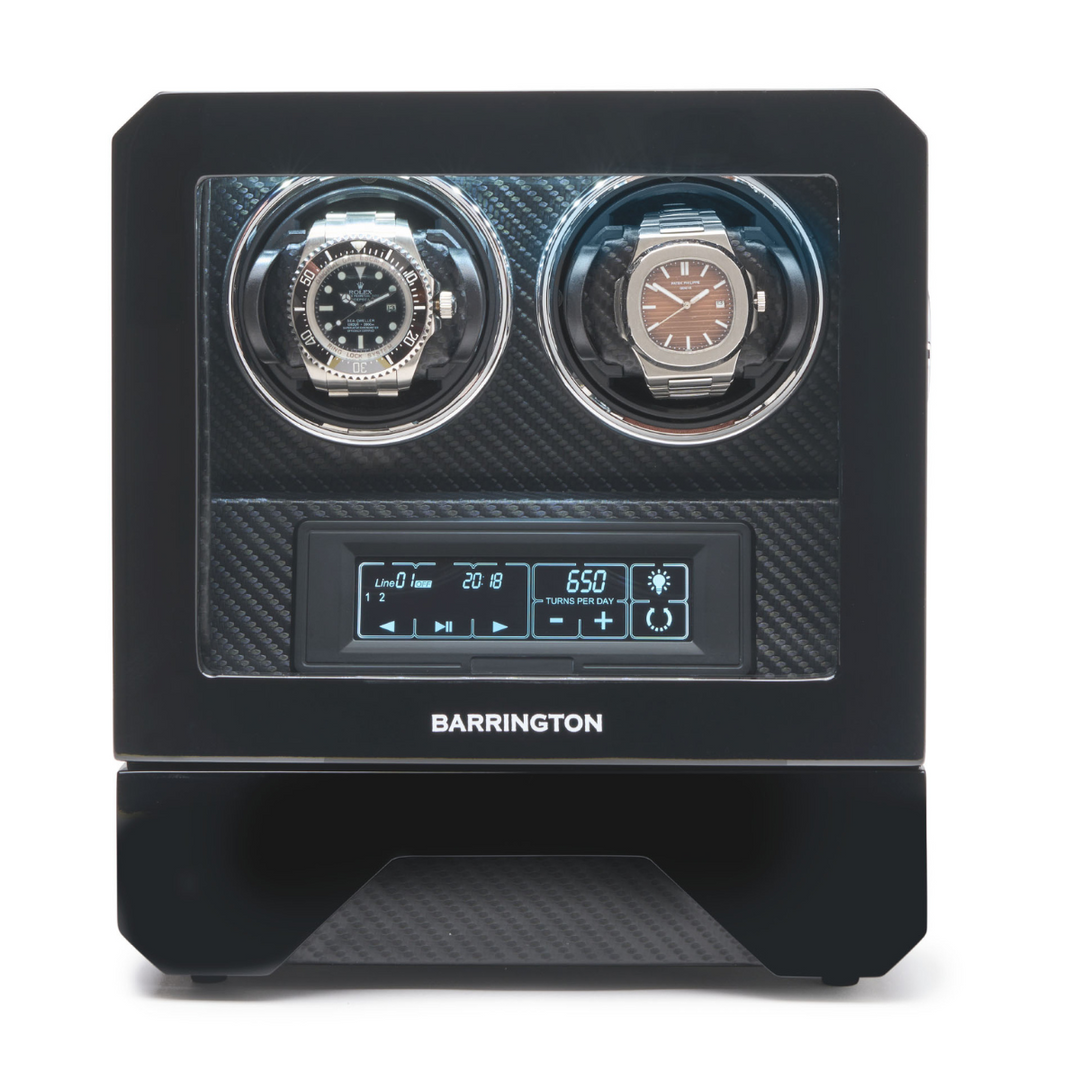
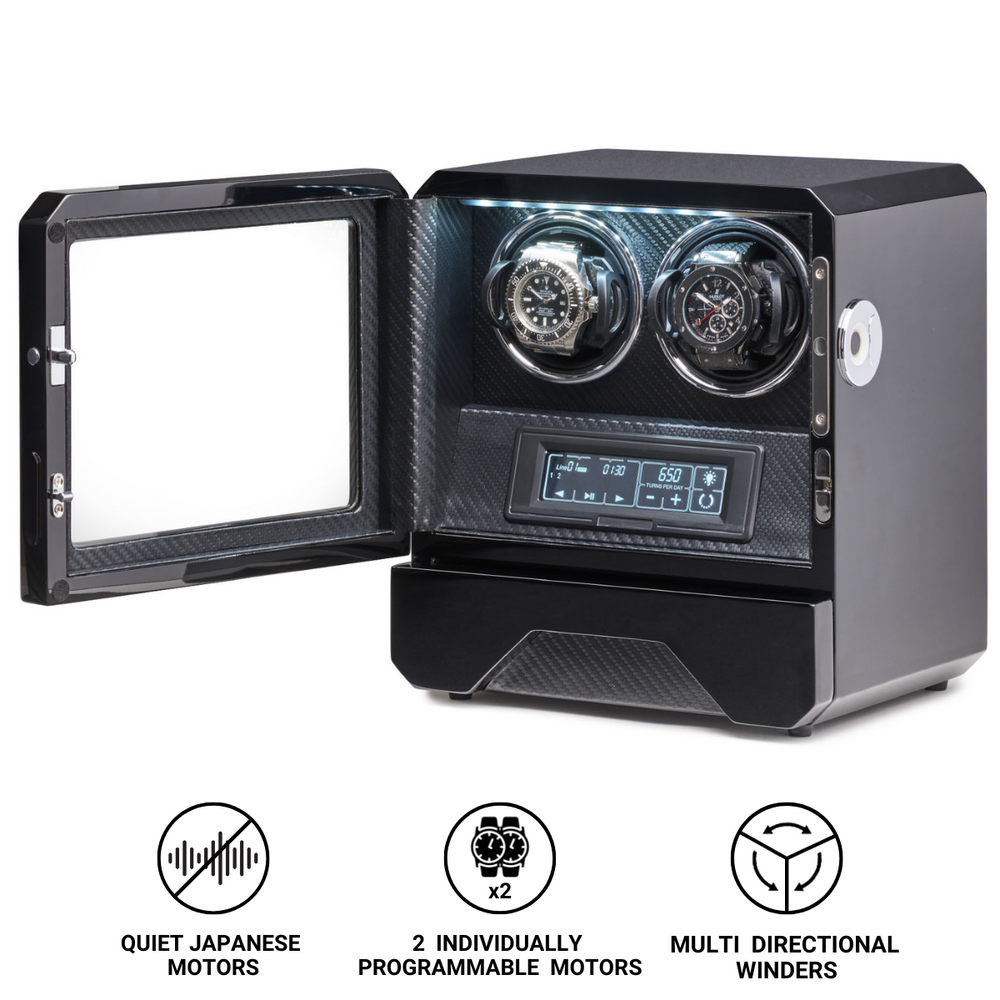
2 Watch Winder

(The Barrington Double Watch Winder from Barrington Watch Winders is designed for collectors who require both performance and sophistication in equal measure. Featuring two individually programmable rotors, it allows each watch to be set to its precise Turns Per Day and rotation direction, ensuring optimal care for different movements. Housed in a refined display case with a carbon fibre effect interior, it combines secure clip in cushions with a 12 o’clock resting position to present each timepiece elegantly. The addition of a fingerprint lock, capable of storing up to 20 prints, enhances security while maintaining ease of access, supported by both a responsive touch screen and full function remote control. Powered by ultra quiet Japanese Mabuchi motors and operating on a 12 hour rotation and 12 hour rest cycle, it is perfectly suited for use in quieter environments such as bedrooms or offices. A discreet storage drawer further increases its practicality, making it a complete solution for maintaining and showcasing multiple automatic watches).
Barrington Oxford Single Winder - White

(The Barrington Oxford Single Winder in White from Barrington Watch Winders offers the same precision engineering as the flagship range, presented in a clean and contemporary finish that complements any interior. Designed to keep automatic watches perfectly wound, it features fully adjustable Turns Per Day and rotation settings, allowing it to suit a wide range of movements from brands such as Rolex, Omega, Breitling and TAG Heuer. Its compact proportions make it easy to place on a desk, bedside table, or within a display cabinet, while the ultra quiet Japanese motor ensures smooth and discreet operation. The watch is securely held in place with a choice of cushions and always returns to a 12 o’clock resting position, creating a refined presentation when not in motion. With the flexibility of mains or battery power and the ability to connect multiple units via the Barrington Jump feature, it provides a versatile and elegant solution for maintaining and showcasing a growing collection).
At Barrington Watch Winders, this philosophy is at the heart of everything we do. Our winders are designed to combine precision engineering with refined aesthetics, ensuring your watches are both protected and beautifully displayed. For collectors who value their timepieces as much as the stories behind them, the right winder is not just an accessory. It is an essential part of the experience.
Conclusion: More Than Just Names
Rolex nicknames are far more than informal labels. They are a reflection of the culture that surrounds Rolex and the people who collect its watches. These names simplify complex references, but more importantly, they add personality, history, and meaning to each timepiece. Over time, they have become an essential part of how enthusiasts understand and engage with the brand.
For collectors, nicknames create a shared language that connects individuals across generations and markets. They make watches more memorable, more accessible, and ultimately more desirable. At Barrington Watch Winders, we see this passion every day. Behind every watch is not just a mechanism, but a story, and preserving those timepieces properly is part of the collecting journey. Whether it is a “Pepsi”, a “Hulk”, or a rare vintage reference, each watch deserves to be kept in optimal condition, ready to be worn and appreciated at any moment.





Leave a comment