


Chronograph Watches Explained: 4 Types and How They Work
Key Points:
Chronograph watches combine standard timekeeping with a built in stopwatch function, making them one of the most practical and popular complications in watchmaking.
There are four main types of chronographs, each offering different levels of functionality, from simple timing to measuring multiple events simultaneously.
Understanding how to use and read a chronograph, including sub-dials and pushers, makes it a versatile tool for both everyday and professional use.
Automatic chronographs benefit from proper care when not worn, making a watch winder a practical addition for maintaining accuracy and convenience.
Few watch complications are as instantly recognisable or as widely appreciated as the chronograph. Combining practical functionality with a bold, technical aesthetic, chronograph watches have earned their place as a cornerstone of modern horology. From timing laps on a racetrack to measuring everyday intervals, they offer a level of interaction that goes far beyond simply telling the time. This blend of purpose and design is precisely what has made the chronograph one of the most enduring and popular features in watchmaking.
What sets the chronograph apart is its ability to act as both a precision instrument and a statement piece. Whether found in iconic models like the Rolex Daytona or the Omega Speedmaster, the complication carries a rich history rooted in aviation, motorsport, and scientific exploration. Yet today, it is just as relevant for everyday wear, appealing to collectors and newcomers alike.
In this guide, we will explain exactly what a chronograph watch is, how it works, and how to use it in real-world situations. We will also explore the four main types of chronograph watches, helping you understand the differences and choose the style that best suits your needs.
What Is a Chronograph Watch?
A chronograph watch is a timepiece that combines standard timekeeping with a built in stopwatch function. In addition to displaying the current time, it allows the wearer to measure elapsed time intervals with precision. This makes it both a practical tool and one of the most engaging complications in mechanical watchmaking.
At a glance, a chronograph can usually be identified by a few distinctive features on the case and dial:
-
Pushers positioned on the side of the case, typically at 2 and 4 o’clock, used to start, stop, and reset the stopwatch
-
Sub-dials on the watch face, which record elapsed seconds, minutes, and sometimes hours
-
A central chronograph seconds hand that remains stationary until the timing function is activated
These elements work together to transform a standard wristwatch into a versatile timing instrument, capable of tracking anything from a few seconds to several hours.
The origins of the chronograph date back to the early 19th century. In 1816, Louis Moinet created one of the first known chronograph mechanisms, designed for astronomical observations. A few years later, in 1821, Nicolas Mathieu Rieussec developed a device to time horse races, which popularised the concept. Since then, the chronograph has evolved into one of the most iconic and widely used complications in horology.
What Is a Chronograph Used For?
One of the key reasons for the enduring popularity of chronograph watches is their versatility. While originally developed as precision instruments for professional use, they have evolved into practical tools for a wide range of everyday situations. Whether used in demanding environments or simple daily routines, a chronograph offers functionality that extends far beyond basic timekeeping.
Historically, chronographs played an essential role in fields where accurate timing was critical. In motorsport, they were used to measure lap times and calculate speed. In aviation, pilots relied on them for navigation and fuel management, where even small timing errors could have significant consequences. Today, these professional roots remain part of the chronograph’s identity, even as its use has expanded.
In modern life, a chronograph is just as useful for everyday tasks. From timing a workout or a run, to tracking cooking intervals or parking durations, it provides a simple and immediate way to measure time without relying on external devices.
|
Use Case |
How a Chronograph Helps |
|
Sport |
Measures lap times, intervals, and performance tracking |
|
Aviation |
Assists with navigation timing and fuel calculations |
|
Everyday Tasks |
Times cooking, workouts, meetings, or daily activities |
Ultimately, the chronograph stands out because of this balance between heritage and practicality. It is equally at home in professional settings and daily life, making it one of the most versatile complications a watch can offer.
How to Use a Chronograph Watch
Using a chronograph watch is straightforward once you understand the role of its pushers. Most chronographs are operated using two buttons on the side of the case, working in a simple sequence of start, stop, and reset.
To begin timing, press the upper pusher, usually located at 2 o’clock. This activates the chronograph function and sets the central seconds hand in motion. The sub-dials will begin recording elapsed minutes and, on some models, hours.
To stop the timing, press the same upper pusher again. This halts the chronograph hands, allowing you to read the measured time. Once you have recorded the result, press the lower pusher at 4 o’clock to reset all hands back to zero, ready for the next measurement.
In practice, this function is intuitive and highly useful. For example, if you are timing a run, you would start the chronograph as you begin, stop it when you finish, and read the elapsed time directly from the dial. The same process applies to everyday situations such as cooking, parking, or timing meetings, making the chronograph both practical and easy to integrate into daily life.
How Does a Chronograph Work?
At its core, a chronograph is an additional mechanism built on top of a standard watch movement. While the base movement keeps time continuously, the chronograph system can be engaged or disengaged on demand to measure specific intervals.
When you press the start pusher, a series of levers and gears are activated inside the movement. This engages the chronograph mechanism and connects it to the gear train, allowing energy from the mainspring to drive the timing function. As a result, the central chronograph seconds hand begins to move, while the sub-dials start recording elapsed minutes and, in some cases, hours.
Pressing the stop pusher disengages this mechanism, halting the chronograph hands without affecting the regular timekeeping of the watch. When the reset pusher is pressed, a set of hammers returns the chronograph hands back to their zero position. This precise coordination of components is what allows a chronograph to start, stop, and reset instantly.
From a technical perspective, the way this process is controlled depends on the movement’s design. High-end chronographs often use a column wheel, which ensures smooth and precise operation of the pushers. More widely used movements rely on a cam system, which is simpler and more cost-effective to produce. Both approaches achieve the same result, but they reflect different levels of mechanical refinement and finishing.
Barrington Watch Winders Insight: The added mechanical complexity of a chronograph means more components are in constant motion when the watch is running. Keeping this mechanism active, even when the watch is not worn, helps maintain accuracy and reduces the need for frequent resetting.

Understanding Chronograph Sub-Dials
One of the defining features of a chronograph watch is the presence of sub-dials, also known as registers. These smaller dials are used to display elapsed time when the chronograph function is running, allowing the wearer to track intervals with greater accuracy than a single seconds hand alone.
Each sub-dial has a specific role within the chronograph system. Typically, they are arranged to measure different units of time:
-
Seconds: often displayed on a dedicated sub-dial for continuous running seconds, separate from the chronograph function
-
Minutes: records the number of minutes that have elapsed since the chronograph was started
-
Hours: found on more advanced models, allowing the measurement of longer time intervals
Together, these sub-dials provide a complete picture of elapsed time, making the chronograph a practical tool for both short and extended measurements.
You may also come across the terms bi-compax and tri-compax when describing chronograph layouts. A bi-compax chronograph features two sub-dials, usually for seconds and minutes, offering a cleaner and more balanced appearance. A tri-compax layout includes three sub-dials, typically adding an hour counter, and is often associated with more complex or traditional chronograph designs.
4 Main Types of Chronograph Watches
While all chronographs share the same core function, there are several variations that differ in how they operate and the level of complexity they offer. Understanding these types helps you appreciate both their practical use and their mechanical sophistication.
Standard Chronograph
The standard chronograph is the most common and widely recognised type. It features two pushers, typically positioned at 2 and 4 o’clock, which control the start, stop, and reset functions.
This layout allows for straightforward operation. You start the timing with the upper pusher, stop it with the same button, and reset using the lower pusher. Its simplicity makes it easy to use and highly reliable for everyday timing tasks.
Many iconic watches follow this format, including models like the Rolex Daytona and the Omega Speedmaster, both of which have helped define the modern chronograph.
Monopusher Chronograph
As the name suggests, a monopusher chronograph uses a single pusher to control all functions. This button handles the entire sequence of start, stop, and reset with consecutive presses.
This design is often associated with vintage chronographs and offers a cleaner, more refined case profile. However, it comes with a limitation. Once the timing is stopped, it cannot be restarted from the same point and must be reset before starting again.
Despite this constraint, monopusher chronographs are appreciated for their historical charm and elegant simplicity.
Flyback Chronograph
The flyback chronograph was developed with aviation in mind, where precise and immediate timing adjustments were essential. It allows the wearer to reset and restart the chronograph instantly with a single press of the reset pusher.
Instead of the usual three step process of stop, reset, and start, the flyback function combines these actions into one seamless motion. This makes it ideal for timing consecutive events without delay.
In practical terms, this feature is especially useful when measuring intervals that follow one another closely, such as navigation points or lap timings.
Split-Seconds (Rattrapante) Chronograph
The split-seconds chronograph, also known as a rattrapante, is one of the most complex types of chronograph watches. It features two central seconds hands that start together but can be stopped independently.
This allows the wearer to measure multiple events at the same time. For example, you can track two runners in a race, stopping one hand when the first finishes while the other continues until the second runner crosses the line.
This level of functionality requires a highly intricate mechanism, making split-seconds chronographs some of the most technically advanced and prestigious watches in horology.
Chronograph Variations and Scales
In addition to different chronograph types, many watches feature specialised scales that expand their functionality. These are not separate types of chronographs, but rather additional tools integrated into the dial or bezel, designed to help interpret timing measurements in practical ways.
One of the most common is the tachymeter. Typically found on the bezel or outer edge of the dial, it allows the wearer to calculate speed over a known distance. By timing how long it takes to travel one kilometre or mile, the tachymeter scale converts that time into a units per hour reading. This feature is closely associated with motorsport and is a defining element of watches like the Rolex Daytona.
Another variation is the telemeter scale, which measures distance based on the speed of sound. It was historically used in military contexts to estimate how far away an event occurred. For example, you would start the chronograph when you see a flash of lightning and stop it when you hear the thunder. The telemeter scale then indicates the approximate distance of the storm.
The pulsometer is a more specialised scale designed for medical use. It allows the wearer to measure heart rate by counting a set number of beats, often 15 or 30, and using the chronograph to determine the pulse rate per minute. While less common today, it remains a fascinating example of how chronographs were adapted for professional applications.
These scales highlight the versatility of the chronograph. Rather than changing how the mechanism works, they enhance how the information is read, turning a simple timing tool into a multifunctional instrument.
Chronograph vs Chronometer: What’s the Difference?
This is one of the most common points of confusion in watch terminology, as the two words sound similar but refer to entirely different concepts.
A chronograph is a function. It describes a watch that includes a stopwatch feature, allowing you to measure elapsed time using pushers and sub-dials. The focus here is on added functionality beyond standard timekeeping.
A chronometer, on the other hand, is a certification of accuracy. It indicates that a watch has been tested and meets strict precision standards set by an official body such as the COSC. To qualify, a movement must perform within tightly controlled tolerances over several days in different positions and temperatures.
In simple terms, a chronograph tells you what a watch can do, while a chronometer tells you how accurately it keeps time. A watch can be one, the other, both, or neither, depending on its design and certification.
Chronograph vs Standard Watch
At a fundamental level, the difference between a chronograph watch and a standard watch comes down to functionality. A standard watch is designed solely to display the current time, typically with hours, minutes, and sometimes seconds. Its movement is focused on consistent, uninterrupted timekeeping.
A chronograph watch, by contrast, adds an additional layer of complexity. Alongside telling the time, it incorporates a stopwatch mechanism that can be activated on demand. This requires extra components within the movement, including levers, gears, and coupling systems that allow the chronograph to start, stop, and reset independently of the main timekeeping function.
This is why a chronograph is referred to as a complication in watchmaking. The term does not imply difficulty for the wearer, but rather the increased mechanical complexity involved in its construction. Integrating a chronograph mechanism into a movement demands greater precision in design, assembly, and regulation.
Visually, this added functionality is also reflected in the watch itself. Chronographs are typically characterised by pushers on the case and sub-dials on the dial, giving them a more technical and dynamic appearance compared to the cleaner, more minimal design of standard watches.
Ultimately, the choice between the two comes down to preference. A standard watch offers simplicity and elegance, while a chronograph provides added functionality and a more interactive experience on the wrist.

Are Chronograph Watches Worth It?
Whether a chronograph watch is worth it depends largely on what you expect from your timepiece. For those who appreciate mechanical ingenuity and practical functionality, a chronograph offers far more than a standard watch. It provides a hands-on experience, allowing you to interact with the movement and measure time in a meaningful way.
Chronographs are particularly well suited to enthusiasts who value versatility. If you regularly time activities such as workouts, travel intervals, or everyday tasks, the added functionality can be genuinely useful. They also appeal to collectors who are drawn to the history and engineering behind watch complications, as well as the iconic status of models like the Omega Speedmaster or the Rolex Daytona.
There are also moments when choosing a chronograph makes more sense. If you are building a watch collection, a chronograph adds variety and depth. If you prefer a more technical and sporty aesthetic, the presence of sub-dials and pushers creates a more dynamic look on the wrist compared to a time-only watch.
Ultimately, the decision comes down to balance. A chronograph offers greater functionality and visual presence, but it also introduces more complexity in both design and operation. For many, this added character is exactly what makes it worthwhile, combining precision, heritage, and style in a single watch.
Barrington Watch Winders Insight: For collectors who rotate between watches, chronographs can be more time consuming to reset due to their additional functions. Keeping them wound and ready to wear ensures you can enjoy them instantly, without the need for adjustment.
Caring for Your Chronograph Collection
Owning a chronograph is not just about choosing the right watch, but also about how you care for it between wears. Automatic chronographs, with their added mechanical complexity, benefit from staying in motion to maintain accuracy and ensure all functions remain correctly set. For collectors who rotate their watches, this becomes especially important, as resetting multiple sub-dials and complications can quickly become time consuming.
Barrington Oxford Single Winder - Green

(The Barrington Oxford Single Winder in Green is a refined solution for keeping your automatic chronograph ready to wear at all times. Compact in size yet thoughtfully engineered, it offers customisable Turns Per Day and rotation direction, allowing it to suit virtually any automatic movement, from everyday models to more complex chronographs. The watch is held securely in place and always returns to a 12 o’clock resting position, ensuring both accuracy and an elegant presentation when not in use.
Beyond its functionality, this model stands out for its quiet performance and versatility. Powered either by AC or batteries, and equipped with an ultra-quiet Japanese motor, it can be placed anywhere from a bedroom to a study without disturbance. The ability to connect multiple winders through the Barrington Jump system also makes it an ideal choice for growing collections, combining practical care with a clean, modern display).
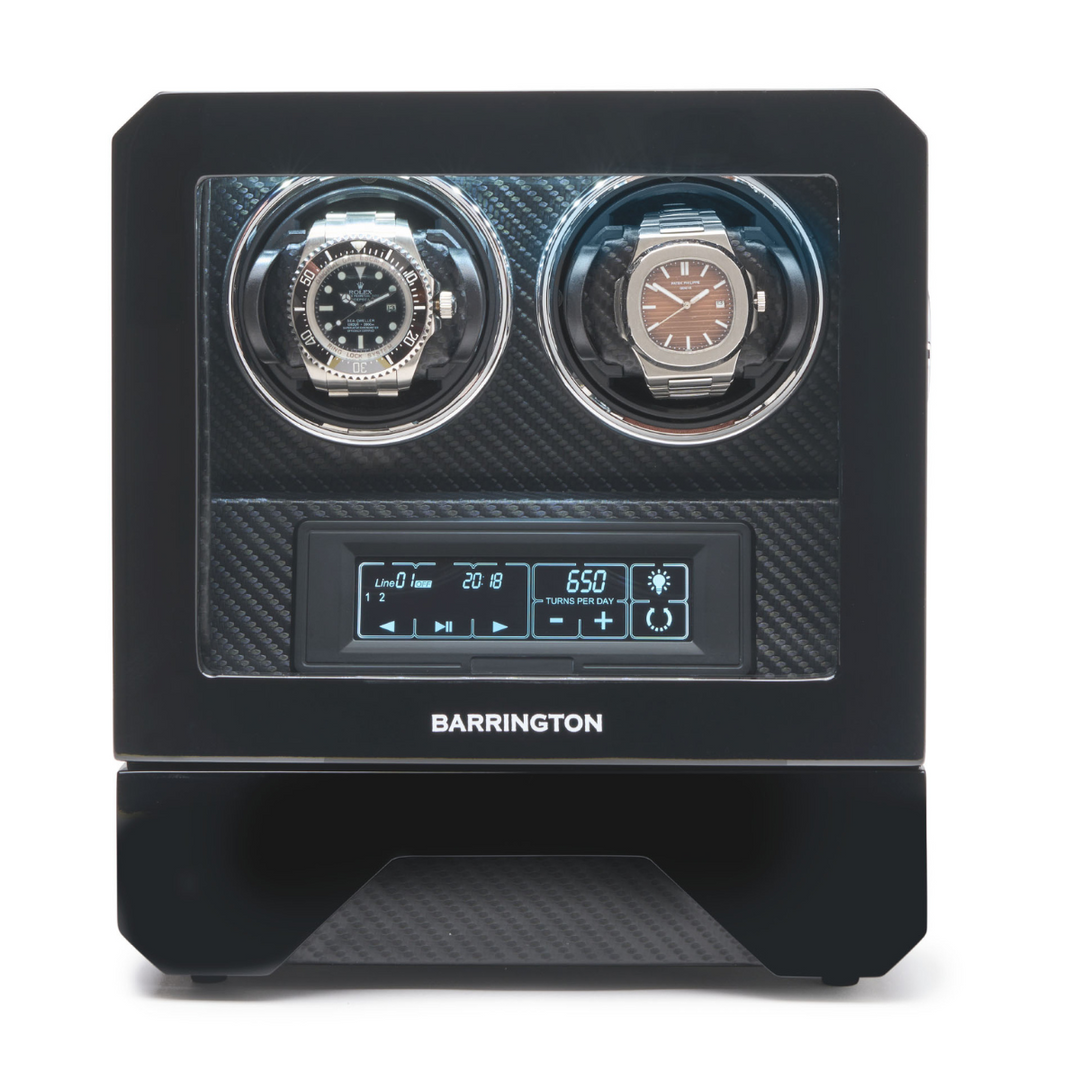
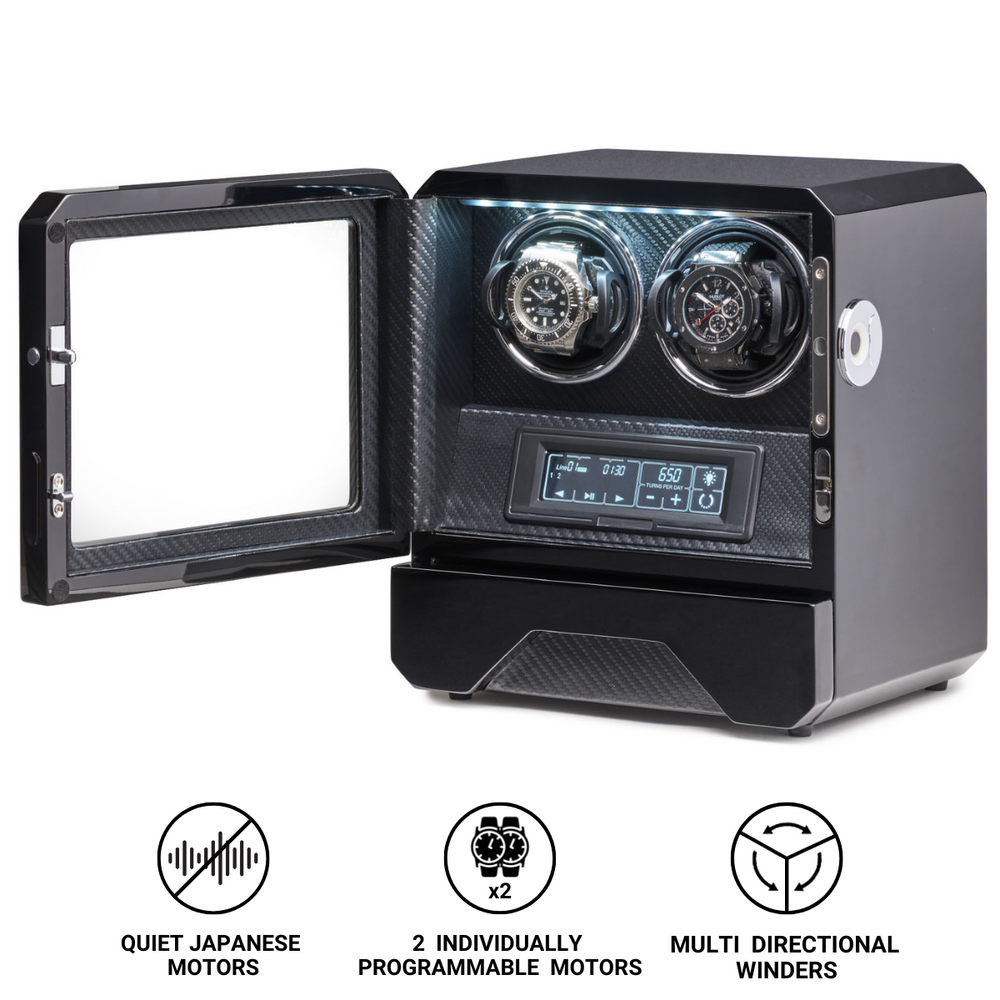
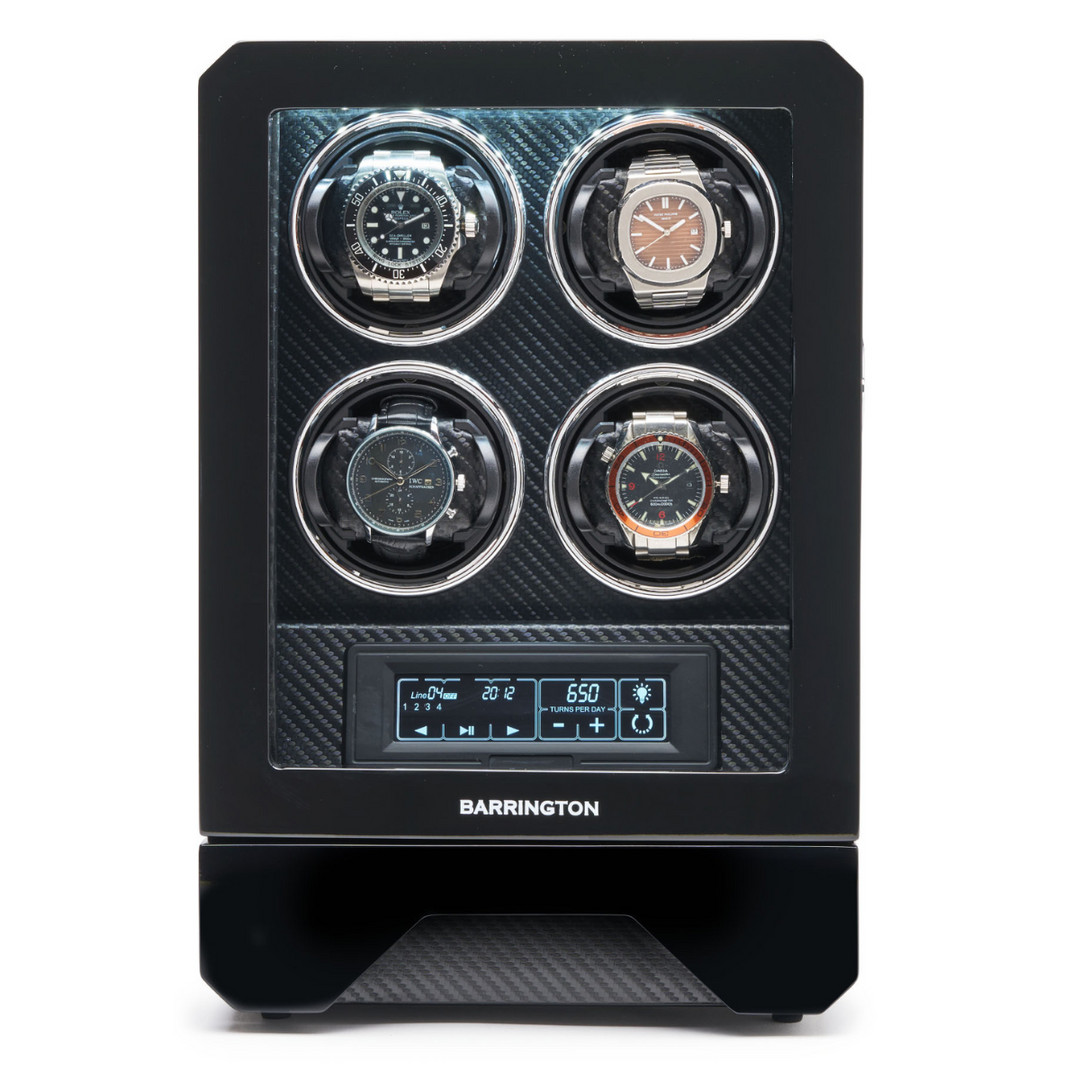
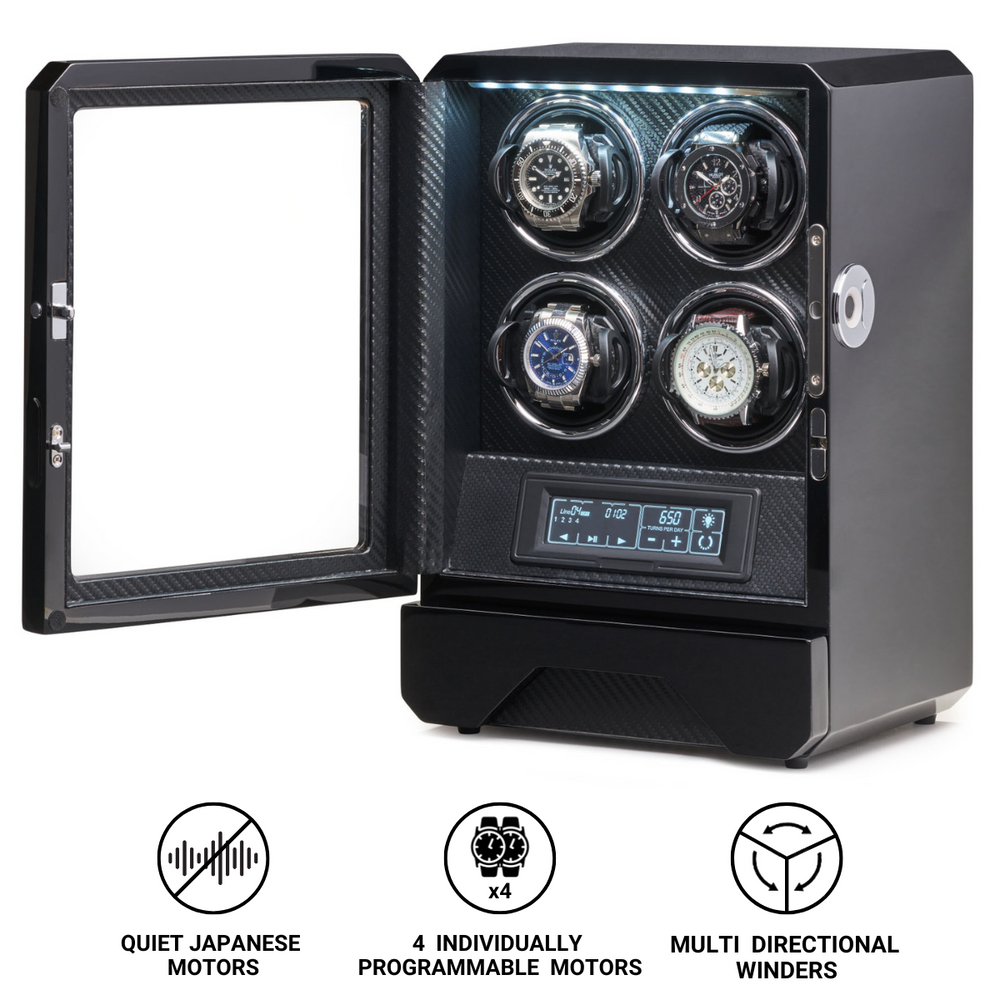
4 Watch Winder

(The Barrington 4 Watch Winder is designed for collectors who want both precision and presentation in a single unit. With four individually programmable rotors, it allows each watch to be set according to its exact Turns Per Day and preferred rotation direction, ensuring optimal performance for a wide range of automatic movements. The watches are securely held on cushioned mounts and always return to a 12 o’clock resting position, creating a clean and balanced display within its carbon fibre effect interior.
Beyond its core function, this model brings a more advanced and considered user experience. A built in fingerprint lock adds a layer of security, while the touch screen controls and remote allow for effortless adjustment of each rotor. Powered by ultra quiet Japanese motors and operating on a gentle rotation cycle, it is suitable for use even in quieter spaces such as bedrooms or offices. The addition of a storage drawer further enhances its practicality, making it a refined solution for managing and showcasing a growing watch collection).
Barrington Oxford Single Winder - Blue

(The Barrington Oxford Single Winder in Blue offers a refined balance of functionality and design, making it an ideal choice for keeping a single automatic chronograph in optimal condition. With customisable Turns Per Day and rotation direction settings, it can be precisely adjusted to suit a wide range of movements, ensuring consistent performance and accuracy. Its compact footprint allows it to fit effortlessly into any space, while the secure cushion and 12 o’clock resting position provide both protection and an elegant presentation.
Designed with everyday usability in mind, this model combines flexibility with quiet, reliable operation. It can be powered either by mains or batteries, offering convenience whether placed at home or used in a more portable setup. The ultra quiet Japanese motor ensures smooth operation without disturbance, while the Barrington Jump feature allows multiple units to be connected as a collection grows. The result is a watch winder that supports both the care and display of your timepiece with understated sophistication).
This is where a well designed watch winder becomes an essential part of a modern collection. Barrington Watch Winders combines precision engineering with elegant design, offering a reliable way to keep your chronograph ready to wear at any moment. By maintaining consistent movement and providing a refined display, it allows you to enjoy both the performance and presentation of your watches without compromise.
Why Chronographs Remain So Popular
The enduring appeal of chronograph watches lies in their unique combination of design, history, and collectability. Few complications manage to balance technical function with such a distinctive visual identity, making them instantly recognisable on the wrist.
From a design perspective, chronographs offer a more dynamic and engaging dial layout than standard watches. The presence of sub-dials, pushers, and often additional scales creates a sense of depth and purpose. This technical aesthetic has become closely associated with sport and performance, giving chronographs a versatile character that works equally well in casual and more refined settings.
Their history also plays a significant role in their popularity. Chronographs have been linked to some of the most important moments in modern watchmaking, from aviation and motorsport to space exploration. Iconic models such as the Omega Speedmaster, worn during lunar missions, and the Rolex Daytona, rooted in racing heritage, continue to reinforce this legacy.
Finally, chronographs hold strong appeal for collectors. Their mechanical complexity, combined with historical significance and limited production in certain cases, makes them highly desirable. Whether vintage or contemporary, chronograph watches often carry a sense of substance and story that goes beyond simple timekeeping, which helps explain why they remain a central part of the watch world today.
Final Thoughts
Chronograph watches bring together functionality, heritage, and mechanical sophistication in a way few other complications can match. From simple timing tools to highly complex mechanisms, they offer both practical value and lasting appeal. Whether you are drawn to their technical capabilities or their distinctive design, a chronograph is a natural addition to any well-rounded watch collection.
For those who own automatic chronographs, proper care is just as important as the watch itself. When not worn, keeping them wound ensures accuracy and preserves their internal mechanics. This is where Barrington Watch Winders plays a valuable role, offering precision engineered winders designed to maintain your watches in optimal condition. Combining functionality with elegant presentation, they provide a practical and refined way to support and showcase your collection.





Leave a comment