


How to Wind a Rolex Watch: Step-by-Step Guide for Automatic and Manual Models
Key Points:
Most modern Rolex watches are automatic, but manual winding is still important after periods of inactivity.
Understanding crown positions helps prevent damage and ensures accurate time and date setting.
Modern automatic Rolex movements cannot usually be overwound, while vintage manual-wind models require greater care.
A high-quality watch winder can keep your Rolex running accurately, maintain power reserve, and simplify watch rotation for collectors.
A Rolex is designed to run with exceptional precision, but like any finely engineered mechanical watch, it performs best when properly wound and correctly handled. Whether you own a modern self-winding model or a vintage manual-wind reference, understanding how to wind your Rolex correctly helps maintain stable timekeeping, protects the movement from unnecessary strain, and supports long-term reliability.
Most Rolex watches produced today use automatic movements powered by the brand’s Perpetual rotor system, which winds the watch through the natural motion of the wrist. However, even automatic Rolex watches occasionally require manual winding, particularly after being left unworn for several days. Older manual-wind models, meanwhile, depend entirely on regular winding to continue running accurately.
In this guide, we’ll explain how to wind a Rolex watch step by step, including both automatic and manual models. We’ll also cover crown positions, common mistakes to avoid, power reserve considerations, and whether a watch winder is worth using for your Rolex collection.
Do Rolex Watches Need Winding?
Most Rolex watches are self-winding, meaning they are designed to wind themselves automatically while being worn. Thanks to Rolex’s Perpetual rotor system, movement from the wrist continuously tensions the mainspring throughout the day, helping the watch maintain its power reserve without daily manual winding.
That said, automatic Rolex watches can still require manual winding from time to time. If a watch is left unworn for several days, the stored power inside the movement will gradually run down until the watch stops completely. At that point, a few manual turns of the crown are needed to restart the movement and restore stable operation.
Typical Rolex power reserve durations include:
-
Modern Rolex calibres: approximately 70 hours
-
Older Rolex movements: approximately 40 to 48 hours
-
Vintage manual-wind Rolex models: usually around 40 hours, depending on calibre and condition
For owners who rotate between several watches during the week, this is a common occurrence. A Rolex that sits in a drawer from Friday evening until Monday morning may still be running if fitted with a newer movement, while older references are more likely to stop after two days of inactivity.
Even though automatic Rolex watches are built for everyday wear, occasional manual winding remains an important part of proper ownership and helps ensure optimal accuracy once the watch is back on the wrist.
Understanding Rolex Movements
Rolex has produced several different movement types throughout its history, and understanding which one powers your watch is essential when it comes to winding and day to day care. While most modern Rolex watches use automatic movements, there are also vintage manual-wind references and a small number of quartz models that operate differently.
The vast majority of current Rolex watches are automatic, or self-winding. These movements use Rolex’s Perpetual rotor system, which converts wrist movement into stored energy inside the mainspring. Popular examples include the Rolex Submariner, Rolex Datejust, and Rolex GMT-Master II. Although these watches wind themselves during wear, they can still be manually wound through the crown when necessary.
Manual-wind Rolex watches are less common and are mostly found among vintage references. Early Daytona models and certain Cellini watches require regular hand winding because they do not contain an automatic rotor. These watches should typically be wound daily to maintain consistent operation and accuracy.
Rolex also experimented with quartz technology during the 1970s and 1980s through the Oysterquartz line. Unlike mechanical movements, quartz Rolex watches are powered by a battery and do not require winding at all.
|
Rolex movement type |
How it works |
Requires manual winding? |
Examples |
|
Automatic |
Self-winds through wrist movement using a rotor |
Occasionally |
Submariner, Datejust, GMT-Master II |
|
Manual-wind |
Powered entirely by hand winding |
Yes, regularly |
Vintage Daytona, select Cellini models |
|
Quartz |
Battery-powered electronic movement |
No |
Oysterquartz |
Knowing which movement your Rolex uses will help you wind it correctly, avoid unnecessary wear, and maintain reliable timekeeping over the long term.
Understanding the Rolex Crown Positions

Source: monochrome-watches.com
Rolex watches use a screw-down crown system designed to protect the movement from water, dust, and moisture. Before winding or setting the watch, it is important to understand the different crown positions and how they function. While the exact operation can vary slightly between models, most modern Rolex watches follow the same four-position layout.
Position 0 - Crown Screwed Down
In its normal resting state, the crown is fully screwed into the case. This is known as Position 0. In this position, the watch maintains its water resistance and the Oyster case remains properly sealed against external elements.
Rolex’s screw-down crown system is a major part of the brand’s Oyster architecture, first introduced in 1926. Leaving the crown unscrewed, even slightly, can compromise water resistance and expose the movement to moisture or dust.
Modern Rolex watches typically use one of two crown sealing systems:
-
Twinlock crown: features two sealed zones for water resistance
-
Triplock crown: uses three sealed zones and is generally found on professional sports models such as dive watches
The Triplock system is designed for greater pressure resistance and is commonly used on models intended for underwater use.
Position 1 - Manual Winding
Once the crown is unscrewed, it naturally springs outward into Position 1. This is the manual winding position. Turning the crown clockwise in this position winds the mainspring and restores power to the movement.
For automatic Rolex watches, this is used when the watch has stopped or has been unworn for several days. Manual-wind models rely on this position for daily operation.
Position 2 - Date Setting
Pulling the crown out one click moves it into Position 2. On date-equipped Rolex watches, this position allows the wearer to adjust the date independently without moving the hands around the dial.
This quick-set function is particularly useful after the watch has stopped and needs resetting. However, date adjustment should generally be avoided during late evening and early morning hours when the date mechanism is actively engaged.
Position 3 - Time Setting
Pulling the crown out to the furthest position activates Position 3, which is used to set the time. Turning the crown moves the hour and minute hands around the dial, allowing precise adjustment.
On many modern Rolex movements, the seconds hand also stops in this position. This feature, known as hacking seconds, allows more accurate synchronisation when setting the time.
Understanding these crown positions not only makes winding and setting your Rolex easier, but also helps prevent unnecessary wear to the crown threads, seals, and movement components over time.
How to Wind an Automatic Rolex Watch
Although modern Rolex watches are designed to wind themselves during wear, there are times when manual winding is necessary. If the watch has stopped after being left unworn, or if you want to restore full power reserve more quickly, manually winding the movement is the correct approach.
Step 1 - Unscrew the Crown
Hold the watch securely and locate the winding crown on the side of the case. Turn the crown counter-clockwise, towards you, until it releases from the case threads and gently pops outward into Position 1.
At this stage, the crown should feel free moving, but it should not be pulled away from the case yet. The watch is now ready for manual winding.
Step 2 - Wind the Watch
Turn the crown clockwise, away from you, approximately 30 to 40 times. As you wind the movement, you will feel a smooth mechanical resistance along with a subtle clicking sensation from the movement inside.
On modern automatic Rolex watches, overwinding is not normally possible because the movement uses an internal slipping clutch mechanism. Once the mainspring reaches optimal tension, excess energy is safely released.
Turning the crown counter-clockwise in this position does not wind the watch and has no mechanical effect.
Step 3 - Set the Date
Once the watch has enough power, gently pull the crown out one click into Position 2 to adjust the date. Rotate the crown until the date displays one day behind the current date.
This method helps ensure the watch is correctly synchronised between AM and PM when setting the time in the next step.
For example, if today’s date is the 12th, set the date to the 11th before adjusting the hands.
Step 4 - Set the Time
Pull the crown out fully into Position 3 to set the time. Turn the hands clockwise until the date changes at midnight. This confirms the watch has moved into the AM hours rather than midday.
Once the date advances to the correct day, continue setting the accurate time. Taking a few extra moments here helps ensure the watch remains synchronised correctly over the following 24 hours.
Many modern Rolex movements feature hacking seconds, meaning the seconds hand stops while the crown is in this position, allowing more precise time setting.
Step 5 - Screw the Crown Back Down
After the date and time have been set, press the crown gently back towards the case and begin turning it clockwise while applying light inward pressure. Continue until the crown is fully screwed down and secure.
This final step is essential for maintaining the watch’s water resistance and protecting the Oyster case from moisture and dust. The crown should feel snug, but never forced. Overtightening can place unnecessary stress on the crown threads and seals over time.
Barrington Watch Winders Comment: Many Rolex owners are surprised to learn that automatic watches still benefit from occasional manual winding. In our experience, giving the watch a full wind after a few days off the wrist helps restore more stable accuracy and smoother operation.
How to Wind a Manual-Wind Rolex
While most Rolex watches today are automatic, certain vintage references use manual-wind movements that require more regular interaction from the wearer. Unlike self-winding calibres, these watches rely entirely on manual winding to maintain power and accurate timekeeping.
For manual-wind Rolex watches, winding should generally become part of a daily routine. Many collectors prefer winding the watch each morning at roughly the same time each day, which helps maintain more consistent amplitude and accuracy throughout the power reserve cycle.
To wind a manual Rolex, unscrew the crown if the watch features a screw-down system, then turn the crown clockwise slowly and steadily. You will feel increasing resistance as the mainspring tightens. Unlike modern automatic Rolex movements, vintage manual-wind calibres do not contain a slipping clutch to release excess tension.
One of the most important differences with manual-wind watches is recognising when the mainspring is fully wound. The crown will gradually become firmer until it reaches a clear stopping point. At this stage, winding should stop immediately. Attempting to force the crown further can damage the mainspring, crown, or internal gear train.
Extra caution is particularly important with older Rolex references. Vintage components may be more delicate due to age, wear, or servicing history, and replacement parts for rare calibres are not always easy to source. If the crown feels unusually stiff, gritty, or inconsistent during winding, it is best not to force the mechanism and instead have the watch inspected by a qualified watchmaker.
For collectors of vintage Rolex models, careful winding is part of proper ownership. A gentle and consistent approach helps preserve both the movement’s mechanical integrity and the long-term value of the watch itself.
How to Wind a Vintage Rolex Without a Screw-Down Crown
Not all vintage Rolex watches use the screw-down crown system found on modern Oyster models. Depending on the age and reference, some older Rolex watches feature simpler push-pull crowns that do not need to be unscrewed before winding. This is particularly common among early non-Oyster references and certain dress watches produced before screw-down waterproof cases became standard across the collection.
Vintage Oyster models with screw-down crowns are wound in much the same way as modern Rolex watches, although they should always be handled more gently due to age and wear. Non-Oyster references, however, usually allow the wearer to wind the movement directly by turning the crown clockwise without first releasing it from the case.
The winding process itself is therefore simpler, but older movements and crown components are often considerably more fragile than their modern counterparts. Decades of use, previous servicing, and natural metal fatigue can all affect the feel and reliability of vintage mechanisms.
When winding any vintage Rolex, resistance should remain smooth and controlled. If the crown feels stiff, rough, loose, or unusually tight, it is important not to force it. Applying pressure to an ageing stem or crown assembly can lead to damaged threads, broken winding components, or costly repairs that may require difficult-to-source vintage parts.
Collectors and enthusiasts often underestimate how delicate older watches can become over time. A careful approach, slow winding, and minimal force are usually the safest way to preserve both the movement and originality of a vintage Rolex.
Can You Overwind a Rolex?
In most cases, modern automatic Rolex watches cannot be overwound. Contemporary Rolex calibres are fitted with an internal slipping clutch mechanism that prevents excess tension from building inside the mainspring once the watch reaches full power reserve.
As the mainspring becomes fully wound, the slipping clutch allows it to disengage safely and release surplus energy gradually. This means that manually winding an automatic Rolex beyond its full reserve will not normally damage the movement. For this reason, winding a modern Rolex 30 to 40 turns is entirely safe and often recommended after the watch has stopped.
Manual-wind Rolex watches are different. Vintage hand-wound movements do not usually include the same protective slipping mechanism found in automatic calibres. Once the mainspring is fully tensioned, the crown will reach a firm stopping point. Continuing to force the crown beyond this resistance can damage the mainspring, winding gears, or crown assembly.
As a general rule:
-
Modern automatic Rolex watches are designed to prevent overwinding
-
Vintage manual-wind Rolex watches can be damaged if excessive force is applied
-
Resistance should always feel smooth and controlled during winding
If a Rolex crown suddenly feels unusually tight, rough, or difficult to turn, it is best to stop winding immediately and have the watch inspected by a qualified watchmaker rather than forcing the mechanism further.
When Should You Manually Wind a Rolex?
Even though most Rolex watches are automatic, there are several situations where manual winding is recommended. Giving the movement a few deliberate turns through the crown helps restore stable power delivery and ensures the watch performs as accurately as possible.
One of the most common scenarios is after the watch has been left unworn for several days. Once the power reserve is depleted, the movement will stop completely and require manual winding to restart. While wrist movement will eventually begin winding the watch naturally, manually winding it first provides immediate power to the mainspring and allows the movement to stabilise more quickly.
It is also good practice to manually wind a Rolex before setting the time and date. Starting with sufficient power reserve reduces strain on the movement during adjustment and helps ensure the watch runs consistently once set.
You may wish to manually wind your Rolex in the following situations:
-
After the watch has stopped completely
-
After several days off the wrist
-
Before setting the time or date
-
After a service or maintenance appointment
-
When rotating between multiple watches in a collection
For collectors who regularly alternate between watches, manual winding becomes especially relevant. A Rolex worn only once or twice per week may not remain fully powered between wears, particularly older references with shorter power reserves.
Many owners also choose to manually wind their Rolex after servicing. Fresh lubrication and newly regulated components often benefit from a stable initial power reserve before the watch returns to normal daily wear.
As a general rule, occasional manual winding is entirely safe for modern automatic Rolex watches and forms part of normal ownership rather than something to avoid.
Should You Use a Watch Winder for a Rolex?
A watch winder is not essential for owning a Rolex, but for many collectors it can be a practical and worthwhile addition, particularly for automatic models that are not worn every day. By gently rotating the watch throughout the day, a watch winder keeps the movement running and maintains the power reserve when the watch is off the wrist.
This can be especially convenient for Rolex models with additional functions such as annual calendars, dual time displays, or more complex setting procedures. Rather than resetting the time and date each time the watch is worn, a winder keeps everything running and ready to wear.
Many enthusiasts also appreciate that regular movement helps keep lubricating oils distributed across the calibre’s moving parts. Mechanical watch oils naturally settle over long periods of inactivity, so occasional motion can help maintain smoother operation between wears.
However, it is important to understand that a watch winder is a convenience tool rather than a requirement. A Rolex stored safely and wound manually when needed will function perfectly well without one.
The quality of the watch winder also matters considerably. Poorly built winders may use inconsistent rotation patterns, excessive turns per day, or noisy low-grade motors that create unnecessary wear on the movement over time. Incorrect settings can also place avoidable strain on the automatic winding system.
When choosing a watch winder for a Rolex, it is worth considering:
-
Correct turns per day settings
-
Rotation direction compatibility
-
Quiet motor quality
-
Secure watch support and cushioning
-
Whether you need a single or multi-watch configuration
Collectors with one daily-wear Rolex may prefer a compact single watch winder, while larger collections often benefit from double or multi-watch winders designed for rotation between several pieces.
If you are considering adding one to your setup, our guides on Rolex watch winder settings, the best watch winders for Rolex models, and choosing between single vs double watch winders offer more detailed recommendations for different types of collections.
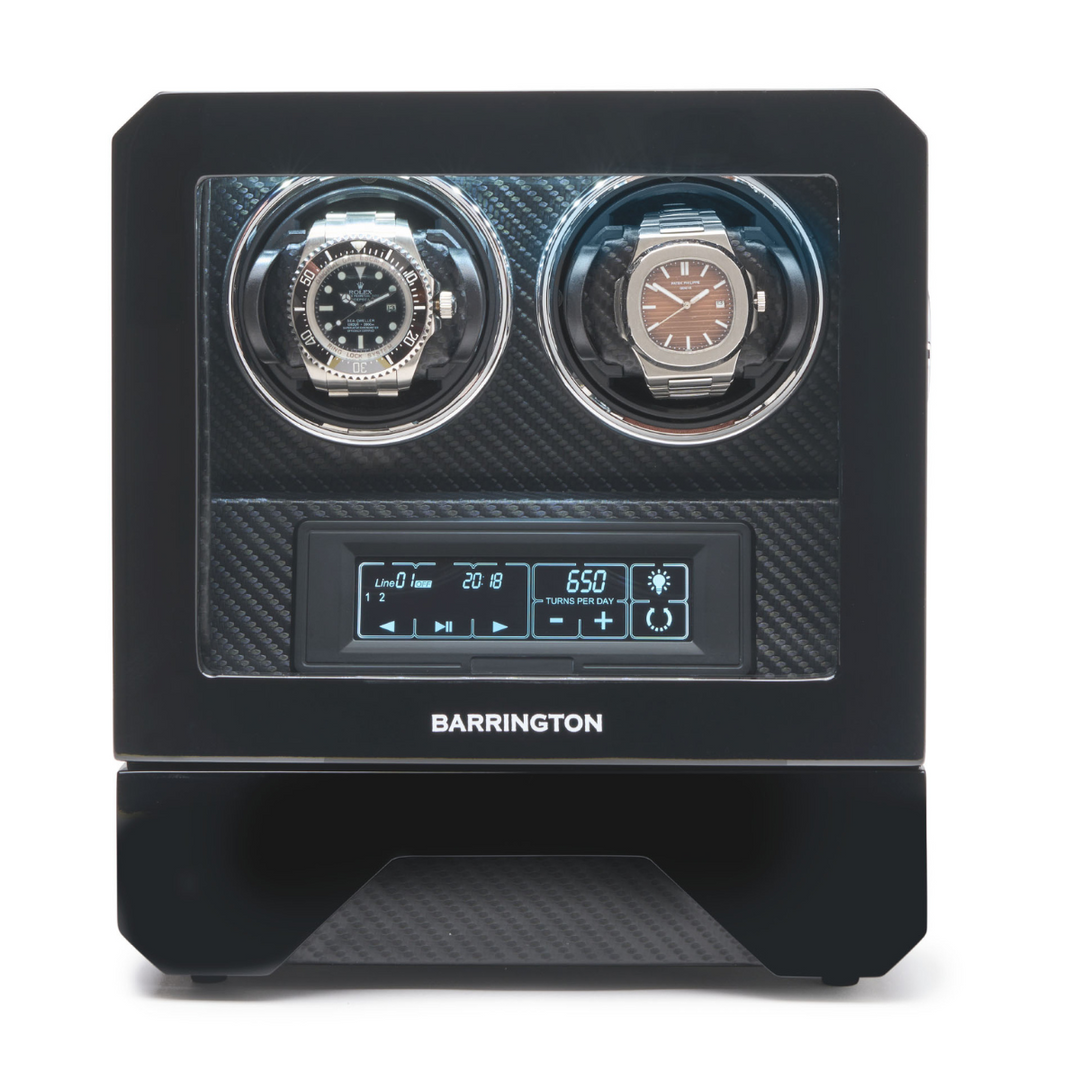
Barrington Watch Winders Comment: A well-configured watch winder should support the movement rather than constantly keep it in motion. That is why Barrington winders use intermittent rotation cycles and adjustable TPD settings designed to mirror realistic daily wear as closely as possible.
Barrington Watch Winders for Automatic Rolex Watches
For Rolex owners who rotate between watches or prefer keeping their timepiece ready to wear, a quality watch winder can make everyday ownership considerably more convenient. A well-configured winder helps maintain power reserve, keeps the date and time accurate, and provides a secure, elegant way to store your watch when it is off the wrist. Below are several Barrington watch winders particularly well suited to automatic Rolex models and modern watch collections.
Barrington Oxford Single Winder - Orange

(The Barrington Oxford Single Winder in Orange combines compact proportions with the level of functionality expected from a premium automatic watch winder. Suitable for Rolex, Omega, Breitling, TAG Heuer, and virtually any automatic watch, it features fully adjustable Turns Per Day and rotation direction settings, allowing precise configuration for different movements and calibres. Its ultra-quiet Japanese motor makes it discreet enough for a bedside table or office, while the Gentle Rotation system helps maintain movement lubrication and consistent winding without placing unnecessary strain on the watch. The elegant 12 o’clock resting position presents the watch beautifully when not rotating, and the Jump connection system allows multiple winders to be linked together from a single power source, making it an ideal choice for collectors planning to expand their collection over time).
6 Watch Winder

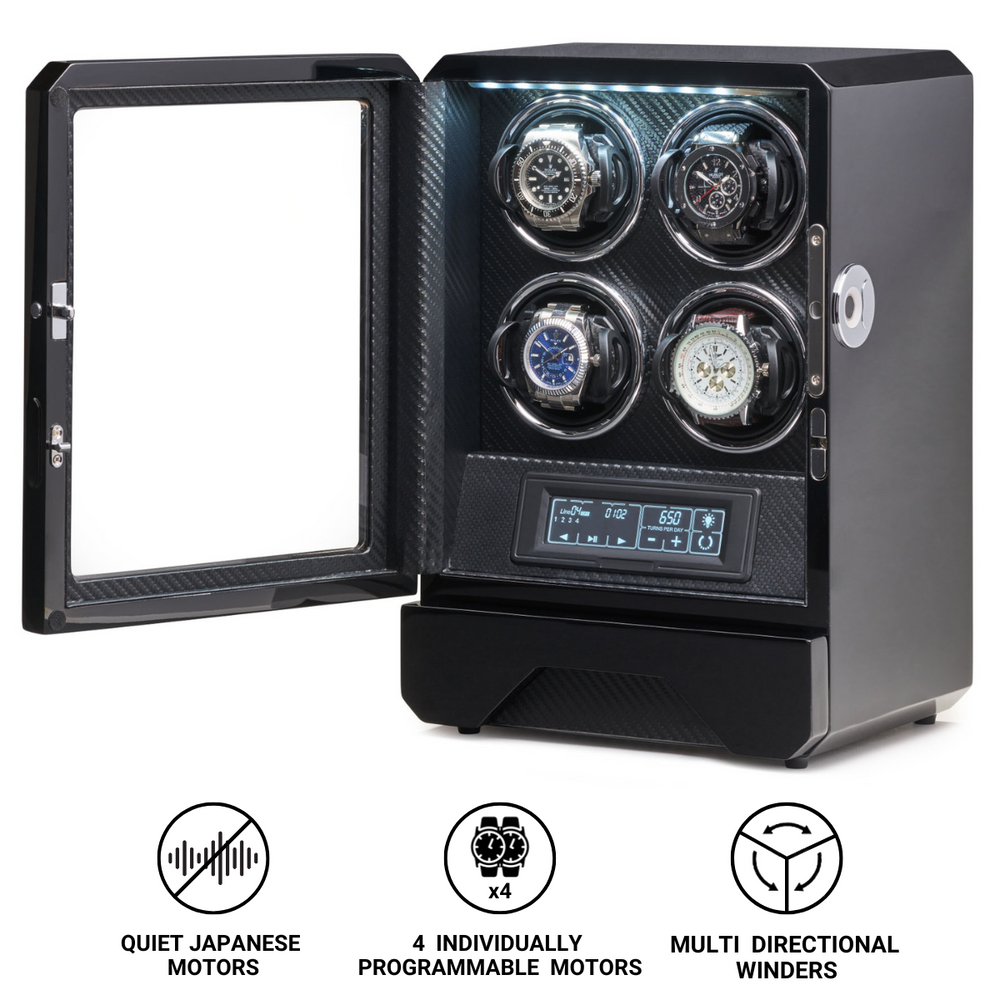
(The Barrington 6 Watch Winder is designed for collectors who want advanced functionality alongside elegant presentation and secure storage. Featuring six individually programmable rotors, it allows each automatic watch to be configured independently with its own Turns Per Day and rotation direction settings, making it particularly well suited to mixed collections that include Rolex, Omega, Breitling, and other luxury brands. The carbon fibre-effect interior, integrated LED lighting, and 12 o’clock resting position create a refined display, while the fingerprint locking system adds an extra layer of security capable of storing up to 20 fingerprints. Powered by ultra-quiet Japanese Mabuchi motors and Barrington’s Gentle Rotation technology, the unit remains discreet enough for bedroom or office use, with a 12 hour rotation and 12 hour rest cycle designed to support long-term movement health. Practical details such as the built-in storage drawer, touch screen controls, remote operation, and user-replaceable motors further reinforce its appeal as a serious long-term solution for growing watch collections).
Barrington Oxford Single Winder - Yellow

(The Barrington Oxford Single Winder in Yellow offers the same precision engineering and compact practicality as the rest of the Oxford range, but with a brighter, more contemporary visual character that stands out beautifully in modern interiors. Designed for automatic watches from brands such as Rolex, Omega, Breitling, and TAG Heuer, it combines fully adjustable Turns Per Day settings with clockwise, counter-clockwise, and bi-directional rotation modes to suit a wide range of movements. Its ultra-quiet Japanese motor and Gentle Rotation system make it suitable for bedrooms, offices, or display spaces, while the 12 o’clock resting position presents the watch elegantly when not in motion. The ability to operate via either AA batteries or USB mains power adds flexibility for different setups, and Barrington’s Jump feature allows additional single winders to be connected together seamlessly as a collection expands over time).
Choosing the right watch winder ultimately comes down to the size of your collection, your daily wearing habits, and the type of Rolex you own. Whether you prefer a compact single winder or a larger multi-watch setup, Barrington watch winders are designed with adjustable TPD settings, quiet operation, and gentle rotation technology to support long-term mechanical performance. For collectors looking to combine practicality with refined presentation, they offer a reliable solution for keeping automatic Rolex watches wound, protected, and ready to wear.
Common Rolex Winding Mistakes to Avoid
Rolex movements are engineered for durability and long-term reliability, but improper handling can still lead to unnecessary wear or damage over time. Fortunately, most winding mistakes are easy to avoid once you understand how the crown and movement are designed to operate.
One of the most common mistakes is forcing the crown when resistance is felt. Whether winding, setting the date, or screwing the crown back into the case, everything should feel smooth and controlled. If the crown suddenly becomes tight, gritty, or difficult to turn, applying additional force can damage the crown threads, stem, or internal winding components.
Another frequent issue involves adjusting the date during what many watchmakers refer to as the “danger zone”. On many mechanical watches, including Rolex models, the date change mechanism begins engaging several hours before midnight. Attempting to manually change the date during this period can place stress on the calendar system.
As a general precaution, avoid quick-setting the date when the hands are positioned roughly between 9 pm and 3 am.
Other common Rolex winding mistakes include:
-
Not screwing the crown fully back down after winding or setting the watch
-
Using excessive force when tightening the crown
-
Continuing to wind a vintage manual-wind Rolex after resistance increases
-
Ignoring unusual resistance or roughness while winding
-
Pulling the crown too aggressively between positions
Failing to screw the crown down properly is particularly important on Oyster models, as this compromises the watch’s water resistance and leaves the case more vulnerable to moisture and dust ingress.
Vintage Rolex watches deserve additional care. Older crowns, stems, and gaskets may be more delicate due to age, and forcing worn components can quickly turn a minor issue into a more serious repair.
A properly functioning Rolex should always feel refined in operation. Smooth winding, precise crown engagement, and controlled resistance are usually good signs that the movement and crown system are functioning as intended.
Troubleshooting: If Your Rolex Still Won’t Run
If your Rolex still refuses to run after winding, the issue may be something more than a depleted power reserve. In many cases the cause is minor and easily resolved, but persistent problems should not be ignored, particularly with older or vintage watches.
The first possibility is insufficient winding. An automatic Rolex that has completely stopped may require a full 30 to 40 turns of the crown before the movement begins operating consistently. A few turns alone are not always enough to restore stable amplitude and proper timekeeping.
Low amplitude is another common issue, especially in watches that have not been serviced for several years. In mechanical watchmaking, amplitude refers to the balance wheel’s range of motion. When lubrication begins to dry out or internal friction increases, the movement may continue running weakly or stop shortly after winding.
Signs of low amplitude can include:
-
The watch stops overnight despite being worn
-
Timekeeping becomes noticeably inconsistent
-
The seconds hand stutters or hesitates
-
Power reserve appears shorter than normal
Magnetisation can also affect mechanical Rolex movements. Exposure to strong magnetic fields from electronics, speakers, phones, or magnetic clasps may interfere with the hairspring and disrupt accuracy. In some cases, the watch may run extremely fast or behave erratically after exposure to magnetism.
Problems with the crown or stem assembly may also prevent proper winding. If the crown feels unusually loose, fails to engage correctly, or spins without building resistance, there could be wear or damage within the winding mechanism itself.
If your Rolex continues to stop despite proper winding and normal wear, it may simply require servicing. Over time, lubricants degrade naturally and internal components experience wear, even in well-maintained watches.
You should consider consulting a qualified watchmaker if:
-
The watch will not start after full winding
-
The crown feels rough or unstable
-
The movement stops repeatedly
-
Power reserve has noticeably decreased
-
The watch has not been serviced in many years
Attempting to force the crown or repeatedly winding a malfunctioning movement can sometimes worsen the problem. A professional inspection is usually the safest approach if anything feels mechanically abnormal.
Conclusion
Winding a Rolex correctly is a simple part of ownership, but it plays an important role in preserving the accuracy, reliability, and long-term health of the movement. Whether you own a modern automatic model or a vintage manual-wind reference, careful handling of the crown, sensible winding habits, and proper storage all contribute to consistent performance over time.
For collectors who rotate between watches or prefer keeping their timepieces ready to wear, a high-quality watch winder can add both convenience and protection. At Barrington Watch Winders, our precision engineered winders are designed specifically for automatic luxury watches, combining quiet operation, adjustable TPD settings, and elegant display solutions suitable for Rolex and other premium brands. With the right care and storage setup, your Rolex can continue performing exactly as intended for decades to come.







Leave a comment