


A Complete Timeline Of Every Rolex CEO And How They Shaped The Brand
Key Points:
Rolex has been led by only a handful of CEOs since 1905, creating a rare model of long term leadership stability in the luxury industry.
Each CEO shaped the brand incrementally, reinforcing precision, reliability, and controlled evolution rather than radical change.
Rolex’s leadership structure prioritises long term value over short term trends, which directly influences product consistency and collector trust.
This philosophy extends beyond purchase, encouraging thoughtful ownership, proper care, and long term preservation of mechanical watches.
When people talk about Rolex, the conversation almost always starts with watches. Submariner. Daytona. Datejust. Iconic references, incremental updates, waiting lists that stretch for years. Yet focusing solely on products misses a deeper truth. The history of Rolex is not just a catalogue of models. It is a story shaped by a remarkably small number of individuals who guided the brand over more than a century.
In an era defined by rapid executive turnover, this stands out sharply. Today, CEOs in large corporations often come and go within a handful of years, each bringing new priorities, strategies, and slogans. The result is frequently short term thinking, constant repositioning, and a race to show results quickly. In the luxury sector, this churn is even more pronounced, with leadership regularly moving between brands within the same group.
Rolex has followed a very different path. Since its founding in 1905, the company has been led by only a handful of chief executives. Each remained in position long enough to shape not just product lines, but the underlying philosophy of the brand. Decisions were made with decades in mind, not quarterly reports. This continuity explains why Rolex rarely makes abrupt changes, avoids chasing trends, and prefers evolution over reinvention.
This slow, deliberate approach is not accidental. Rolex evolves slowly because it is led slowly. Its watches change in small, carefully judged steps because its leadership has always favoured stability, consistency, and long term vision over rapid transformation. To understand why Rolex looks and behaves the way it does today, you have to understand the people who have guided it. Only then does the brand’s unique position in modern watchmaking truly make sense.
A Rare Case Of Stability: Rolex’s Leadership Model Explained
From its founding in 1905 to the present day, Rolex has been led by just six chief executives. For a company operating at the very top of the global luxury market, this level of continuity is exceptional. It becomes even more striking when placed alongside modern corporate norms.
To put this into perspective, the average tenure of a CEO in a large publicly listed company today is often less than eight years. In the luxury sector, where brands are frequently part of large conglomerates, leadership changes can be even more frequent. Executives rotate between maisons, strategies shift with market sentiment, and creative or commercial direction is regularly reset. Against this backdrop, Rolex’s leadership history appears almost anachronistic.
Rolex CEOs At A Glance
|
CEO |
Tenure |
Approximate Years in Role |
|
Hans Wilsdorf |
1905–1960 |
55 years |
|
André Heiniger |
1964–1997 |
33 years |
|
Patrick Heiniger |
1992–2008 |
16 years |
|
Bruno Meier |
2008–2011 |
3 years |
|
Gian Riccardo Marini |
2011–2014 |
3 years |
|
Jean Frédéric Dufour |
2014–Present |
10+ years |
Even a brief glance at this timeline shows a pattern that is increasingly rare. Long tenures are the rule rather than the exception. Leadership transitions are infrequent, deliberate, and typically internal.
A key reason for this stability lies in the ownership structure of the company. Rolex is not publicly traded, nor is it controlled by a luxury group. Instead, it is owned by the Hans Wilsdorf Foundation, established by the founder in the mid twentieth century. This foundation structure removes the pressure of shareholder expectations, quarterly earnings calls, and short term market reactions.
As a result, Rolex is managed more like a private institution than a conventional brand. Its leaders are not hired to generate rapid growth or headline grabbing transformations. They are appointed to protect the long term health of the company, its manufacturing independence, and its reputation for consistency. Investment decisions can take decades to pay off. Product strategies can unfold slowly. Mistakes are avoided not by speed, but by restraint.
This governance model explains why Rolex often appears conservative when compared to its peers. It does not chase trends, rush innovation, or radically redesign its collections. Instead, it relies on continuity of leadership to maintain continuity of purpose. In an industry increasingly driven by novelty and noise, Rolex’s stability at the top remains one of its most powerful and least discussed competitive advantages.
The Complete Rolex CEO Timeline (At A Glance)
This timeline serves as a quick reference point for the leadership history of Rolex. It allows readers to immediately place each era in context before exploring how individual CEOs shaped the brand in greater detail in the sections that follow.
Rolex CEOs Since 1905:
-
1905–1960 - Hans Wilsdorf
-
1964–1997 - André Heiniger
-
1992–2008 - Patrick Heiniger
-
2008–2011 - Bruno Meier
-
2011–2014 - Gian Riccardo Marini
-
2014–Present - Jean Frédéric Dufour
This overview is intentionally concise. Its purpose is not to explain, but to orient. The sections that follow explore how each leadership period influenced Rolex’s strategy, manufacturing philosophy, and position at the very top of the watch industry.

Hans Wilsdorf (1905–1960)
Hans Wilsdorf was far more than the founder of a watch company. He was an entrepreneur with a sharp commercial instinct, a visionary who understood the future of wristwatches long before the market did, and a marketer who knew that credibility had to be earned through proof rather than promises. These three roles shaped not only the early success of Rolex, but the principles by which the brand still operates today.
At a time when wristwatches were dismissed as fragile novelties, Wilsdorf believed they could become precise, reliable instruments suitable for everyday use. His ambition was not to make decorative objects, but practical timepieces that performed consistently in real world conditions. This belief drove his early focus on chronometric certification, long before accuracy became a standard talking point in watchmaking. In 1910, a Rolex wristwatch became the first of its kind to receive an official Swiss chronometer certificate, establishing precision as a non negotiable pillar of the brand.
Reliability followed naturally. Wilsdorf understood that accuracy meant little if a watch could not withstand daily wear. The development of the Oyster case in 1926 and the self winding Perpetual rotor in 1931 were not exercises in novelty. They were solutions to real problems, designed to protect the movement and ensure consistent operation on the wrist. This approach laid the foundation for what would later become known as purpose driven design. Every technical advance served a functional goal, and every aesthetic decision remained secondary to performance.
Equally important was Wilsdorf’s understanding of communication. Rather than relying on abstract claims, he demonstrated Rolex’s capabilities publicly. From placing watches in shop window aquariums to supporting high profile endurance challenges, he turned real world performance into the most powerful form of marketing. This strategy created trust and established a reputation that advertising alone could never achieve.
Perhaps Wilsdorf’s most consequential decision came near the end of his life. In 1945, following the death of his wife, he transferred ownership of Rolex to the Hans Wilsdorf Foundation. By doing so, he deliberately removed the company from personal inheritance and external control. This ensured that Rolex would never be driven by family succession, shareholders, or short term financial pressure.
That decision explains why Rolex still operates according to Wilsdorf’s original blueprint. Precision remains central. Reliability is still engineered rather than claimed. Design continues to serve a clear purpose. Above all, the company retains an unusually long term perspective. More than sixty years after his death, Rolex continues to function as an extension of Hans Wilsdorf’s thinking, guided by principles he put in place when the wristwatch itself was still fighting for legitimacy.
André Heiniger (1964–1997)
When André Heiniger took over leadership in the mid 1960s, Rolex was already known for precision and reliability. Heiniger’s task was not to reinvent the product, but to redefine what the brand represented on a global scale. His tenure marked the moment when Rolex moved beyond being the finest tool watch maker and became a universal symbol of achievement.
A central element of this shift was the internationalisation of the brand. Heiniger focused on building strong global distribution and visibility, travelling extensively and strengthening Rolex’s presence in key markets. At the same time, he reshaped the narrative around the watches themselves. Rolex was no longer positioned solely as equipment for professionals, but as a discreet expression of status and success.
This repositioning proved crucial during the quartz crisis. While much of the Swiss industry rushed to embrace electronic movements, Heiniger resisted undermining Rolex’s mechanical identity. His strategy prioritised long term brand value over short term market trends, allowing Rolex to emerge from the crisis not weakened, but reinforced.
Key elements of Heiniger’s leadership included:
-
Global expansion and consolidation of distribution networks
-
Reframing Rolex as a luxury status symbol
-
Strategic resistance to the quartz crisis
-
Significant investment in production capacity and infrastructure
These decisions were supported by substantial long term investment. Manufacturing scale was increased, facilities were modernised, and supply stability was prioritised. By the end of his tenure, Rolex had become the benchmark for modern luxury watchmaking, defined by global recognition, consistency, and controlled growth. In many respects, the Rolex we recognise today was shaped more by André Heiniger than by any other figure after the founder.
Patrick Heiniger (1992–2008)
When Patrick Heiniger became CEO, Rolex was already the dominant name in Swiss watchmaking. Rather than focusing on visible product expansion, Heiniger concentrated on something far less glamorous but far more consequential. He reshaped the internal structure of the company, laying the groundwork for the level of quality control Rolex is known for today.
During his tenure, Rolex introduced very few entirely new models. This was a deliberate choice. Heiniger believed that long term strength did not come from frequent launches, but from mastering every stage of production. His strategy centred on vertical integration, with Rolex gradually acquiring key suppliers and consolidating manufacturing under its own control. Cases, movements, dials, and bracelets were increasingly produced in house, reducing dependence on external partners.
This period also marked a decisive break with quartz. In the early 2000s, Heiniger ended Rolex’s production of quartz watches altogether, committing the brand fully to mechanical movements. At a time when quartz still represented convenience and efficiency, this move reinforced Rolex’s identity as a manufacturer of enduring mechanical timepieces rather than disposable consumer products.
The core pillars of Heiniger’s strategy can be summarised as follows:
-
Prioritising structural and manufacturing control over new model launches
-
Acquiring suppliers to achieve full vertical integration
-
Eliminating quartz movements in favour of mechanical exclusivity
-
Strengthening long term consistency in quality and production
The impact of these decisions is still felt today. Rolex’s reputation for uniform quality across its entire range, its ability to scale production without sacrificing standards, and its independence from external suppliers all trace back to this era. Patrick Heiniger’s tenure was not about short term visibility, but about building a system that would support Rolex for decades. In many ways, the modern perception of Rolex quality was engineered behind the scenes during these years.
Bruno Meier (2008–2011)
Bruno Meier assumed leadership at one of the most difficult moments in modern economic history. The global financial crisis of 2008 had shaken consumer confidence, disrupted luxury markets, and forced many watch brands into aggressive discounting or rapid strategic shifts. Rolex entered this period from a position of strength, but the priority was clear. Stability had to be protected above all else.
Meier’s background in finance made him a natural choice for this transitional role. Rather than pursuing growth or visibility, he focused on preservation. Production was carefully managed, costs were controlled, and long term planning took precedence over short term opportunity. In an environment where many competitors rushed to react, Rolex chose restraint.
One of the most notable aspects of this period was the absence of major product launches. This was not a failure of imagination, but a deliberate decision. Introducing new models during a period of uncertainty would have added risk without clear benefit. Instead, Rolex concentrated on maintaining its existing collection, protecting its pricing structure, and avoiding actions that could weaken brand perception.
Meier’s tenure was brief, but its importance should not be underestimated. He ensured that Rolex emerged from the crisis without compromising its identity or operational integrity. When markets began to recover, the company was positioned to resume its long term strategy without needing to rebuild trust or reverse hasty decisions. In this sense, his leadership served as a quiet but essential bridge between two much longer and more transformative eras.

Gian Riccardo Marini (2011–2014)
Gian Riccardo Marini took over leadership as Rolex entered a period of renewed global growth. The immediate crisis years were over, and the challenge had shifted from preservation to positioning. Marini’s background in distribution and retail shaped his approach, placing greater emphasis on regional strength and brand visibility.
One of his priorities was empowering local markets. Rather than enforcing a rigid central model, Marini focused on giving key regions more autonomy, allowing them to adapt to cultural and commercial realities. This was particularly relevant in fast growing markets such as China and the Middle East, where demand for luxury watches was expanding rapidly. At the same time, established markets like Italy remained strategically important, both commercially and symbolically, as centres of taste and influence.
Marini also expanded Rolex’s presence through high profile partnerships. Sport became a central platform for brand expression, reinforcing associations with precision, endurance, and performance. Sailing and golf remained core pillars, while Formula 1 represented a bold investment in global visibility. These partnerships were not about short term exposure, but about embedding Rolex within disciplines that reflected its values.
This period was defined by a clear set of strategic priorities:
-
Strengthening local market structures and regional autonomy
-
Expanding influence in China and the Middle East
-
Reinforcing core European markets, particularly Italy
-
Investing in global sports partnerships, including Formula 1
Although Marini’s tenure was relatively short, it played a critical role in preparing Rolex for its next phase. By reinforcing market foundations and elevating global visibility, he ensured that the brand was ready to operate at an even greater scale. His leadership bridged operational stability with modern brand presence, setting the stage for the more assertive and strategically expansive era that followed.
Jean Frédéric Dufour (2014–Present)
Under Jean Frédéric Dufour, Rolex entered a radically different luxury environment. Demand surged globally, information travelled instantly, and social media amplified scarcity to unprecedented levels. Rather than responding by increasing volumes, Dufour chose a more disciplined approach. His strategy focused on managing desirability, not chasing output.
Production growth under Dufour has remained controlled, even as waiting lists lengthened and market attention intensified. This restraint has been paired with steady price increases, reinforcing the perception of Rolex as a long term purchase rather than an impulse luxury good. Higher prices were not positioned as barriers, but as signals of value, confidence, and permanence.
At the same time, the product range evolved. New collections such as the 1908 signalled a renewed interest in classical watchmaking, while technically complex models like the Sky Dweller gained greater prominence. Materials, dials, and finishing became more expressive, adding layers of sophistication without disrupting the recognisable Rolex identity.
Several defining moves characterise this era:
-
Prioritising demand management over production expansion
-
Using price positioning to reinforce desirability
-
Broadening the collection through refined and more complex models
-
Launching the Rolex Certified Pre Owned programme
-
Acquiring Bucherer to strengthen control over retail distribution
Perhaps the most significant development has been Rolex’s entry into the secondary market. The Certified Pre Owned programme and the acquisition of Bucherer marked a decisive step towards controlling both primary and secondary channels. By doing so, Rolex reduced its reliance on external retailers and gained greater influence over pricing, customer experience, and brand perception across the entire ownership lifecycle.
Dufour’s leadership reflects a deep understanding of modern luxury dynamics. In an age defined by excess availability and constant novelty, Rolex has doubled down on restraint. The result is a brand that feels more exclusive than ever, not because it produces less, but because it controls every part of how its watches are made, sold, and valued.
How Each CEO Shaped The Watches We Know Today
The watches that define Rolex today did not emerge in isolation. They are the cumulative result of leadership decisions made over more than a century. Each CEO added a layer to the brand, influencing not only how Rolex watches look, but how they are built, positioned, and perceived.
Hans Wilsdorf established the core principles. Precision, reliability, and functional design became non negotiable standards. Without this foundation, later developments would have lacked credibility. André Heiniger transformed those principles into global symbols, ensuring that Rolex watches carried social meaning as well as technical merit. Models such as the Submariner, Datejust, and Day Date evolved into cultural references precisely because the brand stood for consistency and achievement.
Patrick Heiniger’s impact is felt in the unseen details. The uniform quality across the range, the durability of cases and bracelets, and the long term reliability of movements are direct outcomes of his push for vertical integration. By controlling production from start to finish, Rolex ensured that incremental changes could be made without disrupting the whole. This made gradual improvement possible.
Even shorter leadership periods played a role. Bruno Meier preserved stability during crisis, preventing reactive decisions that might have damaged the brand. Gian Riccardo Marini strengthened market structures and partnerships, allowing Rolex to operate confidently on a global stage. Jean Frédéric Dufour has refined this system further, managing scarcity, expanding complexity, and extending control beyond manufacturing into distribution and resale.
The result is a brand that evolves rather than reinvents. Rolex watches rarely change dramatically from one generation to the next, yet they consistently improve. This evolutionary approach is not a product strategy alone. It is a direct reflection of leadership continuity. Stable governance enables patient product development, which in turn reinforces trust and reputation.
In Rolex’s case, management, product, and perception are inseparable. The watches inspire confidence because the company behind them behaves predictably. Over time, this alignment has created something rare in modern luxury. A brand whose reputation is not driven by novelty, but by the quiet accumulation of decisions made with the long term firmly in mind.
Barrington Watch Winders Commentary: The consistency seen in Rolex watches is never accidental. It is the result of leadership decisions that favour refinement over reinvention, and systems over shortcuts. When watches are created this way, they respond best to owners who treat them as long term mechanical instruments rather than seasonal accessories.
What Rolex’s Leadership History Teaches Collectors
For collectors and long term owners, the leadership history of Rolex offers an important lesson. Rolex is not designed to be consumed quickly. It is built for decades of ownership, shaped by decisions that prioritise durability, consistency, and long term relevance over short lived excitement.
One of the most valuable outcomes of Rolex’s stable leadership is predictability. In a market where designs, materials, and positioning can change abruptly, Rolex moves with restraint. This makes ownership easier and more reassuring. A watch purchased today will not feel obsolete in a few years, nor will it be undermined by sudden shifts in strategy or identity. For collectors, this continuity translates into confidence.
This predictability extends beyond aesthetics. Rolex’s approach to manufacturing, servicing, and parts availability reflects the same long term thinking. Watches are designed to be maintained, not replaced. Movements evolve gradually, ensuring compatibility and familiarity across generations. As a result, ownership becomes a relationship rather than a transaction.
Importantly, Rolex’s strategy matters not only at the point of purchase. It shapes everyday ownership. How a watch performs over years of wear, how it responds to servicing, and how it retains its character all stem from leadership choices made far from the sales floor. This is where the philosophy of long term stewardship becomes tangible.
Understanding this context naturally shifts attention towards care and preservation. Mechanical watches reward thoughtful ownership. Proper maintenance, appropriate storage, and consistent winding habits all contribute to longevity. In this sense, Rolex’s leadership history encourages owners to think beyond acquisition and towards preservation. The same patience and discipline that define the brand’s management are mirrored in the way its watches are best enjoyed and protected over time.
Barrington Watch Winders Commentary: Long term ownership demands more than admiration. Mechanical watches benefit from regular, gentle operation even when they are not worn daily. At Barrington Watch Winders, we see watch care not as an add on, but as a natural extension of the same long term thinking that defines the world’s most enduring watch brands.

Caring For Mechanical Watches The Long Term Way
For watches shaped by decades of careful leadership and incremental refinement, ownership does not end when they leave the wrist. Mechanical timepieces are designed to operate continuously, and how they are treated between wears plays a quiet but important role in their longevity. This is especially true for brands like Rolex, whose movements are engineered with long term consistency in mind. Thoughtful storage and regular winding are not accessories to ownership, but part of the same philosophy that values durability over novelty.
Barrington Single Winder - Shadow Black
(The Barrington Single Winder Shadow Black is designed as a practical companion for long term ownership of automatic watches, balancing technical precision with discreet presentation. Compact in size yet substantial in build, it keeps an automatic watch correctly wound through fully adjustable Turns Per Day and rotation direction settings, making it suitable for everything from a daily worn Rolex to a watch that rotates in and out of use. The ultra quiet Japanese motor allows it to be placed anywhere, including a bedroom, while the 12 o’clock resting position ensures the watch is always displayed cleanly and consistently. Flexible power options via mains or batteries, combined with the ability to link multiple units together, reflect the same philosophy seen in well engineered watches themselves. Thoughtful design, controlled movement, and respect for the mechanics inside. Developed by Barrington Watch Winders, it is a tool created not for novelty, but for preserving automatic watches exactly as they were intended to run).
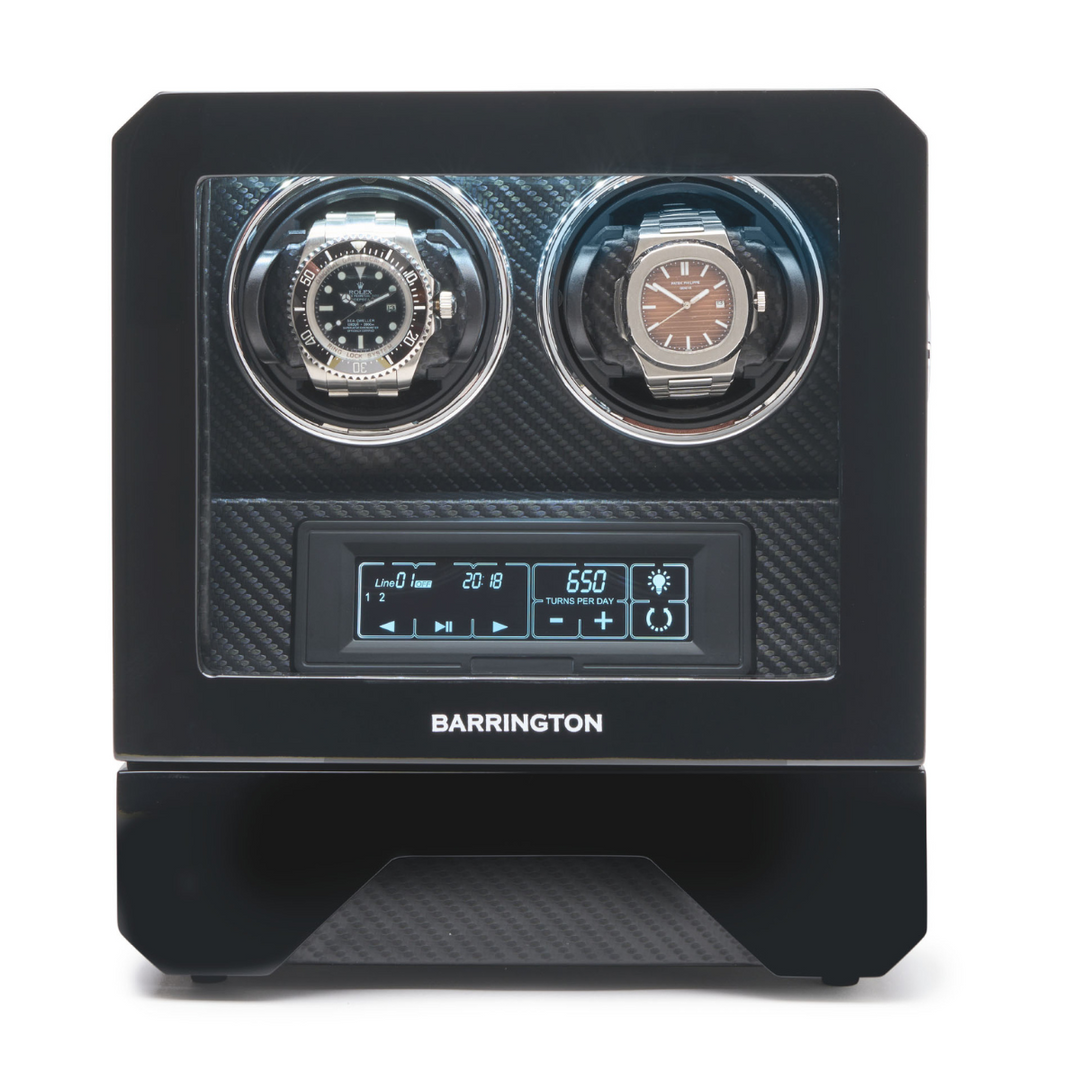
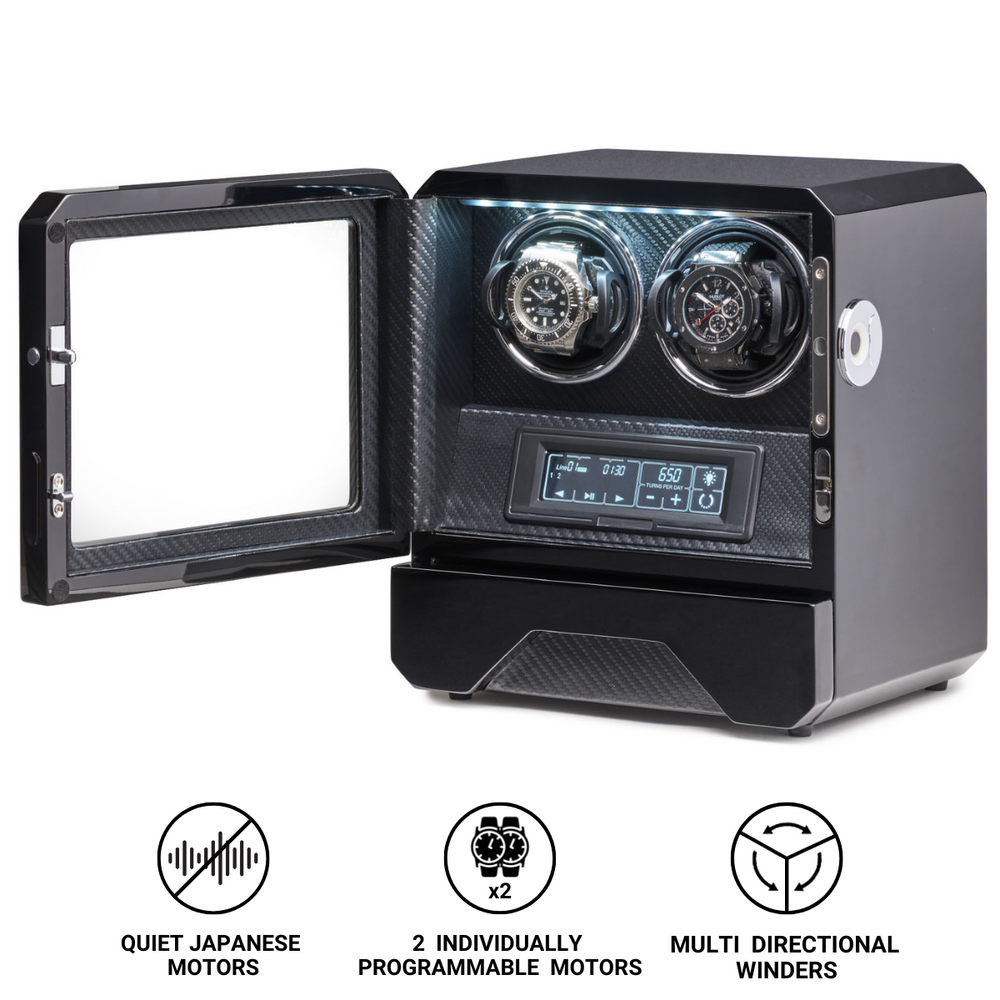
2 Watch Winder
(The Barrington 2 Watch Winder is designed for collectors who rotate between multiple automatic watches and expect precision without compromise. Each rotor is independently programmable, allowing both watches to run at their correct Turns Per Day and preferred rotation direction, ensuring accuracy regardless of movement type or weight. Security and presentation are treated with equal importance, with a discreet fingerprint lock, secure clip in cushions, and rotors that always return the watches to a refined 12 o’clock resting position. Ultra quiet Japanese Mabuchi motors and a 12 hour on and 12 hour off cycle make it suitable even for bedroom use, while the integrated storage drawer and full function remote control reflect a thoughtful approach to everyday ownership. Developed by Barrington Watch Winders, it is less a display accessory than a carefully engineered system for preserving mechanical watches exactly as their makers intended).
Barrington Single Winder - Glacier White

(The Barrington Single Winder Glacier White offers the same technical precision as its darker counterparts while introducing a lighter, more contemporary aesthetic that suits modern interiors. Designed to keep any automatic watch correctly wound, it features fully adjustable Turns Per Day and rotation direction settings, allowing the movement to run exactly as intended even when the watch is not being worn. The compact footprint makes it easy to place on a shelf or bedside table, while the ultra quiet Japanese motor ensures it remains unobtrusive in daily life. A secure cushion and consistent 12 o’clock resting position protect and present the watch with understated elegance, and flexible power options via mains or batteries allow it to adapt effortlessly to different settings. Created by Barrington Watch Winders, the Glacier White edition reflects the same philosophy found in well engineered mechanical watches. Precision, restraint, and long term reliability expressed through thoughtful design rather than excess).
This is where purpose built tools become relevant, not as luxuries, but as practical extensions of responsible ownership. Products from Barrington Watch Winders are designed to support automatic watches when they are not being worn, keeping movements active and ready without unnecessary intervention. In the context of long term watch ownership, these solutions align naturally with the principles that define enduring brands. Consistency, care, and respect for the mechanics beneath the dial are what allow great watches to remain great over time.
Conclusion: Rolex’s Greatest Innovation Isn’t A Watch
Looking back across more than a century of leadership, Rolex stands as a rare example of managerial continuity in modern luxury. Its CEOs were never mere executives hired to chase growth or trends. They acted as custodians of a system built on patience, restraint, and long term thinking. This consistency explains why Rolex evolves quietly, avoids abrupt shifts, and continues to command trust across generations. The brand’s resilience is not the result of any single model or technical breakthrough, but of a leadership culture that values stability over spectacle.
For owners and collectors, this philosophy naturally extends beyond the moment of purchase. A watch designed for decades of use deserves the same thoughtful approach in daily ownership. Care, maintenance, and proper storage become part of the relationship, not an afterthought. This is where companies like Barrington Watch Winders fit naturally into the picture, supporting mechanical watches through precise, considered winding and protection when they are not on the wrist. In that sense, preserving a Rolex is an extension of the very principles that built the brand itself. Long term thinking, consistency, and respect for the mechanics of time.





Leave a comment