


Most Popular Watch Brands in 2026
Key Points:
Rolex, Omega, Cartier and other established names remain among the most popular watch brands in 2026.
Popularity reflects recognition, current demand, iconic collections, collector interest and secondary-market activity, not simply price or prestige.
Tissot, Longines and Seiko provide more accessible routes into mechanical watchmaking, while Patek Philippe and Vacheron Constantin represent high horology.
Automatic watches from many popular brands can be kept ready to wear with a correctly configured watch winder matched to the movement's TPD and rotation requirements.
Popularity in watchmaking is not simply a question of price or prestige. Some highly exclusive maisons produce relatively few watches each year, while other brands achieve far broader recognition through iconic collections, strong retail demand and a visible presence on the secondary market. In 2026, the most popular watch brands are those that combine heritage with continued relevance, attracting both established collectors and people buying their first serious timepiece.
This guide looks beyond reputation alone. We consider brand recognition, demand for key models, collector interest, secondary-market activity and the strength of each manufacturer’s current range. The list therefore includes both high-end watchmakers and more accessible brands with a strong following, reflecting the wider watch market rather than focusing only on haute horlogerie.
What Makes the Most Popular Watch Brands Stand Out in 2026?
The most popular watch brands are not necessarily the most expensive or the most technically complex. Popularity comes from a combination of factors, including how widely a name is recognised, how much demand exists for its key models and how successfully the manufacturer continues to engage both established collectors and new buyers. Heritage matters, but a long history alone does not guarantee relevance in the modern watch market.
The most popular watch brands in 2026 tend to have several strengths in common:
-
strong global brand recognition and a clear identity;
-
recognisable collections that remain desirable across generations;
-
sustained demand for both new and pre-owned watches;
-
credible watchmaking heritage and manufacturing expertise;
-
movements and technologies that distinguish the brand from competitors;
-
active collector communities and a visible secondary-market presence;
-
collections spanning different styles, case sizes and price points;
-
the ability to evolve without losing established design characteristics.
This combination explains why popular watch brands can range from highly exclusive maisons to manufacturers producing watches at considerably more accessible prices. The following table provides a quick overview of the 15 brands covered in this guide.
|
Brand |
Founded |
Country |
Iconic Collections |
Why It Is Popular |
|
Rolex |
1905 |
Switzerland |
Submariner, Daytona, Datejust, GMT-Master II |
Global recognition and consistently strong demand |
|
Omega |
1848 |
Switzerland |
Speedmaster, Seamaster, Aqua Terra |
Heritage, technology and broad everyday appeal |
|
Cartier |
1847 |
France |
Tank, Santos, Panthère |
Distinctive design and renewed collector interest |
|
Patek Philippe |
1839 |
Switzerland |
Nautilus, Aquanaut, Calatrava |
High horology, scarcity and collector demand |
|
Audemars Piguet |
1875 |
Switzerland |
Royal Oak, Royal Oak Offshore |
Defining influence on luxury sports watches |
|
Tudor |
1926 |
Switzerland |
Black Bay, Pelagos, Ranger |
Tool-watch heritage and strong value proposition |
|
Breitling |
1884 |
Switzerland |
Navitimer, Chronomat, Superocean |
Aviation heritage and recognisable chronographs |
|
TAG Heuer |
1860 |
Switzerland |
Carrera, Monaco, Aquaracer |
Motorsport heritage and broad recognition |
|
Longines |
1832 |
Switzerland |
Spirit, HydroConquest, Master Collection |
Heritage and accessible Swiss watchmaking |
|
Tissot |
1853 |
Switzerland |
PRX, Gentleman, Seastar |
Accessible pricing and the popularity of the PRX |
|
IWC Schaffhausen |
1868 |
Switzerland |
Pilot's Watches, Portugieser, Ingenieur |
Engineering-led design and aviation heritage |
|
Jaeger-LeCoultre |
1833 |
Switzerland |
Reverso, Master Control, Polaris |
Movement expertise and distinctive design |
|
Grand Seiko |
1960 |
Japan |
Heritage, Evolution 9, Elegance |
Finishing, Spring Drive and Japanese craftsmanship |
|
Vacheron Constantin |
1755 |
Switzerland |
Overseas, Patrimony, Historiques |
High horology and increasing collector attention |
|
Seiko |
1881 |
Japan |
Prospex, Presage, 5 Sports |
Enormous range, accessibility and enthusiast following |
15 Most Popular Watch Brands in 2026
Any list of the most popular watch brands in 2026 has to reflect more than prestige alone. Some names dominate public recognition, others have comparatively small production but exceptional collector demand, while brands at lower price points attract a much broader audience. Together, these 15 manufacturers illustrate how varied the modern watch market has become.
Rolex
Rolex remains one of the most recognisable names in watchmaking. Founded in London in 1905 before establishing its operations in Switzerland, the company built its reputation around robust, practical mechanical watches and highly consistent design. The Submariner, Cosmograph Daytona, GMT-Master II and Datejust are among the most recognisable watches ever produced, while the Oyster Perpetual provides a simpler route into the collection.
Its popularity extends far beyond specialist collectors. Sports-watch buyers, first-time luxury-watch customers and experienced enthusiasts all participate in the Rolex market, while strong pre-owned demand gives the brand an unusually visible secondary-market presence. In 2026, Rolex continues to command exceptional attention across both new and pre-owned markets, with established collections such as the Datejust remaining important alongside the brand's highly sought-after sports watches.
Omega
Omega combines technical watchmaking with some of the strongest historical associations in the industry. The Speedmaster Professional remains inseparable from the history of crewed space exploration, while the Seamaster family covers professional-style dive watches, sportier everyday pieces and models closely associated with popular culture. The Aqua Terra and Constellation broaden the range further.
A major part of Omega's modern identity is its focus on movement technology. Co-Axial escapements and Master Chronometer-certified watches have helped the brand distinguish itself on engineering as well as heritage. This makes Omega attractive to buyers looking for a luxury mechanical watch that can still function comfortably as an everyday timepiece. The breadth of the range also means there is no single type of Omega owner, from Moonwatch enthusiasts to divers and buyers seeking a more understated daily watch.
Cartier
Cartier occupies an unusual position because its reputation is built on both jewellery and watchmaking. Rather than relying mainly on conventional round sports watches, the maison has created some of the most recognisable case shapes in horological history. The Tank, Santos and Panthère remain central to its appeal, while the Ballon Bleu provides a more contemporary interpretation of Cartier's design language.
Interest in Cartier has continued to expand as collectors rediscover shaped watches and smaller, more classically proportioned cases. The wider return of interest in dress watches and distinctive case shapes has placed collections such as the Tank and Santos firmly back in the spotlight. This helps explain why Cartier now appeals not only to traditional jewellery buyers but also to enthusiasts who previously concentrated primarily on conventional Swiss sports watches.
Patek Philippe
Patek Philippe represents a very different form of popularity. Production is limited compared with mass-market manufacturers, yet the brand has extraordinary recognition among collectors and remains one of the defining names in high horology. Its Calatrava models express traditional dress-watch design, while the Nautilus and Aquanaut have brought Patek Philippe into the luxury sports-watch market.
The manufacture is also renowned for complicated mechanical watches, including perpetual calendars, minute repeaters, chronographs and world-time models. This technical depth is central to its appeal. Buyers are generally not choosing Patek Philippe simply because the name is famous, but because the brand combines complex movements, traditional finishing and a long-established collector culture. Its limited availability further separates it from higher-volume luxury brands.
Audemars Piguet
Audemars Piguet has produced complicated watches since the nineteenth century, but its modern identity is inseparable from the Royal Oak. Introduced in 1972, the model helped establish the concept of a high-end stainless-steel sports watch with an integrated bracelet, an idea that subsequently influenced much of the luxury-watch industry.
The Royal Oak remains the centre of the collection, accompanied by the larger and more overtly sporting Royal Oak Offshore and the contemporary Code 11.59 family. This concentration around a highly recognisable design gives Audemars Piguet an exceptionally strong visual identity. The brand appeals particularly to collectors interested in luxury sports watches, distinctive case finishing and watches that are immediately recognisable without relying on conventional dress-watch styling.
Tudor
Tudor has developed from its historical relationship with Rolex into a manufacturer with a much clearer identity of its own. The Black Bay range remains its most visible collection, combining details inspired by historic Tudor diving watches with modern construction and movements. The Pelagos takes a more overtly technical approach, while the Ranger offers a simpler field-watch aesthetic.
Much of Tudor's popularity comes from its positioning. It offers substantial Swiss mechanical watches and increasingly sophisticated manufacture calibres at prices below many traditional luxury competitors. This makes the brand relevant to enthusiasts buying their first premium mechanical watch as well as collectors looking for robust watches that can be worn regularly. Its emphasis on practical sizes, vintage-inspired details and tool-watch functionality has also aligned well with broader tastes in recent years.
Breitling
Breitling's history is closely associated with chronographs, aviation and professional timing. The Navitimer, introduced in the early 1950s, remains one of the most recognisable pilot's watches, while the Chronomat, Superocean and Premier collections show how much broader the modern portfolio has become.
Recent Breitling collections balance the brand's traditional technical image with a wider range of sizes, colours and vintage-inspired designs. A buyer can now move from an aviation chronograph to a diving watch or a relatively restrained three-hand model without leaving the brand. This versatility has helped Breitling appeal beyond its historical aviation audience while preserving the chronograph expertise and bold visual identity for which it is best known.
TAG Heuer
TAG Heuer has one of the strongest links between watchmaking and motorsport. The Carrera and Monaco are particularly important, with both collections rooted in the racing culture that helped define the brand during the twentieth century. The Aquaracer adds a more conventional sports and dive-watch option, while other models broaden the range across both mechanical and quartz movements.
This mixture makes TAG Heuer one of the more approachable names within Swiss luxury watchmaking. Enthusiasts may be drawn to its chronograph history, while less specialised buyers often recognise the brand through motorsport, sponsorships and the distinctive square case of the Monaco. Its broad price range and combination of automatic, quartz and connected watches give it visibility well beyond the traditional mechanical-watch collector community.
Longines
Longines combines a long Swiss history with pricing that remains below many of the industry's major luxury maisons. Founded in Saint-Imier in 1832, it has extensive archives covering aviation, sports timing, chronographs and elegant dress watches. The modern Spirit collection draws heavily on that heritage, while the HydroConquest addresses the dive-watch market and the Master Collection offers a more classical aesthetic.
That diversity is important to the brand's popularity. Longines can appeal to buyers looking for their first serious Swiss automatic watch without presenting itself as a purely entry-level manufacturer. Collections such as the DolceVita also give the company a strong presence in shaped and dress-oriented watches, making its catalogue unusually broad in both style and audience.
Tissot
Few recent Swiss watches have expanded their audience as effectively as the Tissot PRX. Its integrated-bracelet design, range of dial options and availability with both quartz and Powermatic 80 automatic movements helped turn the model into one of the most visible watches in its price category. The range has since expanded into different sizes and complications while retaining the same core design.
Tissot is far more than the PRX, however. The Gentleman provides a versatile everyday option, the Seastar covers sports and diving, and the Le Locle represents the brand's more traditional side. The combination of Swiss production, broad availability and comparatively accessible pricing makes Tissot a common starting point for buyers moving from fashion or quartz watches towards mechanical watchmaking.
IWC Schaffhausen
IWC Schaffhausen is particularly well known for pilot's watches, although its catalogue extends far beyond aviation. The Pilot's Watch family ranges from relatively simple three-hand models to chronographs and larger Big Pilot references, while the Portugieser offers a more elegant interpretation of the brand's mechanical identity. The Ingenieur adds an engineering-led sports-watch design and the Portofino covers the more formal end of the collection.
IWC appeals to buyers who favour functional, restrained design but still expect the finishing and movement quality associated with luxury Swiss watchmaking. Its aviation heritage remains commercially important, yet the revived interest in the Ingenieur has also reinforced the brand's place in the integrated-bracelet sports-watch category.
Jaeger-LeCoultre
Jaeger-LeCoultre has long been respected for movement development as much as for external design. The manufacture has produced a remarkably wide range of calibres and complications over its history, giving it particular credibility among technically minded collectors.
Its most famous watch, however, is recognised as much for design as engineering. The Reverso's rectangular rotating case originated in the early 1930s and remains distinctive more than nine decades later. Alongside it, the Master Control and Polaris collections give the brand conventional round dress and sports watches. Renewed interest in classic proportions, shaped cases and historically important designs has also helped bring greater attention to Jaeger-LeCoultre in 2026.
Grand Seiko
Grand Seiko began as a premium line within Seiko in 1960 and has since developed a distinct international identity. Its appeal rests on a combination of highly precise movements, carefully finished cases and dials that frequently take inspiration from Japanese landscapes and seasonal changes.
Spring Drive is one of the clearest points of differentiation. The technology combines a mainspring-driven gear train with electronic regulation and produces the characteristically smooth motion of the seconds hand. Grand Seiko also offers conventional mechanical and high-accuracy quartz movements. Collections such as Heritage, Elegance and Evolution 9 give buyers several approaches to Japanese high-end watchmaking, while the quality of case polishing and dial finishing has made the brand increasingly familiar to collectors who once focused almost exclusively on Swiss manufacturers.
Vacheron Constantin
Founded in Geneva in 1755, Vacheron Constantin is one of the oldest continuously operating names in high watchmaking. The Patrimony and Traditionnelle collections represent the maison's classical side, while Historiques revisits important archive designs. The Overseas brings that expertise into the luxury sports-watch category and has become one of the brand's most visible modern collections.
Vacheron Constantin continues to attract significant collector attention in 2026, with the Overseas playing an important role in the maison's modern appeal. Its combination of high-end finishing, established watchmaking heritage and contemporary luxury sports-watch design gives the collection a distinctive position in the market. Vacheron Constantin remains a relatively exclusive manufacturer, demonstrating that popularity in high horology does not necessarily depend on high production volumes.
Seiko
Seiko illustrates why a list of popular watch brands should not be restricted to luxury manufacturers. Its catalogue stretches from inexpensive everyday watches to sophisticated mechanical pieces and, through Grand Seiko, into high-end watchmaking. Few brands cover such a broad range while retaining a strong enthusiast following.
The 5 Sports collection provides accessible automatic watches, Presage focuses more heavily on traditional styling and decorative dials, and Prospex covers diving, exploration and other sports applications. Seiko also has a long history of developing its own mechanical, quartz and electronic technologies. For new collectors, this breadth makes it easy to explore mechanical watches without a substantial initial outlay, while long-time enthusiasts often remain interested in the brand's specialist and limited models.

Most Popular Luxury Watch Brands for Men and Women
Many of the most popular luxury watch brands still organise parts of their collections around traditional men's and women's categories, but those boundaries are becoming less important. Case diameter, thickness, bracelet fit, dial design and personal style often provide more useful guidance than the gender label applied to a model.
Traditionally male-oriented collections remain particularly strong in sports, diving, aviation and chronograph categories. Brands frequently considered in this context include:
-
Rolex, particularly the Submariner, GMT-Master II, Explorer and Daytona;
-
Omega, through the Speedmaster, Seamaster and Aqua Terra;
-
Tudor, especially the Black Bay and Pelagos families;
-
Breitling, with the Navitimer, Chronomat and Superocean;
-
TAG Heuer, through the Carrera, Monaco and Aquaracer;
-
IWC Schaffhausen, particularly its Pilot's Watches and Ingenieur.
These collections tend to emphasise legibility, water resistance, timing functions and robust cases, although many are now available in a much broader range of dimensions than in previous decades.
Popular luxury watch brands associated with smaller or more jewellery-influenced watches include:
-
Cartier, particularly the Tank and Panthère;
-
Rolex, with the Datejust and smaller Oyster Perpetual references;
-
Omega, including smaller Constellation and Aqua Terra models;
-
Patek Philippe, whose catalogue ranges from complicated mechanical pieces to refined smaller watches;
-
Longines, with collections such as the DolceVita and Mini DolceVita.
The distinction should not be treated as a rule. A Cartier Tank or Rolex Datejust can work across a wide range of wrists, while smaller case sizes are increasingly being adopted by buyers regardless of gender. The renewed interest in compact and traditionally proportioned watches during 2026 further reduces the usefulness of rigid men's and women's classifications.
How to Choose Between the Best Watch Brands in 2026
There is no single answer to which manufacturer belongs among the best watch brands for a particular buyer. A brand that makes sense for someone seeking a robust everyday automatic may be very different from the choice of a collector interested in hand-finished complications or a buyer looking for a slim quartz dress watch.
Before comparing the best watch brands in 2026, it is more useful to define what the watch needs to do:
-
Set a realistic budget that includes future servicing as well as the purchase price.
-
Decide between mechanical, automatic, manual-winding, quartz or technologies such as Grand Seiko's Spring Drive.
-
Consider whether the watch will primarily be used for everyday wear, formal occasions, diving, travel or sport.
-
Look at case diameter, lug-to-lug dimensions and thickness rather than relying on diameter alone.
-
Choose an appropriate level of water resistance for the way the watch will actually be used.
-
Compare movement specifications such as power reserve, winding system, frequency and chronometer certification where relevant.
-
Research recommended service intervals and the availability of authorised servicing.
-
Consider whether heritage and historical associations matter to you or whether contemporary design is more important.
-
Check availability. Some highly desirable models can be considerably harder to obtain than others.
-
Review secondary-market prices if resale flexibility matters, but do not assume that a watch will increase in value.
-
Decide whether the purchase needs to work as a single versatile watch or fill a specific role within a larger collection.
The same principle applies when comparing the best Swiss watch brands. Rolex, Omega, Longines, Tissot, Patek Philippe and Vacheron Constantin all make Swiss watches, but they operate at very different price levels and fulfil very different roles. Country of manufacture is therefore only one part of the decision.
Trying a watch on is equally important. Two models with identical case diameters can feel completely different because of lug shape, bracelet articulation, thickness and weight. Technical specifications can narrow the shortlist, but comfort and personal preference should ultimately determine which watch stays on the wrist.
Comment from Barrington Watch Winders: A brand name can help narrow your search, but the watch itself should come first. Case proportions, movement type, comfort and how you intend to wear it will usually matter more in everyday ownership than prestige alone.
Popular Automatic Watch Brands and Watch Winder Compatibility
Automatic movements are found throughout many popular watch brands, from relatively accessible Tissot and Longines models to watches from Rolex, Omega, Tudor, Breitling, TAG Heuer, IWC, Grand Seiko and Vacheron Constantin. However, the fact that a brand produces automatic watches does not mean every watch in its catalogue is automatic.
Rolex's current mechanical range, for example, relies heavily on self-winding movements, while Omega combines automatic watches with manual-winding models such as versions of the Speedmaster Moonwatch. Cartier, Longines, TAG Heuer, Grand Seiko and Tissot offer various combinations of automatic, manual, quartz or other movement technologies depending on the collection.
For watch winder use, the movement matters more than the logo on the dial. The important points are:
-
Turns Per Day, or TPD, indicates approximately how many rotations the winder should complete within a day.
-
Automatic movements may wind clockwise, counter-clockwise or in both directions.
-
Two watches from the same manufacturer can require different TPD or rotation settings if they use different calibres.
-
Manual-winding mechanical watches are not designed to be wound by a watch winder.
-
Quartz watches do not need a winder because their operation does not depend on an automatic winding rotor.
-
An automatic watch can be kept on a suitable winder, provided the correct programme is selected.
Barrington Watch Winders offers adjustable TPD and rotation direction, including clockwise, counter-clockwise and bi-directional programmes. The Barrington Watch Database can also be used to check recommended settings for a particular watch model or movement rather than relying on a generic setting for the entire brand.
This becomes particularly useful for collectors with several automatic watches. A multi-watch winder with independently programmable rotors allows different movements to run on their appropriate settings at the same time instead of applying one programme to an entire collection.
Comment from Barrington Watch Winders: When choosing a watch winder, always check the requirements of the specific movement rather than relying on the brand name alone. Two automatic watches from the same manufacturer can require different TPD and rotation settings, so correct configuration is essential.
Watch Winders for the Most Popular Watch Brands
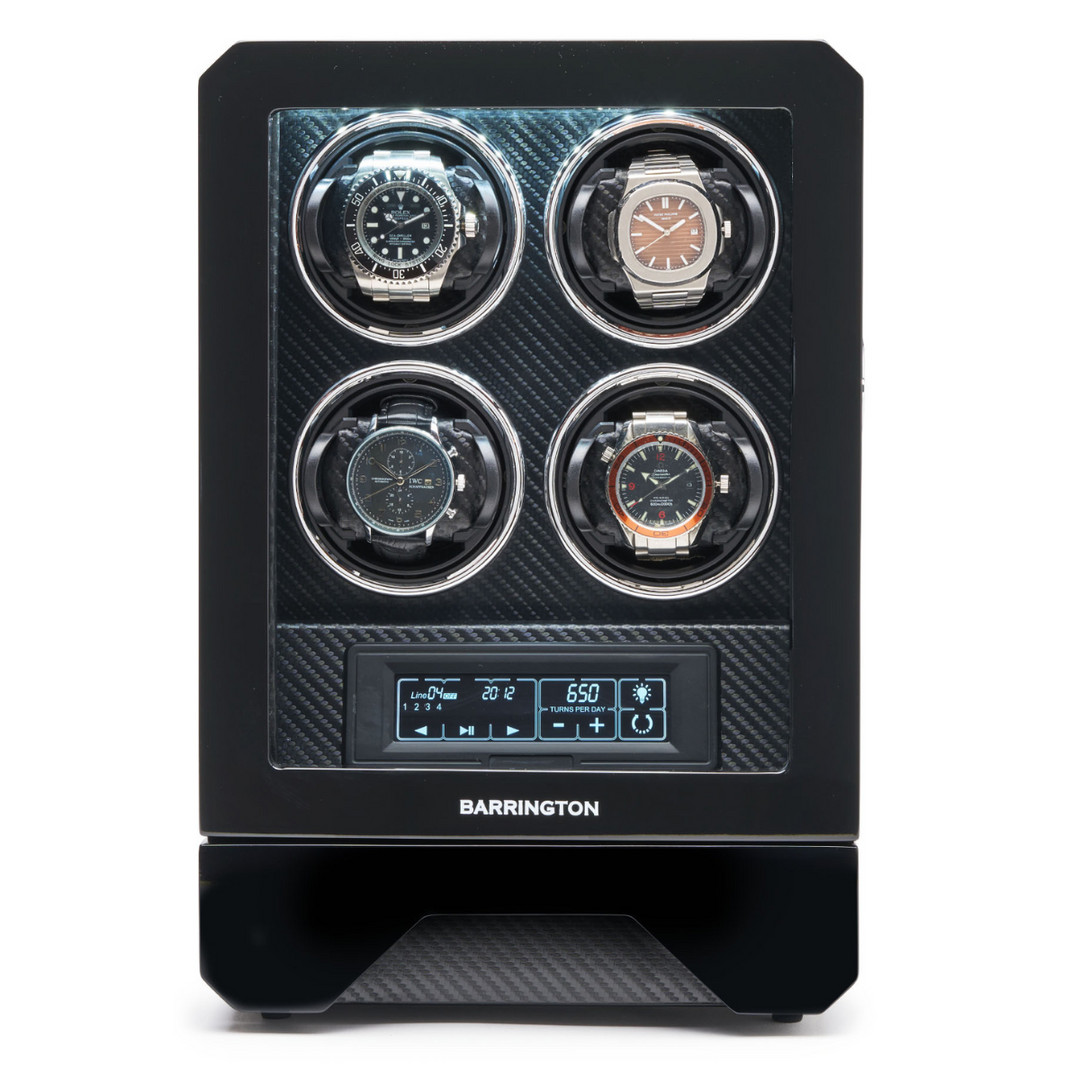
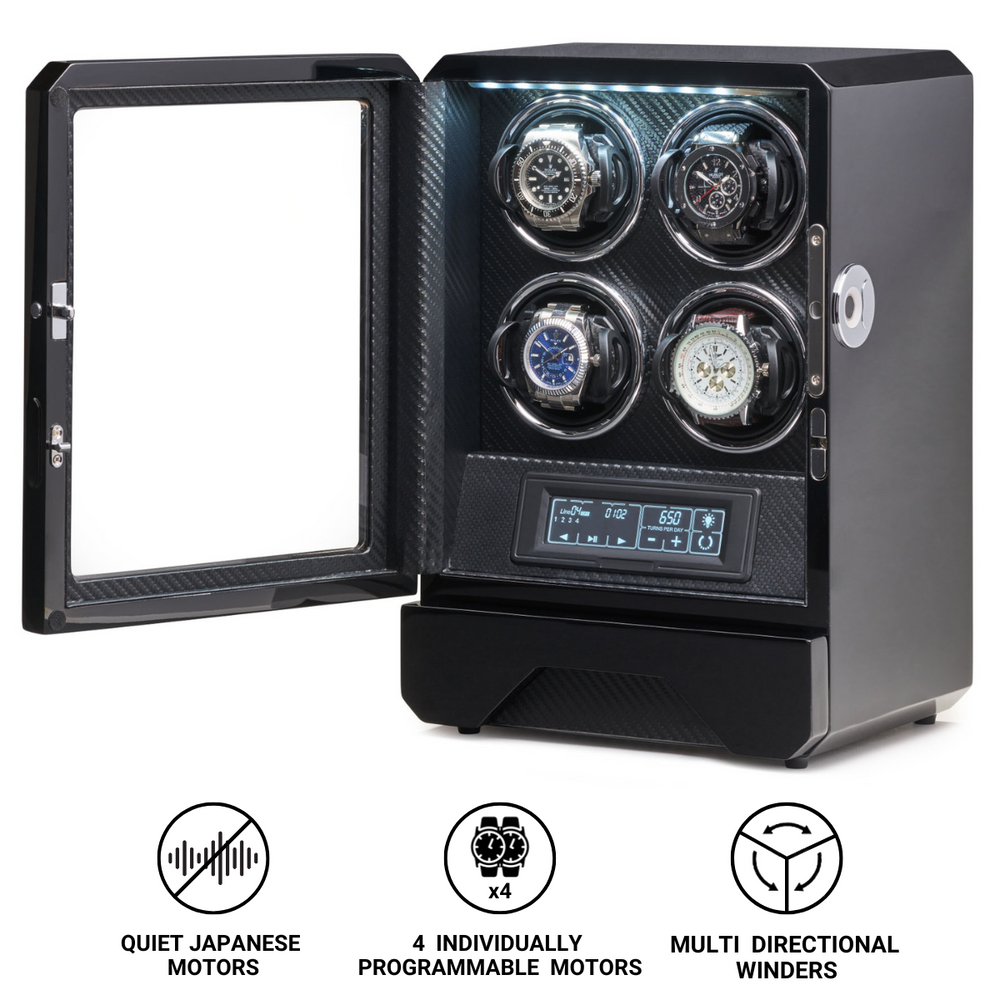
A growing automatic watch collection can include models from several brands, each with its own movement and winding requirements. Barrington Watch Winders offers options for individual watches as well as larger collections, with adjustable Turns Per Day and rotation direction settings that allow the winder to be configured for the specific automatic movement. Below are several Barrington models suited to different collection sizes.
Barrington Oxford Single Winder - Black

(The Barrington Oxford Single Winder in Black is a compact option for keeping one automatic watch wound and ready to wear, with compatibility across major brands including Rolex, Omega, TAG Heuer and Breitling. It offers five Turns Per Day settings from 650 to 1,950 and clockwise, counter-clockwise or bi-directional rotation, allowing the programme to be matched to the requirements of a specific movement. An ultra-quiet Japanese motor makes it suitable for bedrooms and other quiet spaces, while the watch returns to the 12 o'clock position when resting for a neat display. The winder can run from AC mains power or four AA batteries and includes Barrington's Jump feature, allowing multiple single winders to share one power source as a collection expands).
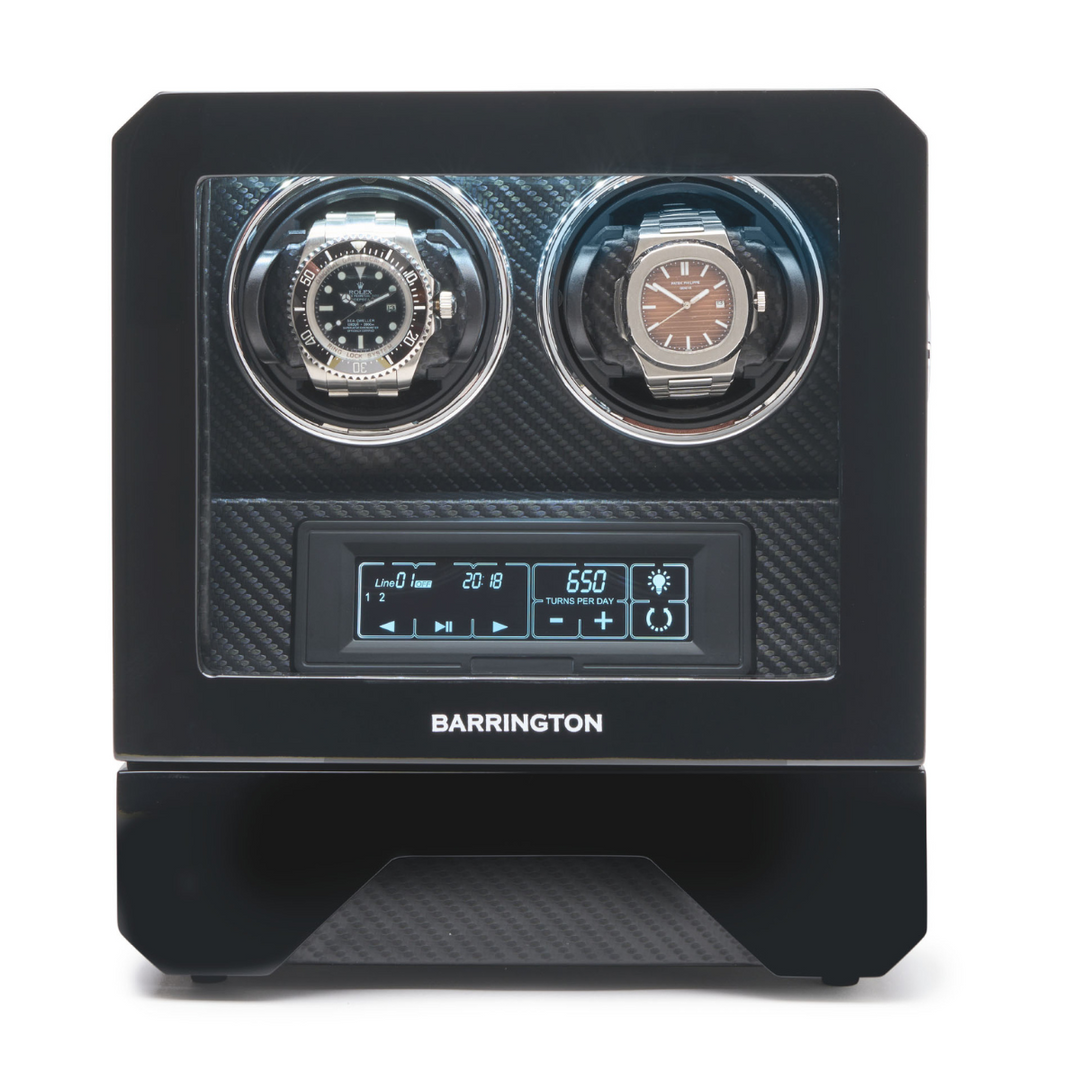
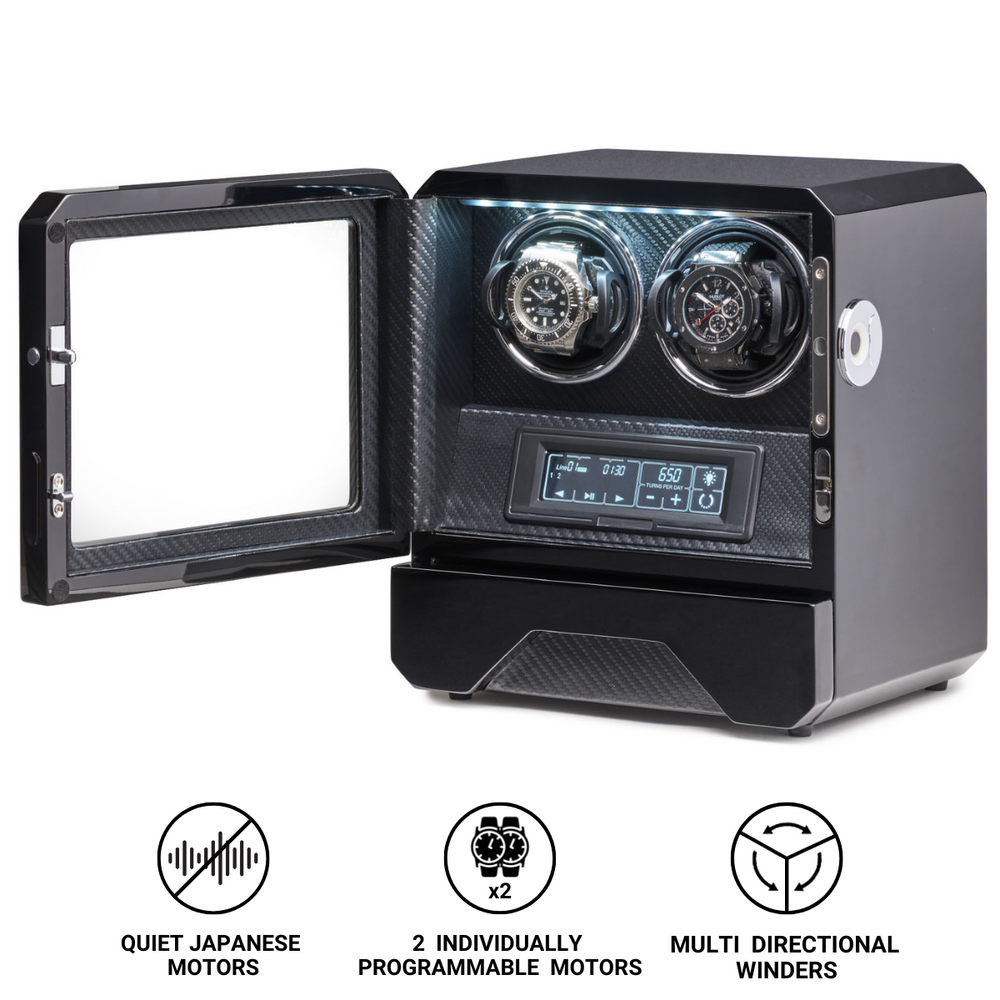
2 Watch Winder

(The Barrington 2 Watch Winder is designed for a small automatic watch collection, with two individually programmable rotors that allow different watches to run simultaneously at their required settings. Each rotor offers five TPD options from 650 to 1,950 and clockwise, counter-clockwise or bi-directional rotation, making it suitable for automatic models from brands such as Rolex, Omega, TAG Heuer and Breitling. Ultra-quiet Japanese Mabuchi motors and a 12-hour active, 12-hour rest cycle make it practical for bedrooms and offices, while the watches return to the 12 o'clock position when resting. A touchscreen and remote control simplify programming, while LED lighting, a storage drawer and a fingerprint lock capable of storing up to 20 fingerprints add convenience and security).
Barrington Oxford Single Winder - White

(The Barrington Oxford Single Winder in White combines the same compact design and flexible programming as the Black version with a clean, understated finish suited to lighter interiors. Designed for one automatic watch, it offers five TPD settings from 650 to 1,950 together with clockwise, counter-clockwise and bi-directional rotation, making it compatible with automatic models from Rolex, Omega, TAG Heuer, Breitling and many other brands when the appropriate settings are selected. Its ultra-quiet Japanese motor allows discreet operation, while the watch stops at the 12 o'clock position when resting for a tidy display. Power is available through AC mains or four AA batteries, and Barrington's Jump feature allows additional Oxford Single Winders to be connected and powered from a single AC source as a collection grows).
Whether you own a single everyday automatic watch or rotate between several timepieces, the right winder should match both the size of your collection and the requirements of each movement. Barrington's range provides solutions for different collection sizes while allowing compatible automatic watches to remain wound and ready to wear between uses.
Most Popular Watch Brands and Trends to Watch in 2026
The most popular watch brands remain dominated by established names, but the type of watches attracting attention continues to change. Rolex still has exceptional market reach, while collector interest increasingly extends across a broader range of established maisons, including Cartier, Patek Philippe, Audemars Piguet and Vacheron Constantin.
Several broader trends are shaping the watch market in 2026:
-
Classic and shaped watches continue to attract attention. Cartier is one of the clearest beneficiaries, but renewed interest extends to rectangular, tonneau and other non-round cases across several manufacturers. This trend also reflects a broader return of interest in dress-oriented watches and more traditional proportions.
-
Smaller and more wearable proportions are increasingly visible. Watches around the mid-30mm to high-30mm range now sit comfortably alongside the larger sports watches that dominated previous decades.
-
Integrated-bracelet sports watches remain an established part of the luxury market. The Royal Oak continues to define the category, while models such as the Vacheron Constantin Overseas, IWC Ingenieur and Tissot PRX bring the concept to very different price points.
-
Accessible Swiss mechanical watches remain important. Longines, Tissot and Tudor give buyers routes into mechanical watchmaking without entering the price territory of high horology.
-
Collector interest is becoming less concentrated around a small group of obvious names. Established maisons such as Vacheron Constantin, Jaeger-LeCoultre and Cartier are receiving greater attention alongside the traditionally dominant luxury sports-watch brands.
-
Japanese high-end watchmaking continues to occupy a stronger position among international enthusiasts, with Grand Seiko offering an alternative approach to movement technology, case finishing and dial design.
-
Vintage-inspired watches remain widespread, but brands increasingly reinterpret archive designs rather than producing exact historical copies. Tudor, Longines, Breitling and TAG Heuer all demonstrate how heritage can be adapted to contemporary movements, materials and sizing.
The result is a market in which popularity is becoming more diverse. Famous Swiss manufacturers remain central, but buyers in 2026 have more recognised alternatives across different countries, price levels, case shapes and movement types than the traditional luxury-watch hierarchy might suggest.
Final Thoughts on the Most Popular Watch Brands in 2026
The most popular watch brands in 2026 reflect very different parts of the market. Rolex combines exceptional global recognition with broad demand, while maisons such as Patek Philippe and Vacheron Constantin occupy the upper reaches of high horology. At more accessible levels, Longines and Tissot continue to introduce buyers to Swiss mechanical watchmaking, while Seiko and Grand Seiko demonstrate the scale and technical depth of Japanese watchmaking.
Whatever the brand or price point, mechanical watches continue to attract enthusiasts through their engineering, design and individual character. For owners of automatic timepieces, Barrington Watch Winders provides precision-engineered winders with adjustable TPD and rotation settings, helping collectors keep compatible watches wound and ready to wear when they are not on the wrist.





Leave a comment