


Are Watch Winders Bad for Your Watch? Myths, Safety and What Every Owner Should Know
Key Points:
Quality watch winders are generally safe for automatic watches when TPD and rotation settings match the movement.
Incorrect settings, poorly designed motors and insecure watch holders can cause unnecessary wear or damage.
Watch winders are particularly useful for complicated calendar watches and collectors who regularly alternate between timepieces.
Barrington Watch Winders offer adjustable winding programmes, Gentle Rotation technology and secure watch cushions for reliable everyday use.
A well-made watch winder is generally safe for a properly functioning automatic watch when its rotation direction and turns per day match the movement. It keeps the mainspring wound while the watch is off your wrist, but it does not eliminate the normal wear that comes with a running mechanical movement. Nor is a winder essential for every automatic watch.
Concerns about watch winders usually centre on premature movement wear, overwinding, magnetism and whether a watch should be kept running continuously. The risks deserve a closer look, particularly when winding programmes are poorly matched or the device itself is badly designed. Understanding what a winder can and cannot do will help you decide when using one makes sense for your watch.
Are Watch Winders Bad for Watches? How Automatic Movements Really Work
An automatic watch uses a self-winding mechanism to convert movement into stored mechanical energy. Inside the movement, a weighted rotor rotates as the wearer's wrist changes position. Its motion drives a winding train that tightens the mainspring, which stores the energy needed to power the watch.
The amount of time a fully wound watch can operate without additional winding is called its power reserve. For example, a movement with a 48-hour power reserve can run for approximately two days without further winding. Once the stored energy is exhausted, the balance stops oscillating and the hands stop moving.
A watch winder maintains this process while the watch is not being worn. By rotating the entire timepiece at controlled intervals, it causes the internal rotor to move and engage the automatic winding mechanism.
The device does not wind the mainspring directly or force the movement to operate beyond its normal design. Instead, it supplies motion through the same automatic winding system used during everyday wear. Whether the watch remains running depends on sufficient rotation, the appropriate direction and its existing power reserve.
Do Watch Winders Wear Out Watches or Cause Overwinding?
Mechanical watches contain moving components that experience friction during operation. The rotor, winding gears, mainspring barrel, gear train and escapement all contribute to the movement's operation, although they perform different functions. Keeping an automatic watch running therefore involves mechanical activity that would otherwise stop once its power reserve was exhausted.
A watch winder can contribute to ordinary operating wear because it keeps the movement active. However, this does not mean that properly controlled winding causes premature damage. Automatic movements are designed to operate for extended periods, and the additional wear depends on factors such as movement condition, lubrication, winding frequency and the quality of the mechanism.
Wearing a watch also exposes it to changing wrist positions, temperature variations and occasional impacts. A stationary winder generally provides a more predictable environment, although it cannot eliminate friction within the movement.
Overwinding is another common concern. Most modern automatic movements use a slipping bridle attached to the outer end of the mainspring. When the spring approaches its maximum tension, the bridle can slip against the inner wall of the barrel, preventing excessive tension from accumulating.
This means that continued rotor movement does not keep tightening the mainspring indefinitely. Nevertheless, excessive winding cycles can increase activity within the winding system and cause the slipping bridle to operate more frequently than necessary.
Turns Per Day (TPD) settings are therefore important. A correctly programmed winder should provide enough movement to maintain the watch's power reserve without unnecessary rotations. Higher TPD settings do not make an automatic watch more accurate or provide additional protection once sufficient winding has been achieved.
Barrington Watch Winders Expert Comment: The aim of a watch winder is not to maximise rotation but to maintain sufficient power in the movement. At Barrington Watch Winders, we use adjustable TPD settings and controlled winding cycles with rest periods to reduce unnecessary winding activity while keeping automatic watches ready to wear.
Are Watch Winders Good or Bad? Common Myths vs Facts
Much of the debate surrounding watch winders comes from confusing normal mechanical operation with actual damage. Some concerns have a technical basis, but others overlook how modern automatic movements and winding systems are designed.
The following comparison separates common assumptions from established mechanical principles.
|
Myth |
Fact |
|
Watch winders always damage movements |
A suitable winder does not inherently damage a properly functioning automatic movement. |
|
A watch winder can overwind any watch |
Most modern automatic movements use a slipping bridle to prevent excessive mainspring tension. |
|
Watches must run continuously to protect their oils |
Modern lubricants do not require constant movement to remain effective. |
|
All watch winders magnetise watches |
Magnetic exposure depends on motor design, field strength and distance from the watch. |
|
More turns per day means better winding |
Extra rotations provide no useful benefit once the movement receives sufficient winding. |
|
An automatic watch should never stop |
A properly functioning automatic watch can stop when its power reserve runs out without being damaged. |
|
Every luxury automatic watch needs a winder |
Winders provide convenience, particularly for complicated watches and rotating collections, but are not essential. |
Several misconceptions originate from older watchmaking practices, experiences with unsuitable equipment or an incomplete understanding of mechanical wear. The distinction is between keeping a watch operating within its intended conditions and subjecting it to unnecessary winding activity.
When Are Watch Winders Bad for Automatic Watches? Real Risks Explained
Although modern automatic watches are generally compatible with suitable winders, certain operating conditions can create avoidable problems. These risks primarily involve unsuitable winding programmes, poor mechanical construction, inadequate watch support and movements that already require attention.
The most important situations to recognise include:
-
Excessive TPD and incorrect rotation direction. Setting a winder to rotate substantially more than the movement requires increases activity in the automatic winding system without improving its performance. Some calibres wind in only one direction, so selecting the opposite direction may leave the watch insufficiently wound. This generally causes the watch to stop rather than damaging it. Correct TPD and direction settings are essential for effective operation.
-
Poor-quality motors, vibration and magnetism. A poorly constructed motor may produce uneven movement, excessive noise or noticeable vibration. Severe mechanical instability can also affect how securely a watch remains positioned. Electric motors generate magnetic fields, but the risk of magnetising a watch depends on field strength, shielding and the distance between the motor and movement. Magnetisation is not an inevitable consequence of using a winder.
-
Incorrect positioning and unsuitable cushions. A watch must remain securely attached throughout every rotation. An oversized cushion can place unnecessary pressure on a bracelet or strap, while an undersized holder may allow the watch to move inside the compartment. Poorly secured watches can knock against surrounding surfaces, potentially scratching cases or damaging external components. Holders should support the watch without excessive tension.
-
Worn or damaged automatic movements. A winder cannot compensate for deteriorating lubrication, damaged winding components or a malfunctioning rotor. If a watch repeatedly stops despite appropriate settings, the cause may lie within the movement rather than the device. Continuing to increase the rotation frequency is not an appropriate substitute for professional inspection.
These circumstances explain why watch winder quality and correct setup matter. An inexpensive device is not automatically harmful, just as a premium winder cannot guarantee the safety of a watch with an existing mechanical defect.

Is a Watch Winder Good or Bad for Long-Term Watch Care?
Keeping an automatic watch running and allowing it to stop periodically are both reasonable approaches to ownership. Neither guarantees a longer movement lifespan, and the better choice depends on how frequently the watch is worn, its complications and the condition of its mechanism.
A watch that remains on a winder continues operating even when it is not being worn. Its escapement, balance and gear train remain active, producing normal friction and mechanical wear. A watch left stationary avoids this operating wear during periods of rest, although it must be wound and adjusted before returning to use.
Modern watchmaking has also changed the relationship between lubrication and storage. Older lubricants were more susceptible to deterioration, while contemporary synthetic oils and greases offer improved stability. They can still age, migrate or lose effectiveness, but a watch does not need constant movement simply to prevent its oils from solidifying.
Leaving an automatic watch stopped for several days or weeks does not ordinarily damage its lubrication. Equally, using a winder does not restore ageing lubricants or remove the need for servicing.
Service requirements depend on movement construction, age, operating conditions and manufacturer recommendations. Some manufacturers specify relatively long intervals, while older or heavily used movements may require more frequent attention.
Ultimately, using a winder should not be treated as a method of extending service intervals. Maintaining an appropriate servicing schedule, avoiding unnecessary shocks and addressing changes in performance are more important aspects of long-term mechanical watch care.
Watch Winder Pros and Cons: Which Watches Actually Benefit?
The usefulness of a watch winder varies considerably between different types of watches. Its greatest advantage is not necessarily mechanical protection, but the convenience of keeping an automatic movement operating and its indications ready for use.
The following categories illustrate where a winder offers practical benefits and where it may be unnecessary:
-
Automatic watches with complications. Perpetual calendars, annual calendars, complete calendars and moonphase displays can require considerable effort to reset after stopping. Some have correction procedures that must be followed in a particular order, and operating calendar correctors during prohibited periods can damage certain mechanisms. Keeping these watches running reduces repeated adjustments and the opportunity for setting errors. This makes a winder particularly useful for collectors who wear complicated timepieces intermittently.
-
Everyday automatic watches and larger collections. A conventional automatic watch displaying hours, minutes, seconds and the date is usually straightforward to reset. Owners who wear the same watch daily may have little need for a winder. However, collectors regularly alternating between several watches can benefit from keeping selected pieces ready to wear. This becomes especially convenient when different watches are chosen for work, travel, leisure or formal occasions.
-
Vintage automatic watches and non-quickset dates. Some older watches require the hands to be advanced repeatedly to adjust the calendar because they lack a quickset date mechanism. Maintaining their operation can reduce this inconvenience. However, vintage movements may have worn components, ageing lubricants or winding systems requiring specialist attention. Their condition should be assessed before regular use on a winder, particularly when their service history is uncertain.
-
Manual-winding and quartz watches. Traditional manually wound watches lack an automatic rotor and cannot be wound through external rotation. Conventional quartz watches use a battery or another dedicated energy source rather than a mechanical rotor. Neither type benefits from an ordinary automatic watch winder, although both can be stored in a suitable watch box when not being worn.
Another practical consideration is crown handling. Repeated manual winding and calendar adjustment require manipulation of the crown, particularly on watches with screw-down crowns. Although these components are designed for regular use, careless handling can damage threads or compromise correct closure.
For owners who find crown operation difficult, or who frequently alternate between watches, a winder can reduce the number of adjustments required. Nevertheless, proper crown handling remains essential whenever manual setting is necessary.
How to Use a Watch Winder Safely: TPD, Rotation and Daily Care
Using a watch winder safely begins with matching its programme to the movement rather than relying on a universal setting. Different automatic calibres may require different winding directions and daily rotation counts, even when produced by the same manufacturer.
Turns Per Day describes the number of complete rotations performed by the winder's watch holder over a 24-hour period. The appropriate setting depends on the movement's winding efficiency and design.
Three rotation modes are commonly available: clockwise, anticlockwise and bidirectional. Some automatic calibres wind in both directions, while others receive useful winding energy primarily in one direction. Selecting the wrong programme may prevent the watch from maintaining its power reserve.
For movement-specific recommendations, consult the manufacturer or Barrington's Watch Winder Settings Database, which provides TPD and rotation information for different watches.
The winding schedule is equally important. Instead of operating continuously, a programmable winder can distribute the required rotations across controlled intervals with periods of rest.
Barrington's Gentle Rotation system follows this principle. Its winders complete approximately 10 rotations in 90 seconds before pausing. These cycles continue during a 12-hour operating period until the selected daily rotation count is achieved, followed by 12 hours of rest.
This approach provides regular winding activity without keeping the watch rotating throughout the entire day. The objective is to maintain sufficient power rather than maximise movement.
Several practical precautions further support safe operation:
-
Identify the exact movement calibre and select the appropriate winding programme.
-
If the watch has completely stopped, give it the initial manual winding recommended by its manufacturer before placing it on the winder.
-
Secure the watch firmly on a correctly sized cushion without stretching the bracelet or strap.
-
Check that the watch remains stable throughout rotation and does not contact surrounding surfaces.
-
Monitor whether the watch maintains its power reserve over several days, adjusting the programme only where necessary.
-
Keep the device away from excessive humidity, direct heat, strong magnetic sources and areas where it could be knocked over.
Correctly programmed rotation should support the watch's normal operation without requiring constant attention. However, unexplained stopping, unusual noises or significant changes in timekeeping should prompt further investigation rather than simply increasing the TPD setting.
Can a Watch Winder Damage a Watch? What to Check Before Buying
Choosing a suitable watch winder involves more than comparing appearance and price. The most important considerations are its ability to accommodate different movements, the reliability of its rotating mechanism and how securely it supports the watch.
Before purchasing a winder, assess the following features:
-
Adjustable winding programmes. Look for several TPD options and clockwise, anticlockwise and bidirectional rotation. A fixed programme may not suit every automatic calibre, particularly in a collection containing different movement types. Individually adjustable rotors are especially useful in multi-watch winders because each watch can receive its own programme.
-
Smooth, quiet motor operation. A well-engineered motor should rotate consistently without abrupt changes in speed or significant vibration. Quiet operation is particularly desirable when a winder is placed in a bedroom, office or living area. Motor placement and construction should also minimise unnecessary magnetic exposure.
-
Suitable rotation angle and secure holders. The watch should be positioned so that gravity can move its internal rotor as the holder rotates. A near-vertical or suitably inclined position generally supports this process, although winding efficiency also depends on the movement and the winder's design. Cushions should fit the bracelet or strap circumference securely without excessive compression or stretching.
-
Reliable power supply. Mains-powered winders provide continuous electrical power without battery replacement. Battery operation offers greater flexibility when a nearby socket is unavailable. Check the manufacturer's specifications rather than assuming every model supports both. Low-battery indicators and straightforward access to the power controls are useful additional features.
-
Construction, protection and presentation. A stable enclosure, carefully finished watch holders and suitable interior materials help reduce the risk of accidental contact or scratching. Closed cases can provide additional protection against dust and handling. The external finish and overall dimensions also matter when the winder forms part of a permanent watch display.
For example, the Barrington Oxford Single Watch Winder provides five TPD settings from 650 to 1,950, three rotation modes and a quiet Japanese motor. It also offers Omni and Micro cushion options for different wrist sizes, together with mains or four-AA-battery operation.
These features demonstrate the value of selecting a device around the watch's mechanical requirements and physical dimensions. An attractive case alone cannot compensate for unsuitable settings or an insecure holder.
Barrington Watch Winders Expert Comment: Even the correct winding programme cannot compensate for a poorly fitted watch holder. We recommend choosing a cushion that supports the watch securely without placing excessive tension on its bracelet or strap. This is why Barrington offers different cushion sizes to accommodate a wider range of wrist sizes.
Are Watch Winders Bad for Rolex and Other Luxury Watches?
Modern automatic Rolex watches are generally suitable for use with correctly configured watch winders. Their self-winding Perpetual movements are designed to receive energy from rotor motion, and the automatic winding system incorporates protection against excessive mainspring tension.
Most contemporary Rolex automatic calibres wind bidirectionally. Approximately 650 TPD is a commonly recommended starting point for many current models, including the Submariner, Datejust and Day-Date. However, the exact movement and any relevant manufacturer guidance should take priority over a general recommendation.
The watch's monetary value does not make ordinary automatic winding inherently more dangerous. A properly serviced Rolex can remain on a suitable winder, while an older example with an uncertain service history may require inspection before continuous operation.
Similar principles apply to Omega, Breitling, Tudor and other luxury watch manufacturers. However, their collections incorporate different automatic calibres, sometimes with substantially different winding requirements.
For example, certain chronograph movements use unidirectional automatic winding, while many modern three-hand calibres support bidirectional winding. Selecting settings solely because a watch carries a particular brand name can therefore be misleading.
The safest approach is to identify the actual movement, confirm its winding direction and choose an appropriate TPD programme. Regardless of the manufacturer, a watch winder should complement normal watch care rather than replace servicing or careful handling.
Choosing a Reliable Watch Winder: Barrington Models Reviewed
Choosing a watch winder involves more than finding a suitable place to display your timepiece. Adjustable winding programmes, controlled rotation and secure watch holders are important considerations for protecting automatic watches from unnecessary winding activity. Barrington Watch Winders offers models for individual watches and larger collections, combining flexible TPD settings, multiple rotation directions and thoughtfully designed storage. The following models illustrate options for different collection sizes and everyday requirements.
Barrington Oxford Single Winder - Green

(The Barrington Oxford Single Winder in Green combines compact dimensions with adjustable winding programmes designed for different automatic movements. Measuring 12 × 12.5 × 19 cm, it features a quiet Japanese motor, five TPD settings from 650 to 1,950 and clockwise, anticlockwise or bidirectional rotation. Barrington's Gentle Rotation system distributes winding cycles across a 12-hour operating period, followed by 12 hours of rest to avoid unnecessary continuous rotation. The watch rests in the 12 o'clock position, while a choice of Omni and Micro cushions accommodates different bracelet and strap sizes. Power is supplied through USB mains or four AA batteries, providing approximately 60–70 days of battery operation. The Jump connection also allows multiple single winders to share one power source. Its compact design and flexible settings make it particularly suitable for owners of a single automatic watch or collectors gradually expanding their collection).
6 Watch Winder

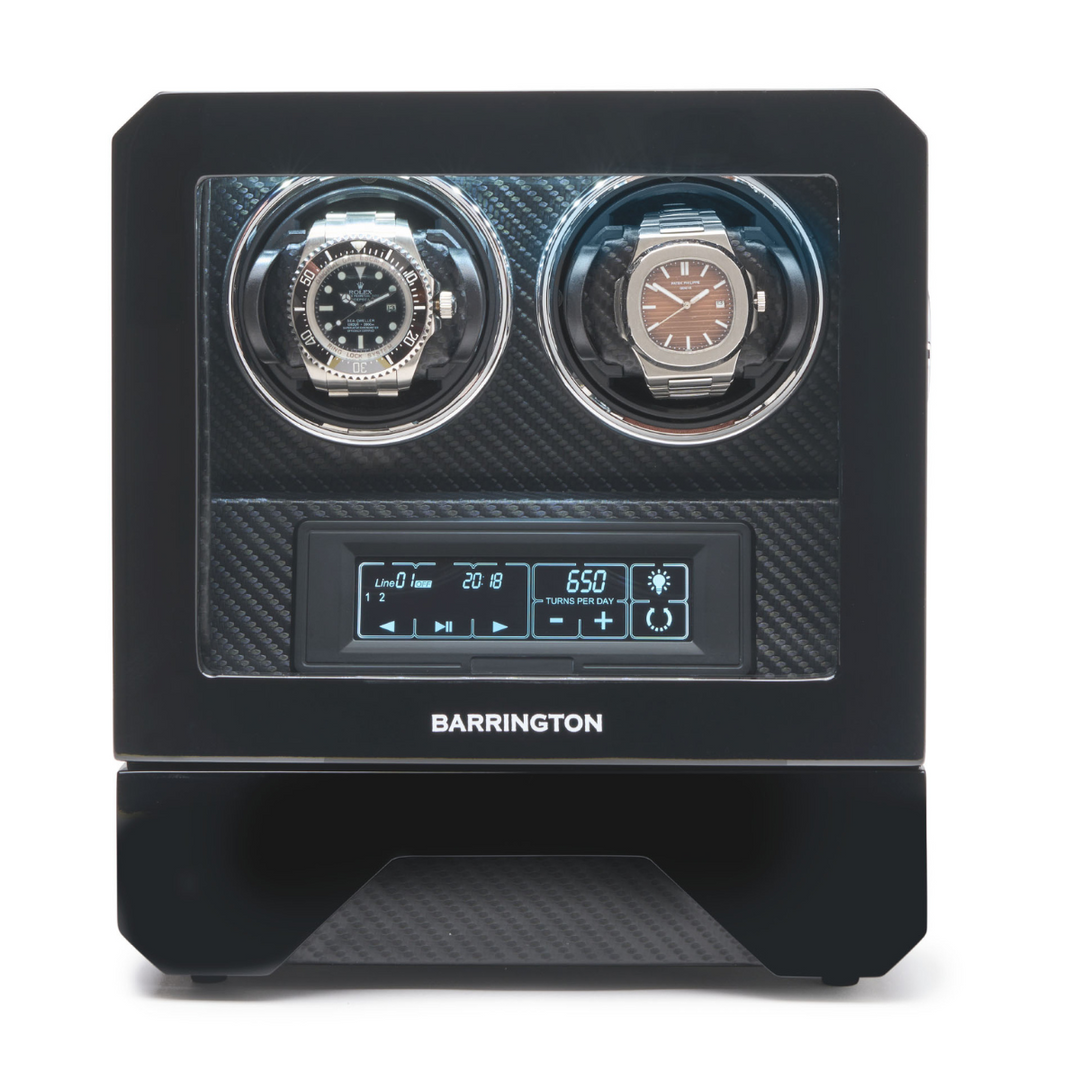
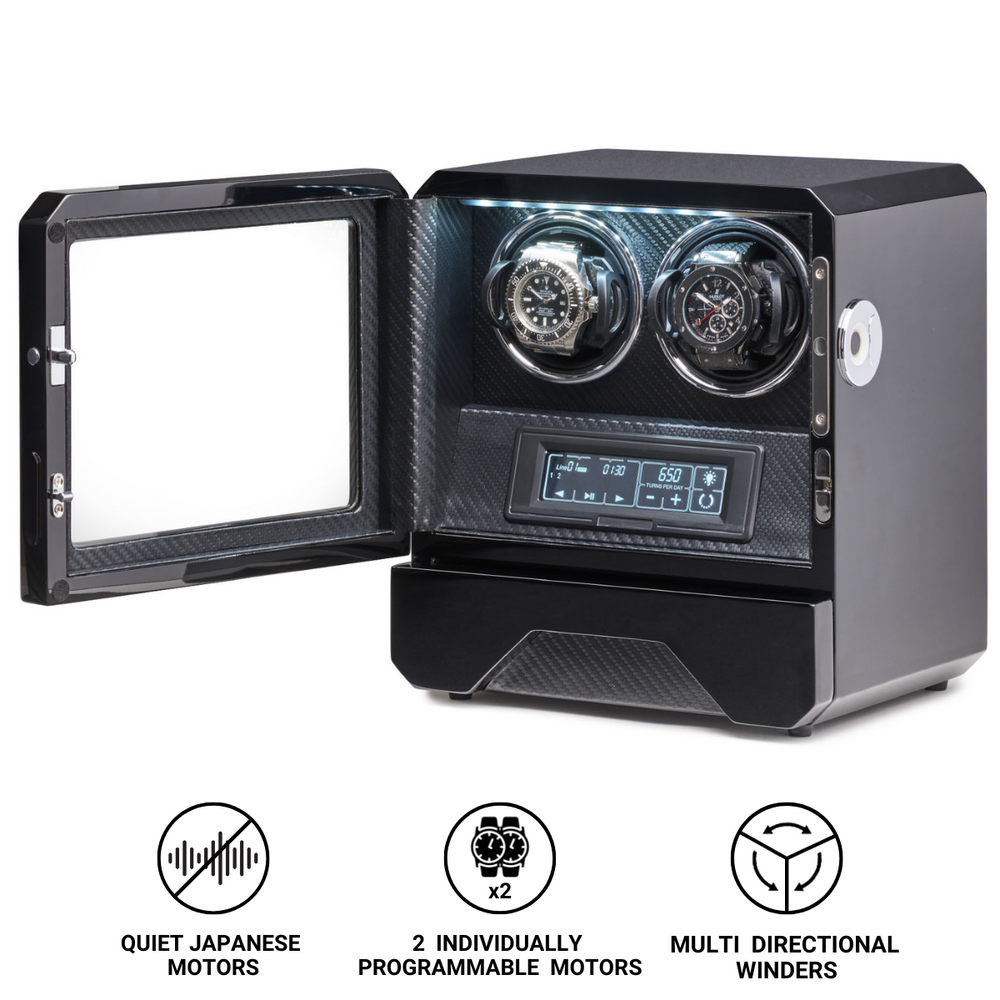
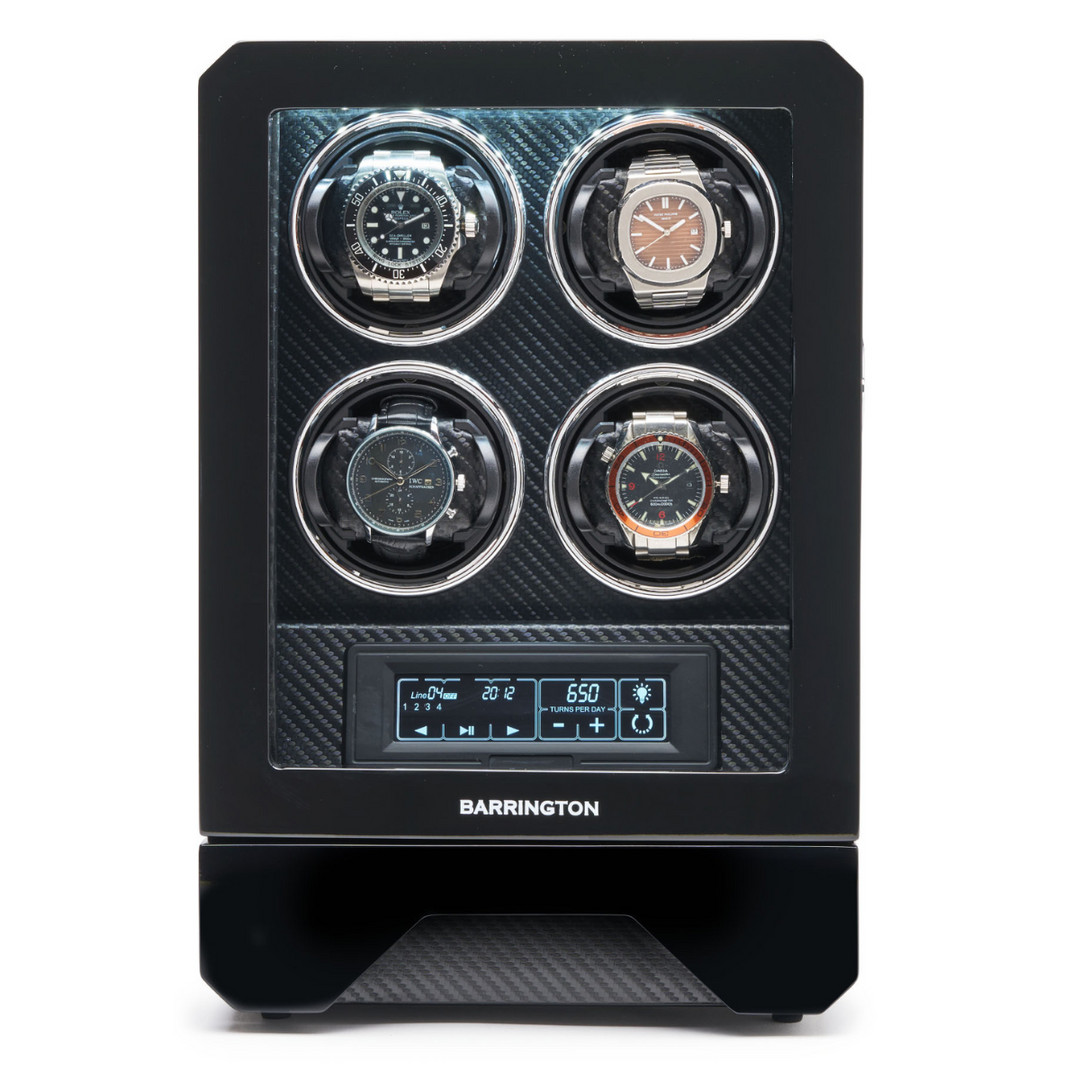
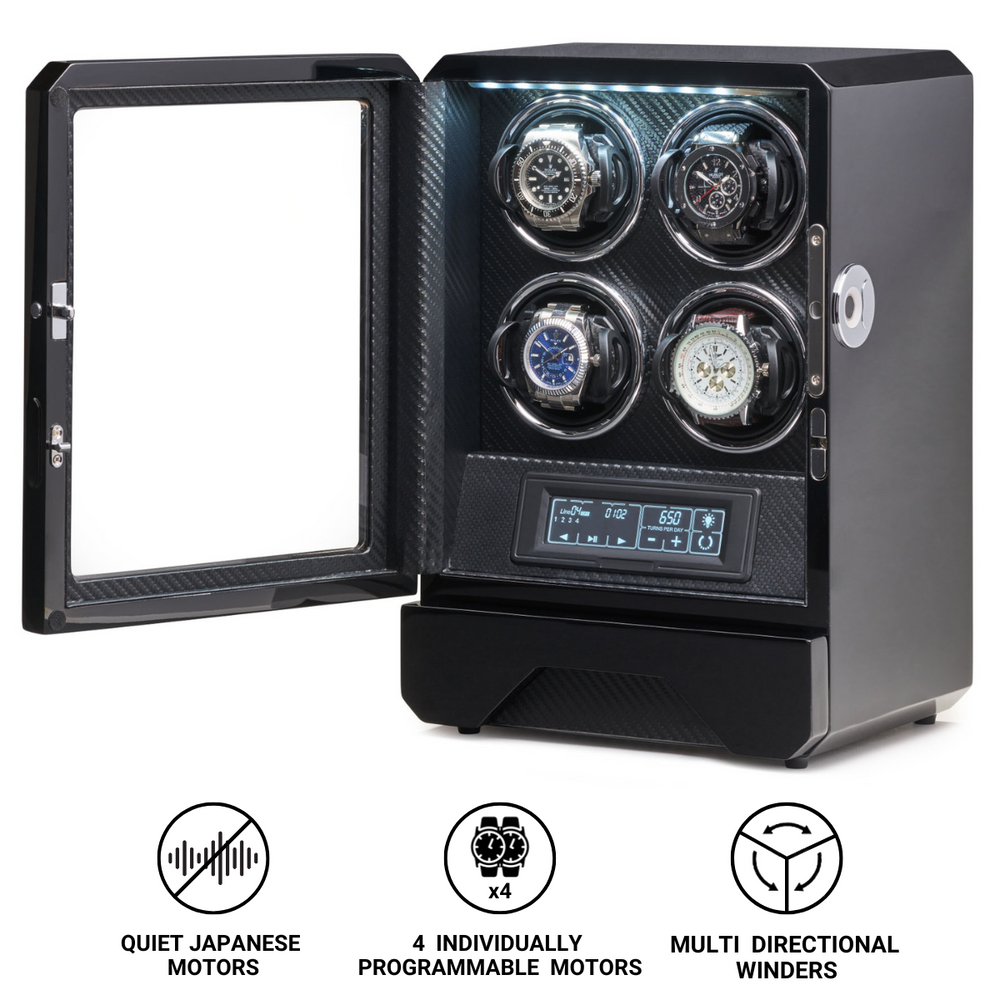
(The Barrington Six Watch Winder is designed for collectors who want to keep up to six automatic watches wound, securely stored and ready to wear. Its six individually programmable rotors offer five TPD settings from 650 to 1,950, alongside clockwise, anticlockwise and bidirectional rotation, allowing each watch to follow a programme suited to its movement. Premium Japanese Mabuchi motors provide quiet operation, while Barrington's Gentle Rotation system combines intermittent winding with a 12-hour rest period. The enclosed cabinet features a carbon fibre-effect interior, LED lighting and secure clip-in cushions, with each watch returning to the 12 o'clock position after rotation. A fingerprint lock supporting up to 20 fingerprints adds security, while touchscreen controls, a remote control and an integrated storage drawer improve everyday convenience. Powered by the mains, this model is particularly suitable for established collections containing automatic watches with different winding requirements).
Barrington Oxford Single Winder - Yellow

(The Barrington Oxford Single Winder in Yellow combines a distinctive, vibrant finish with the practical features needed for maintaining an automatic watch between wears. Its compact case measures just 12 × 12.5 × 19 cm, making it suitable for a bedside table, desk or display shelf. Five adjustable TPD settings from 650 to 1,950 and clockwise, anticlockwise or bidirectional rotation provide flexibility for different automatic movements. The ultra-quiet Japanese motor operates through Barrington's Gentle Rotation system, with intermittent winding followed by a 12-hour rest period to minimise unnecessary rotation. Secure Omni and Micro cushion options accommodate different wrist sizes, while the watch always stops facing upwards at the 12 o'clock position. The winder operates from USB mains power or four AA batteries, offering approximately 60–70 days of battery life. Its Jump connection also allows several Oxford Single Winders to share one power source, making the Yellow model a colourful addition to an expanding watch collection).
The right Barrington watch winder depends on how many automatic watches you own, their movement requirements and how frequently you wear them. Whether you need a compact single-watch model or a larger cabinet, prioritise compatibility, secure positioning and appropriate winding settings. A properly configured winder can keep your collection ready to wear while reducing the need for repeated manual adjustments.
Are Watch Winders Good for Watches? Final Verdict
A correctly configured watch winder is generally safe for a well-maintained automatic watch. It cannot prevent normal mechanical wear or replace servicing, and a watch need not run continuously to remain in good condition. Its main benefit is convenience, especially for owners who alternate between watches or have complicated calendar displays.
Barrington Watch Winders offer adjustable TPD and rotation direction, controlled Gentle Rotation cycles and secure watch cushions. These features help owners keep automatic watches ready to wear without unnecessary winding activity.





Leave a comment